Florida adds more than 3,000 coronavirus cases as Miami-Dade’s known total hits 170,000
Florida’s Department of Health on Tuesday confirmed 3,266 additional cases of COVID-19, bringing the state’s known total to 704,568. Also, 106 Florida resident deaths were announced, bringing the resident death toll to 14,143.
No new non-resident deaths were added, leaving the non-resident death toll at 170.
Tuesday’s single-day count is the highest Florida has reported since Sept. 19 when 3,573 cases were added and comes a day after Florida saw 738 new cases, the lowest single-day count since early June.
Testing also jumped back up and Florida saw an increase in its percent positivity. So did all four South Florida counties.
Testing, like hospitalizations, helps officials determine the virus’ progress and plays a role in deciding whether it is safe to lift stay-at-home orders and loosen restrictions.
Epidemiologists then use the testing data to create a positivity rate. The rate helps them determine if a rise in cases is because of an increase in testing or if it means there’s increased transmission of the virus in the community.
On Tuesday, Florida’s Department of Health reported the results of 70,893 people tested on Monday. The positivity rate of new cases (people who tested positive for the first time) increased from 4.22% to 5.01%.
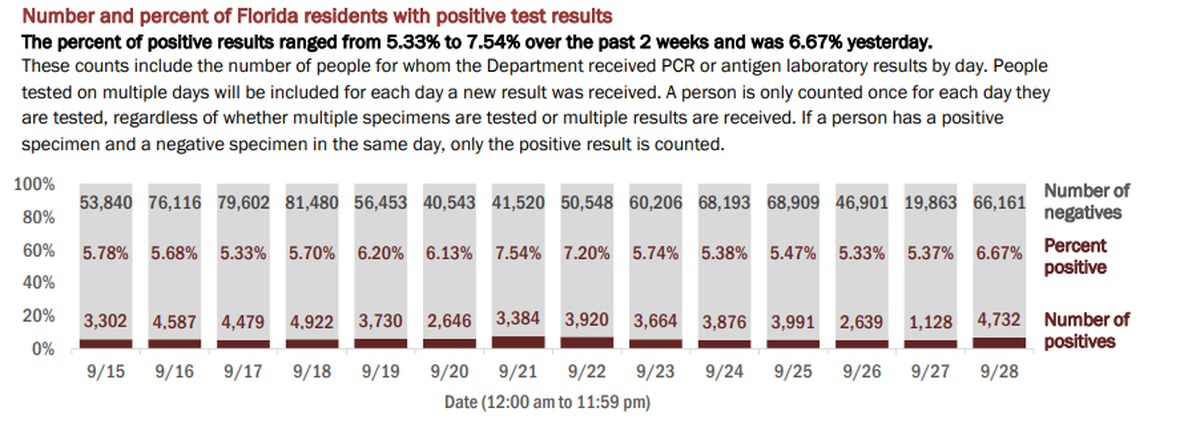
If retests are included — people who have tested positive once and are being tested for a second time — the positivity rate increased from 5.37% to 6.67% of the total, the report said.
Confirmed COVID-19 cases in South Florida
Note: The Florida Department of Health says that each county’s percent positivity for new cases (people who tested positive for the first time) does not include retests (people who have tested positive once and are being tested for a second time).
▪ Miami-Dade County reported 620 additional confirmed cases of COVID-19 and 15 new deaths, according to Florida’s Department of Health. The county now has 170,086 confirmed cases and 3,243 deaths. Percent positivity for new cases rose from 2.72% to 6.87%. The 14-day positivity average is 4.44%, according to Miami-Dade County’s “New Normal” dashboard.
▪ Broward County reported 248 additional confirmed cases of the disease and four new deaths. The county has a known total of 77,122 cases and 1,384 deaths. Percent positivity for new cases rose from 1.74% to 3.11%.
▪ Palm Beach County saw 175 additional confirmed cases and seven new deaths. The county now has 46,485 confirmed cases and 1,350 deaths. Percent positivity for new cases rose from 2.06% to 4.14%.
▪ Monroe County confirmed eight additional cases and no new deaths. The county has a known total of 1,845 cases and 22 deaths. Percent positivity for new cases rose from 3.33% to 6.45%
COVID-19 hospitalizations in Florida
One of the tools that officials rely on to determine whether the coronavirus situation is improving in the state is hospitalization data. Unlike testing, which might be limited or take days to report results, hospitalizations can help give officials a real-time snapshot of how many people are severely ill with COVID-19.
The Florida Agency for Health Care Administration reports the number of patients hospitalized statewide with a “primary diagnosis of COVID.” The data, which is updated at least every hour, does not distinguish between the number of COVID-19 patients in hospital intensive care units and those in acute-care beds, which require less attention from nurses.
Previously, the state was providing only the total number of hospitalizations in its statewide and county-level data. Miami-Dade was an exception, with hospitals self-reporting a number of key metrics, including hospitalizations, to the county, which has made this data public for several months.
As of 6:46 p.m. Tuesday, there were 2,174 COVID-19 patients admitted into hospitals throughout the state, according to the Florida Agency for Health Care Administration dashboard. While there was a slight increase in hospitalizations, it is still much lower than early August, when more than 5,000 COVID-19 patients were admitted into hospitals throughout the state.
Of Tuesday’s hospitalizations, 271 were in Miami-Dade, 199 in Broward, 114 in Palm Beach and four in Monroe counties, according to the agency.
Florida’s current hospitalization data does not always match the hospitalization data reported in Miami-Dade’s “New Normal” dashboard. Officials say this could be for a number of reasons, including the frequency of daily updates.
On Tuesday, Miami-Dade hospitalizations for COVID-19 complications rose for the first time in more than two weeks. It went from 321 to 345, according to Miami-Dade County’s “New Normal” dashboard. According to Tuesday’s data, 43 people were discharged and 45 people were admitted.
The state has had 43,855 Florida residents hospitalized for COVID-19-related complications, according to Florida’s COVID-19 Data and Surveillance Dashboard.
This story was originally published September 29, 2020 at 11:19 AM with the headline "Florida adds more than 3,000 coronavirus cases as Miami-Dade’s known total hits 170,000."