The best and worst social distancing states. How did Florida do in new COVID-19 survey?
Top Data, a market research company, wanted to find out which states are doing the best at social distancing.
So, in early August, researchers conducted a survey.
In Florida, we are like that old Carpenters’ song, “(They Long to Be) Close to You.” Our state ranked 17th in people reducing their social interactions. But Top Data thinks “former hot spot zones like New York, California, Arizona, Texas and Florida are now adhering to social distancing regulations.”
California — which has 574,411 cases and 10,468 deaths as of Wednesday, according to the Centers for Disease Control and Prevention (the highest number of cases in the U.S.) — came out No. 1 best.
Nevada and Illinois were also adhering well enough to social distancing guidelines. But parts of the South and Great Plains are relaxing too much and getting too close. At the bottom of the state’s chart: South Dakota, Alabama and North Dakota.
Hawaii and Alaska were not included in the survey.
How Florida fits into the survey
Florida is once again spiking with new COVID-19 cases after a few days of declining numbers. Florida’s known confirmed cases are 550,901 and a death toll of 8,765, as of Wednesday, the Florida Department of Health reports.
To figure all of this social distancing behavior out, Top Data analyzed cellphone location data to see how close we are getting to one another and the amount of time per interaction was five minutes or more.
The survey did not take into account whether we were wearing masks or face shields while we engaged in social intercourse.
That No. 17 ranking for the Sunshine State actually is better than we figured given the number of people we see flouting rules for the wearing of masks and not limiting group interactions, like underground house parties, which led Miami Beach to toughen curfews.
The Top Data survey was taken before this week’s steady bump upward. At the beginning of August, people in Florida were interacting with an average of 5.31 other people each day, according to the survey. “That is just 47.6% of the normal or pre-COVID level of interactions people were engaging in — 11.16 — during the same time in 2019.”
The U.S. social distancing map
In the Top Data map, the states were measured on their percentage of “normalcy.” The standard of normalcy was based on the average number of interactions in 2019.
“The states with low levels of human interactions in comparison to their normal amount of interactions are in green, while their counterparts are in red,” the survey said.
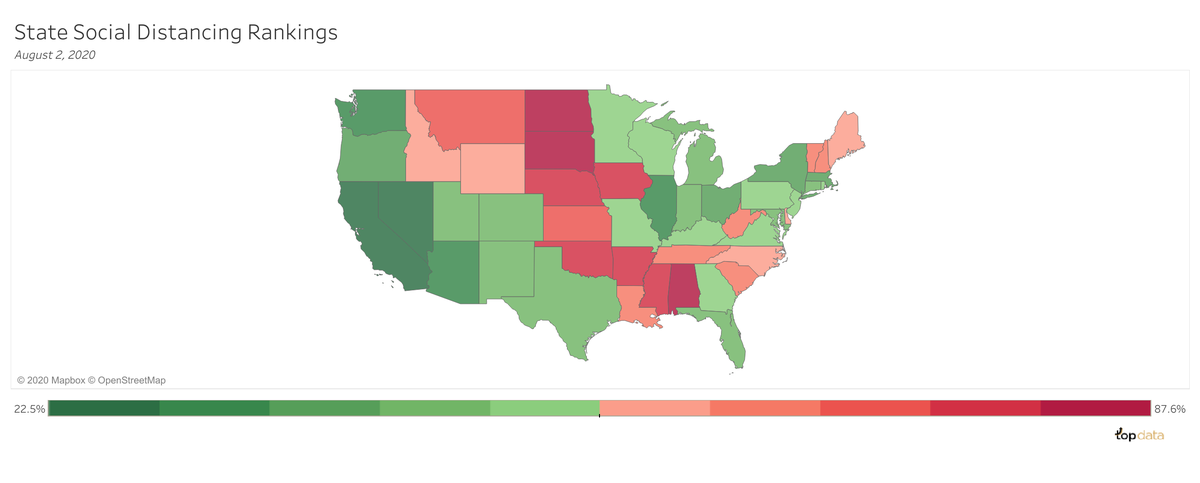
The five best social distancers
1. California
2. Nevada
3. Illinois
4. Arizona
5. Washington
The five worst social distancers
48. South Dakota
47. Alabama
46. North Dakota
45. Nebraska
44. Mississippi
This story was originally published August 12, 2020 at 2:35 PM.