This ZIP code had the highest poverty rate in Miami-Dade County. Then came COVID-19
Andrea, a 45-year-old single mother from Mexico, lives with her three children in Homestead. An undocumented farm worker with no formal ties to the small-scale vegetable and fruit farm where she’s been employed for the past few years, Andrea used her relatively steady work hours picking passion fruit and vegetables to pay rent and put food on the table.
It’s hard work: Andrea gets to the field early in the morning and often works more than nine hours a day, sometimes on weekends. The pay is $8.50 an hour, and in the past she could count on overtime to supplement the base weekly earnings.
Then came the COVID-19 pandemic. Sweeping stay-at-home orders shut down businesses across Miami-Dade County and slashed demand for produce. Andrea’s hours were cut to a trickle when her employer implemented a rotation schedule for its eight workers.
“Suddenly I was only asked to work one, two days a week,” said Andrea, who asked not to be identified by her real name because she doesn’t have permission to work in the U.S. “This never happened to me: being willing and able to work as many hours as possible, but not having a job to go to because of the pandemic.”
Now, due to her reduced income, Andrea has not been able to pay her $800 rent for the last three months. Her 22-year-old daughter, who worked on and off for an assisted living facility and pitched in for the household’s monthly expenses, was also left without a job. Andrea has relied on donations from local associations to pay her electric bill. Food has also been provided by a network of community organizations including the American Friends Service Committee and Centro Campesino.
As the county has loosened restrictions, Andrea’s work hours have increased to a steady three days a week. But her anxiety over the future remains. She’s now earning less money than in the pre-COVID era, when she struggled but was still able to pay her bills, treat her kids to fancy ice cream and maybe even squirrel away a bit of savings.
Her story resonates with many of the approximately 23,000 people who live within the 33034 ZIP code, which stretches for nearly 280 miles across parts of Florida City, Homestead and unincorporated Miami-Dade. The ZIP is home to 4,894 households, with a median of 4.1 persons per household. But only 35% of the residents are married, an indication that more than one family often live under the same roof in order to pay the rent.
More than half of the ZIP code’s residents are Hispanic. 35% are Black and 11% are white. 58% have a high school degree, but only seven percent are college-educated. 73% of the residents have health insurance.
The area has endured catastrophic hardships before. It is close to the precise spot where the eye of Hurricane Andrew made landfall in 1992, wreaking so much damage that rebuilding initially seemed like an impossibility.
Then came the 2008 Great Recession, which caused the values of the newly-built homes in the area to plummet. Many fell into foreclosure or were left vacant. According to Census data, the median value of single-family, owner-occupied homes located within 33034 today is $113,200, only two-fifths of the median home value in the Miami-Fort Lauderdale-West Palm Beach metro area ($259,300).
High poverty rate
According to Census data, the ZIP code has the highest poverty rate in the county — 40% — even though the median household income is $36,363, which is higher than many other ZIP codes in Miami-Dade.
But the per-capita income is $10,608, the lowest of any ZIP code in the county and less than half of the $27,000 per-capita median for the county.
Most residents in the ZIP code work in retail, construction, child care and tourism. But 12% are agricultural workers, the highest rate in Miami-Dade County, where the rate is less than one percent. Florida City, which forms the heart of the ZIP code also relies heavily on the hospitality/restaurant industry. The city is the last town tourists drive through en route to Key West, often stopping there for a bite or an overnight stay before continuing the long trip south.
Those industries, as in the rest of Miami-Dade, have been walloped by the virus, even though the number of confirmed COVID cases is lower than in some neighboring ZIP codes. As of July 16th, the Florida Department of Health, Division of Disease Control and Health Protection reported 913 confirmed cases in 33034— fewer than in 33033, with 1,693 confirmed cases.
The risk of under-testing
But public health experts say many farm workers don’t own cars and haven’t been tested at the state’s drive-thru sites. And because most farm workers in Homestead are immigrants, they tend to avoid state-sponsored activities, especially migrants who are undocumented. They also fear that a positive test result will hurt employment opportunities.
“People don’t want to go and get tested, because as soon as you test positive, then you stop receiving work,” said Elvira Carvajal, a former farmworker and lead organizer of Alianza Nacional de Campesinas (National Alliance of Women Farmworkers), which launched a $500,000 Emergency Relief Fund in June.
“Farm workers don’t have the luxury of staying home, coronavirus or not,” Carvajal said. “And that has always been true. In the past. When folks get sick, if they catch a cold, if they get diarrhea or what have you, they still have to show up to work, because if you don’t, you get fired. Fear of losing a job is a big factor here. The farm worker is always the most vulnerable.”
John Martinez, executive director of Centro Campesino, agrees. His Homestead-based community development corporation is a partner agency to the United Way that provides affordable housing and educational services.
“Economic insecurity and the rising costs of housing in south Dade weren’t new issues; people here had problems paying rent before. But the pandemic has really compounded that problem, in a way that we haven’t really seen before,” Martinez said.
Centro Campesino recently conducted a survey of 560 residents to gauge the impact of the coronavirus pandemic in their lives and identify priorities for aid. More than a third, or 35%, lost all sources of income, and only 21% kept their pre-pandemic income.
In the survey, residents said the most immediate needs were rent (29%), utilities and other bills (23%) and food (12%).
A third of respondents said they would not be able to continue paying rent or their mortgages in the next few months, even after negotiating with landlords or mortgage holders. In case of an eviction, 23% would need emergency housing and 31% are not sure. Over 52% may not have a place to go, according to the survey.
Centro Campesino is providing families in need in Miami Dade and Monroe Counties with emergency food, rental support, and utility assistance. To date, the center distributed over 6,185 meals and food boxes to families in need.
Homestead Mayor Steven D. Losner said that at the start of the pandemic, food was the Number One priority for residents who lost their jobs. In late April, the city partnered with Farm Share for a free public food distribution at the site of the former Homestead baseball stadium.
The event was scheduled to start at 8 p.m. but Losner said the 1,400 vehicles that showed up for the drive-thru event started lining up more than 15 hours before — at 3 a.m.
“Now as we go forward, rent and mortgage, car insurance and utility payments are becoming the greatest needs,” Losner said.
Hunger still an issue
Food still remains a vital necessity though, particularly among the farm worker community.
“The numbers are increasing because of COVID,” said Carolyn Taylor Pates, who was voted in as director of the Homestead Soup Kitchen in April after more than 15 years as a board member. “A lot of people lost their jobs, some had no food, some were denied unemployment or food stamps.”
The soup kitchen has been in Homestead since Thanksgiving 1983. Before the pandemic spread to Florida, the site served a little over 100 meals cooked in-house every Monday, Wednesday and Friday from noon to 1 p.m.
These days volunteers are averaging more than 500 meals a week, roughly 200 more meals weekly.
To help curb the spread of COVID-19, the site began offering meals to-go in March. Clients can now drive up and request the meals they need without having to exit their vehicles.
Some weeks the line of cars has stretched a few blocks down from the small, orange building that houses the soup kitchen, Pates said. But as more sites have opened up for food distribution the numbers have stabilized.
Adriana Hernandez has been coming to the soup kitchen after hearing about it at the church she attends, El Rey Jesús.
As she packed four meals into her SUV — a mask on her face and a cap with the Colombian flag on her head — Hernandez said she lost her job at a daycare facility in mid-March. Since then she’s stayed home helping her two young kids with schoolwork.
Before the virus, the soup kitchen provided meals for around a half dozen children a week. The second week of June volunteers distributed a record 50 kids’ meals. The sack lunches typically include extra snacks.
Not only has the sheer volume of clients gone up, but the operation has changed as well. Clients used to eat meals on-site on reusable trays and take drinks from large coolers. Now the meals are portioned out in Styrofoam containers.
Shortly before the noon start time on a recent day, Eloisa Diaz pulled up in a borrowed truck to pick up meals for her children and a niece. Diaz’s car broke down and she’s had no money to fix it since losing her job as a waitress four months ago.
Mariela Gonzalez drove up soon after Diaz, with four children in tow.
“We’ve gotten by with help from the soup kitchen and from churches,” Gonzalez said in Spanish. “We haven’t gotten anything from the government.”
The $3,000 she and her husband had in savings have whittled down to nothing, she said. In March she lost her job at a restaurant where she typically worked between 35 to 40 hours a week. In recent weeks her employer called her back to work, but she said she’s gotten no more than 25 hours per week.
Scarcity of jobs
Despite the gradual reopening of businesses and hotels around the state, Florida City Mayor Otis T. Wallace said the city’s economy has not changed significantly since the initial close-down in March.
“Hotels have opened up, but the demand for rooms is so low, there’s no justifying having all of them open. Some of the motels are still closed. Even with the county’s limitation of 50% capacity, restaurants are having trouble getting to that level. Our service stations are not selling as much gas. We’re still only 40 to 50% back to the pre-virus normal.”
Pastor Tony Baurichter of the Branches United Methodist Church in Florida City said work is the main priority now for many of the 200 members of his congregation.
“The most common request we are getting now is help finding a job,” he said. “A lot of people have had their hours cut back but their bills remain the same. That’s really impacting people. That financial strain is stressing them out. And if you’re a person who struggles with addiction or if you’re just sitting around without work, the temptation for drugs and alcohol is huge. People are looking for hope.”
Compounding the problem: The stream of tourists en route to the Keys has dwindled to a trickle, crippling many businesses in the city, from restaurants and hotels to gas stations.
Too many vacancies
Michael Hoo bought the Hoosville Hostel at 20 SW Second Ave. in Florida City two years ago. Business was up at the hostel, which is housed inside a 1940 building and offers attractions such as a fresh-water pool, outdoor movie screenings, a three-story treehouse and a kids’ pool.
But then came the coronavirus.
“It was going in the right direction,” Hoo said. “I would’ve been able to pay two years of my property taxes and no telling what I would’ve been able to do with this business if we hadn’t encountered this unforeseen problem.”
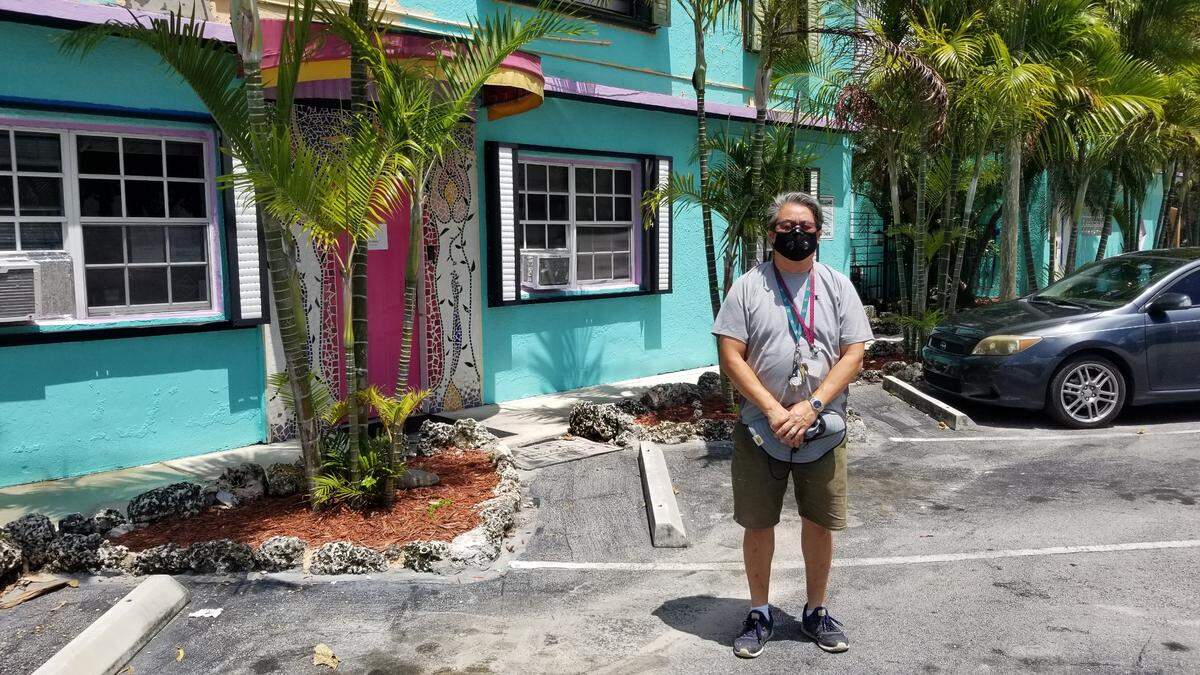
The hostel attracts mostly European guests, Hoo explained. By February he’d lost all his advance bookings.
“I’m only doing 20% of what I do in the summertime,” Hoo said on a recent Friday from the hostel. To conserve resources, Hoo rented out his Florida City house last month and moved into the hostel. The 60-year-old real estate broker, who runs Mahoo Real Estate, has moved his real estate office into the hostel, too.
“It’s bad,” he lamented. “It’s really bad.”
The assistance he got from small business loans – around $8,700 – was quickly wiped out. His insurance costs shot up from $7,500 to $12,000, he said. With beds that go for as low as $35 at the hostel, it’s been impossible for his business to keep up.
“You know what it takes to open up a place that has been shut down for almost eight weeks?” Hoo asked.
Making matters worse are regulations on social distancing that make it near impossible for more than two guests to book beds in the dorm rooms.
When Hoo bought the 56-bed hostel in June 2018 for $450,000, he said it was run down. The former Everglades International Hostel was known for offering “$5 flops” – letting people camp out in a sleeping bag on the property.
Hoo has spent $75,000 to date on landscaping, rehabbing and repairs. Now he caters to families, and while he still rents to homeless residents, he said he runs a tighter ship. But he still needs another $100,000 to finish the renovation.
“People will pay $100 to stay in a hotel here and drive 20 minutes to Key Largo as opposed to paying $200 in Key Largo,” Hoo said. “That’s why the hospitality business is so good here in Florida City.”
When he took over, the hostel rented between 4,000 to 5,000 beds each year. Last year he rented 16,000 beds — which allowed him to just break even. He doesn’t expect he’ll make even 60% of what he did last year.
He also thinks business will not bounce back for another year or two.

As he sits in the courtyard these days, Hoo thinks up ways to continue to bring in revenue. He’s thought of selling tropical fish or African roses. He thinks maybe adding a koi fish pond or garden to the property will help lure visitors. He’s all in.
“I’m going to go down with the Titanic,” he said.
Regular hotels and motels are suffering too. Tony Rosquett, a front desk agent at The Inn of Homestead, has never seen the 55-room hotel this dead in his one year working there.
“It’s slow, it’s very slow,” Rosquett said. “There’s no traffic coming in.”
Before the virus hit, the business had a steady 60% occupancy rate with guests from all over. Now it’s averaging 20% capacity with usually no more than 20 rooms rented.
Tourists have been absent for months. The rented rooms are occupied by residents who are paying month-to-month.
Rosquett said all five employees at the hotel kept their jobs, but he went from working 80 hours every pay period to 65.
A lifelong dream in peril
Orlendina Darcisse, the chef and owner of O’Deeny’s Caribbean Restaurant just a mile away from the Hoosville Hostel, has also seen business plummet due to lack of tourists.
Darcisse worked as a manager at the Hilton Key Largo resort until it closed for extensive renovations (the hotel reopened in 2019 as Baker’s Cay Resort). She tried to find another job in the Homestead/Florida City area but was always told she was overqualified. Those who did offer jobs paid only $7-$9 an hour — too little to make ends meet.
So the fifty-something Haitian woman, who moved to Miami-Dade when she was 22, cashed out her 401K, dipped into her savings and paid $70,000 to open the 22-seat O’Deeny’s Caribbean Restaurant in 2015 inside a strip mall at 1380 N. Krome Ave in Florida City.
“It was always my dream to own my own business,” Darcisse said. “I loved entertaining from the time I was a little girl. I used to cook a lot. And I enjoy seeing people eating my food and having a good time.”
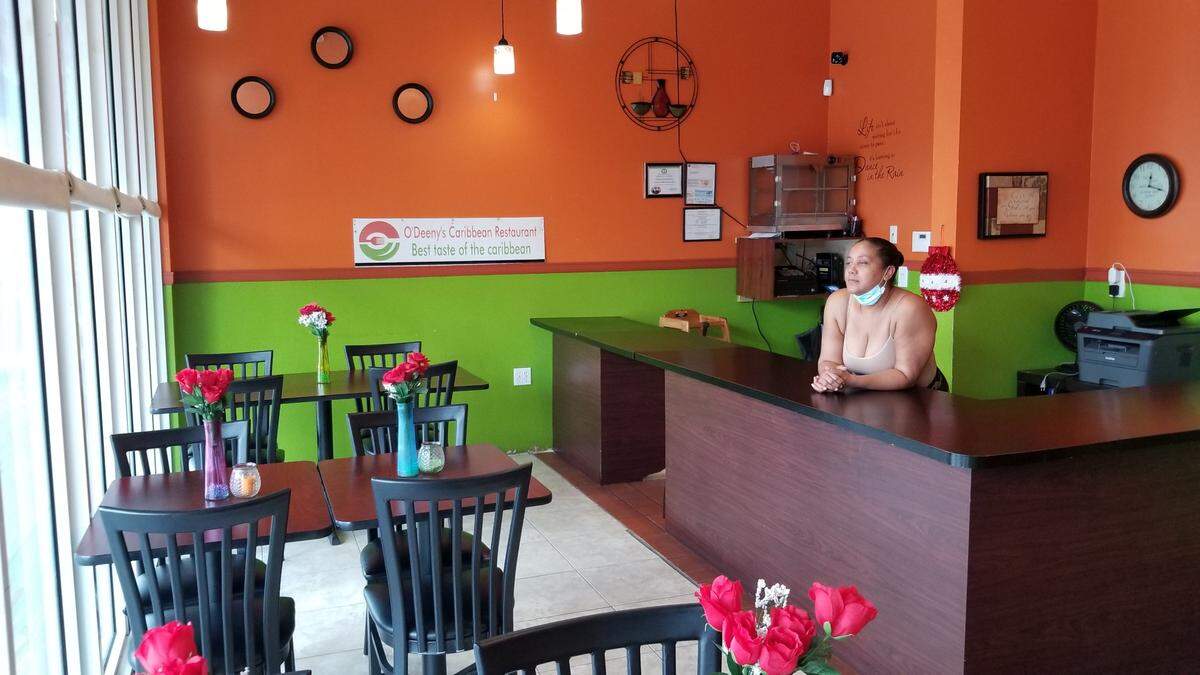
But since the COVID-19 shut-down in March, Darcisse said her business has dropped 80%. The restaurant remains open for take-out, but most of her customer base was made up of European and Asian tourists on their way to the Keys. On a good day now, she will have five take-out orders from other business in the mall. She has put all her part-time employees on call, and she relies on her family members to cover the expenses at home.
Darcisse said she applied for an Economic Injury Disaster loan twice: She was denied the first time and is still waiting to hear on her second application.
“I am worried because for the past couple of months, I could not pay my monthly rent of $1,500 plus utilities,” she said. “If I had not had any savings, I would be closed right now. I’m late every month because I have to figure out a way to make the payment. My landlord understands and has given me extra time. I am hoping for the best. But I am worried that I will able to continue.”
Potential of a virus rebound
The scarcity of work could indirectly result in the further spread of the virus. When Pedro was discharged from Homestead Hospital in mid-May after receiving two days’ worth of treatment for some of the hallmark symptoms of COVID-19 — debilitating fever, difficulty breathing, persistent headaches — doctors told him to self-isolate at home for 14 days.
But for Pedro, a farm worker from Guatemala, going home wasn’t an option.
Before his hospital stay, Pedro shared a small two-bedroom house with three other adults and two children. Once the group got wind of Pedro’s coronavirus diagnosis, they made it clear to their former roommate that he wasn’t welcome back.
Pedro ended up spending his first night away from the hospital in his car, parked in the vast lot in front of the Homestead Walmart.
“It was miserable,” he said. “My whole body hurt, and it was extremely hot being in the car. It was just really unbearable.”
The following night, Pedro moved into a motel that charged $450 a week. He spent almost two weeks there before his savings ran out.
During his time at the motel, Pedro’s former neighbor, Maria, would come by to drop off food in front of his bedroom door.
“I wanted to help him out so that he wouldn’t have a need to go out and infect more people,” she said.
According to Maria, Pedro’s story is far from unique. Both chose to be identified only with their first names because of their immigration status.
“Here in Homestead, many people are going through the same thing. Many of the farm workers here can’t afford to have a room to themselves. So when they get sick, they get turned out, cómo que si fuera un perro que lo dejaron tirado así en la calle, enfermo [as if they were a sick dog that was thrown out into the street].”
Pedro says he is now back to “feeling 100%” and has been able to return to work. After his brief motel stay, friends helped him come up with the money to move to another house, where he now pays $500 a month.
As was the case in his former home, Pedro now lives with many roommates: four.
To preempt objections to him moving in, he never brought up his recent bout with coronavirus.
This story was originally published July 19, 2020 at 7:00 AM.
.jpg)