FDLE releases list of COVID-19 deaths. Top medical examiner calls it a sham.
Acting under intense pressure from a coalition of Florida news organizations and open-government advocates, the state Wednesday evening released a list of every Florida fatality documented by a medical examiner resulting from the coronavirus pandemic.
The information was so riddled with holes, however, that it sparked as many questions as answers.
Missing from the data set were the names of those who have perished from COVID-19, the illness caused by coronavirus infections, the probable cause of death (there can be multiple factors) and the circumstances of the person’s demise.
Several news organizations, including the Miami Herald, had for weeks sought access to the list, which is compiled by individual medical examiners and maintained by the Florida Department of Law Enforcement. Earlier the state had been providing it.
The head of the Florida Medical Examiner’s Commission, which governs the state’s 21 medical examiners, has insisted the information — including the names — is subject to disclosure under the state’s public records law. The administration of Gov. Ron DeSantis, which oversees state health regulators, has warned the examiners to keep the information secret.
“The Department of Health is telling the medical examiners it cannot release this information that the medical examiners have been releasing on a regular basis,” said Barbara Petersen, president emeritus of the First Amendment Foundation, an open-government watchdog in Tallahassee.
“For whatever reason, our governor is trying to hide information — first about nursing homes, and now from medical examiners. They are trying to paint a rosy picture by refusing to provide us accurate information that allows us to make informed decisions about the health and safety of our families,” Petersen said.
“It’s a disservice to the citizens of the state of Florida.”
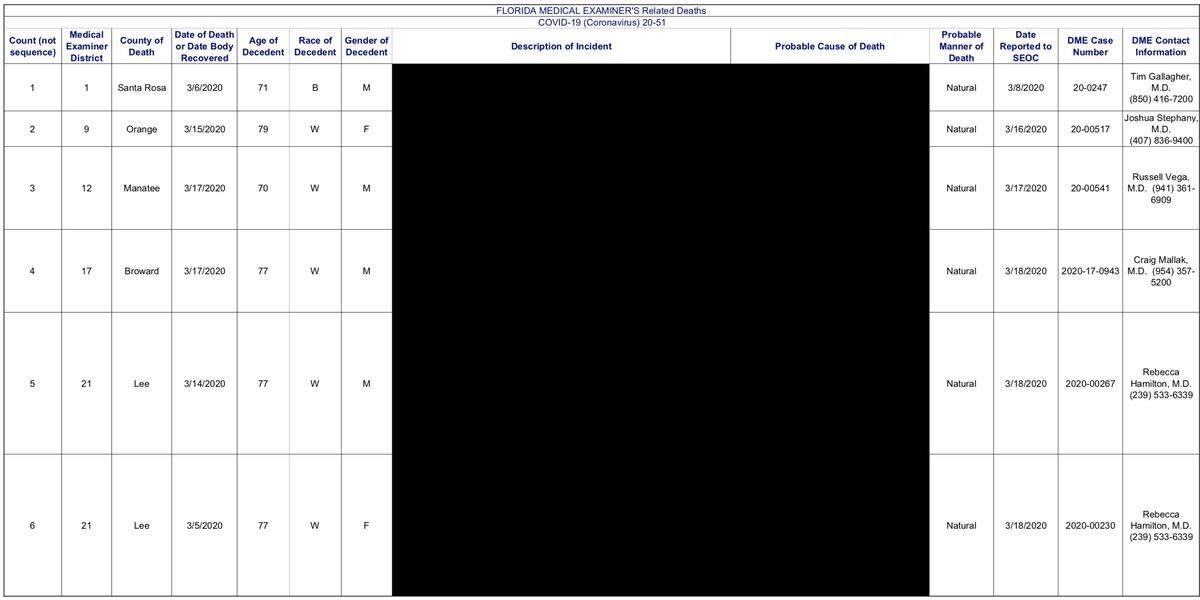
The data, while incomplete, provide a glimpse into the lives of the 1,300 to 1,400 people who died from coronavirus in Florida since the pandemic swept the state.
The spreadsheet released by the Florida Department of Law Enforcement, or FDLE, raises questions about how the state is gathering and studying epidemiological and demographic information about the coronavirus. A health department online “dashboard” updated daily is inconsistent with the information released Wednesday by FDLE.
“Our two lists will never match,” said Stephen J. Nelson, chief medical examiner in Polk, Highlands and Hardee counties, who is chairman of the commission. “They’re not counting snowbirds, tourists. But their number is higher than ours. It’s 1,399. Ours is 1,321. How is their case number higher than ours?”
He said that on Monday. The numbers have risen since then, but DOH continues to have a higher death count. Also, DOH recently began to document non-resident tests.
“We are the only ones under Florida law who can issue a death certificate. I don’t have an explanation,” Nelson said. “I have no explanation as to why their number is higher than ours and growing by the day.”
The Herald asked the FDLE for its spreadsheet of all COVID-19 related deaths back on April 24.
The records had previously been released by the state Medical Examiners Commission — until the Florida Department of Health told the commission to stop providing the list to the public. State health regulators said information from the spreadsheet needed to be redacted. They pointed to two columns in the spreadsheet that contain a description of the manner of death and the probable cause. (Individual medical examiners around the state do not redact that information in response to public records requests.)
It took FDLE, which assumed responsibility for the records request, 12 days to entirely black out the two columns and provide the records to the Herald — a process that could have taken minutes.
Nelson told the Herald that both the redactions and the delay in providing the records were unnecessary. After Hurricane Andrew in 1992, the commission became the state’s official counter of the dead during statewide natural disasters declared by the governor, including pandemics.
“Everything we do is a public record paid for by taxpayers and they are entitled to know what is being done with their money.” Nelson said. “This is no different from what we’ve kept since Hurricane Andrew.”
Before COVID-19, DOH did not object to the commission releasing unredacted death records, Nelson said.
“They’ve never had any heartburn with it in the past,” he said.
For a while, death counts released by the medical examiner’s commission were about 10 percent higher than the totals released by the health department. When the Tampa Bay Times reported the discrepancy last month, health regulators insisted that the commission stop disclosing the data, the Times reported.
This is the third time in as many months that either state health regulators or officials with the DeSantis administration have attempted to shield from the public details that local medical examiners have long deemed a public record.
In March, when the Miami Herald sought information from the Miami-Dade Medical Examiner’s Office about COVID-19 deaths, attorneys for the state health department moved to block the records from becoming public.
Christine Lamia, deputy general counsel for the health department, said in an email to Assistant Miami-Dade County Attorney Christopher Angell that the county should not release the records “as [they are] confidential and exempt from public record disclosure.”
County administrators did not agree, and released the information anyway.
On Wednesday, Nelson voluntarily released the latest detailed records from his three counties regarding victims of COVID-19 to the consortium of news organizations.
The DeSantis administration has clashed with open government and public records advocates for much of his 17-month term, but the conflict has become increasingly acute as news organizations and activists have sought information about the state’s handling of the COVID-19 pandemic.
The Agency for Health Care Administration, which licenses and oversees hospitals, assisted living facilities and nursing homes, refused to name elder-care homes with coronavirus outbreaks until the news organizations filed legal notice that they intended to sue the state.
Likewise, with a lawsuit over coronavirus infections at elder-care facilities pending, health regulators released the number of coronavirus deaths within each home late last Friday, only days before a scheduled hearing on the suit.
It took weeks of demands — and the disclosure of deaths at a North Florida prison by a medical examiner — before the Department of Corrections acknowledged which facilities had inmates and staff who had tested positive for COVID-19.
And the state continues to withhold data about the extent of a backlog of pending results from private labs, which are doing 90% of all testing in Florida. The state announced Wednesday it will start conducting antibody testing of first responders and healthcare workers. But the DeSantis administration has refused to let the public know the extent of the testing in healthcare facilities.
The media companies have in recent days signaled their intent to file suit over that information, as well.
This story was originally published May 6, 2020 at 9:18 PM.