How many Miami coronavirus cases are undetected? A pinprick of blood may offer answers
Miami researchers have started rolling out a county-wide effort using pinprick blood tests to learn how much of the population has already been infected by the novel coronavirus without knowing it, a first-of-its-kind effort they hope will help them figure out, among other things, when social distancing can end.
But just like the virus, there are a lot of unknowns about the tests themselves.
“We’re learning how to fly while we’re building the plane,” said Erin Kobetz, a University of Miami professor of medicine and public health sciences and the lead researcher on the project. “We’re doing the best we can with what we have at our disposal to wrap our heads around something for which we are largely in the dark.”
A team of county officials and University of Miami health researchers have started recruiting 750 residents a week from representative population samples across Miami-Dade. The goal: to figure out how many people have had COVID-19, the disease caused by the coronavirus.
No one knows for sure how effective the process will be, and the tests themselves are not completely proven. While that worries at least one expert, the UM researchers say they are confident they can adjust for any inconsistencies in the testing.
The serological tests, manufactured by the North Carolina research company BioMedomics, detect the presence of antibodies in the blood that are created in response to a coronavirus infection. Antibodies can linger for months or even years after the infection is cleared.
That means serological blood tests are better at searching the past than diagnosing the present. Antibodies don’t rise to a detectable level in the blood stream for days to weeks after an infection, said Dr. Juan Dumois, a pediatric infectious disease physician at Johns Hopkins All Children’s Hospital in St. Petersburg.
Antibody tests are never 100% accurate, Dumois said, but this effort still has a good chance to uncover how many people were asymptomatic, or infected without ever showing symptoms — currently estimated by the U.S. Centers for Disease Control and Prevention to be as high as 25% of all infections, but potentially much higher.
The backward-looking surveys could be especially helpful in places like Florida where tests for the active virus — nasal swabs, in other words — were slow to get off the ground. With antibody testing, researchers could tell if someone had the virus weeks or even months ago.
“By having a better idea of how many people are actually getting infected, as opposed to just testing the people who are sick enough to be in the hospital, we’ll be able to get more accurate hospitalization and death rates,” Dumois said. “Right now, those are overestimated, because we aren’t testing people without symptoms or with cold symptoms.”
Kevin Lynskey, the director of the Miami-Dade Water and Sewer Department who is leading the county’s involvement in the project, predicted the countywide blood testing will show a much wider spread of the virus than is currently known because the effort will help uncover large swaths of people who had no symptoms.
“If you take every positive test, it probably represents one-eighth of the folks who get infected,” he said, adding that many would think they simply had a “light flu to the cold.”
County officials will funnel the data to the University of Washington’s Institute for Health Metrics and Evaluation, where it will be analyzed and could feed into the school’s influential models for the pandemic’s peak that are closely watched by White House officials.
Theo Vos, professor of health metrics sciences at the institute, said scientists around the world are particularly interested in the tests being done in coronavirus hotspots such as Miami, because it will help them determine the true extent of a population’s exposure.
Vos said he has been studying recent results of serological surveillance in Heinsberg, the hardest hit part of Germany. Preliminary research there showed that 14% of the people surveyed had evidence of a past infection, and about 2% had evidence of a current one.
The implications of the study: even in areas of widespread transmission, the type of herd immunity that would slow a virus’ spread — at least 60% of the population — is still far away.
Miami-Dade’s study could offer a similar look at the scope of infections, and that could influence how the county manages its restrictions on group gatherings and business activity, Lynskey said.
“There’s not going to be an off and on switch,” he said. “You may have to take the vulnerable people and keep them isolated. You may have to get other people back to work.”
Vos, the UW scientist, raised questions about the accuracy of the blood tests, noting that all results from Miami-Dade’s tests need to be thoroughly analyzed.
“It’s very exciting that serology tests are coming onto the market, but it’s a little early to say how valuable they are until we have a bit more knowledge of how good, or not, these tests are,” he said.
A wide reach
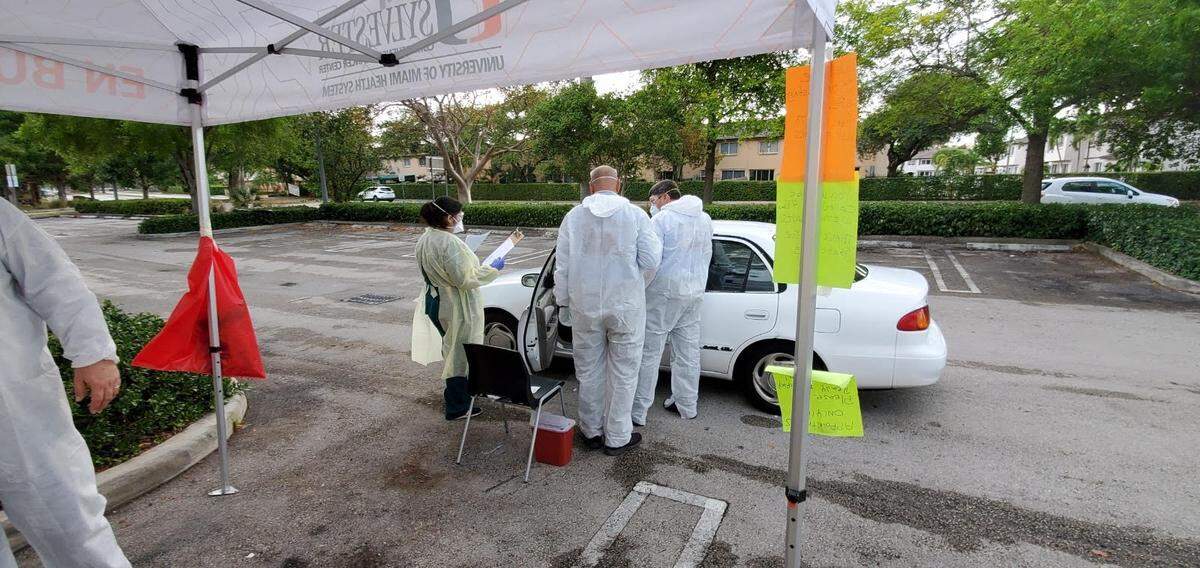
To find test subjects, researchers partnered with Florida Power & Light to randomly generate phone numbers in a cross-section of the community. UM researchers arrange the tests with those who agree to do it. There are 10 drive-thru testing locations, usually libraries, where Miami-Dade Fire Rescue personnel wearing full protective suits take blood samples through car windows.
Participants get results the next day.
Test runs have already been conducted in Coral Gables, Miami Beach, North Dade, Kendall, Miami Lakes, Aventura and Miami Springs, and about 400 samples have been collected so far, researchers said. Most people agree to help.
“It’s been a really positive response,” said Natasha Schaefer Solle, an assistant professor with the University of Miami who is overseeing field collection. “The first day, only 40 people didn’t show up. That’s pretty great in the research world.”
The biggest risk for researchers is the potential for false positives. For the test Miami researchers are using, about 10% of the results could turn out to be wrong, inaccurately indicating that a person has had the disease, according to a study conducted during the early outbreak in Wuhan, China.
Vos, from the University of Washington institute, described the test’s accuracy on positives as “not great” and needing additional validity testing to produce more meaningful data.
But researchers acknowledge that in a pandemic, they have to move quickly, which sometimes means ironing out problems as you go.
“Obviously, you want a very sensitive and specific test,” said Kobetz, the UM researcher. “One that has a high probability of identifying people who are positive and ruling out infection in those who actually do not have it.”
Kobetz said that the team didn’t plan to do further validation on the tests, which have been endorsed by the CDC, and would instead be adjusting statistically for the proportions of false results.
“We trust our randomization and study selection,” she said. “We can say with 95% or so confidence that our estimate is correct.”
What will we learn?
The findings from Miami-Dade’s study could not only inform local policy decisions, but also be helpful for University of Washington researchers.
Lynskey, the county official, said the first full-scale, 750-people-in-a-day testing will be conducted on Tuesday, and that he plans to share the data with the UW researchers the following day.
Vos, the UW scientist, called the lack of understanding on undetected infections the “missing link” — especially how many people are asymptomatic.
He said the Miami data, even using tests that are not fully proven, could become immensely useful as researchers transition from estimating hospital surges and move toward the prospect of easing lockdowns.
“It’s very timely,” Vos said. “We’re starting to get some information, and hopefully we’ll learn a lot more about how good the tests are.”
This story was originally published April 10, 2020 at 5:00 AM.