
These 55k South Floridians were struggling to pay rent. Then COVID-19 took their jobs.
Herbert Polite hasn’t worked up the nerve to call his landlord yet.
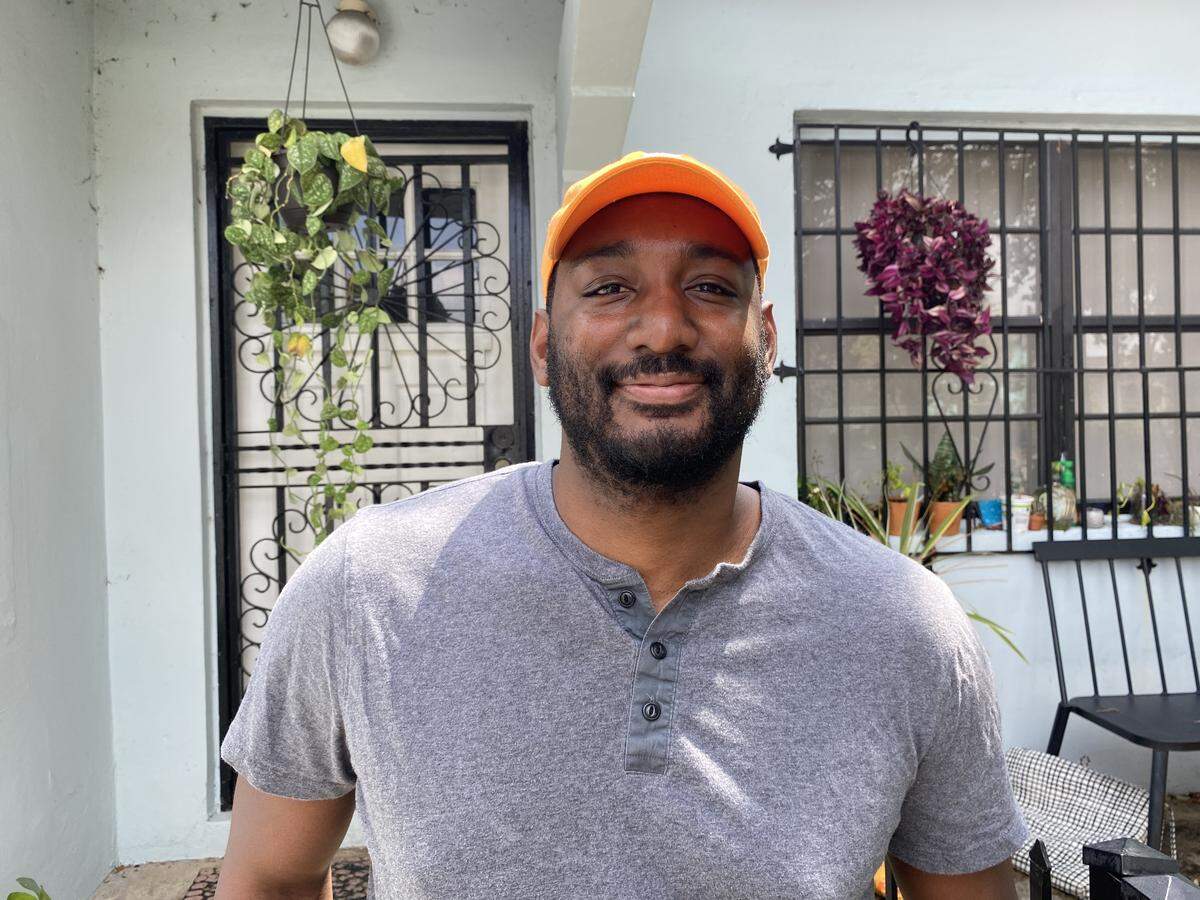
The COVID-19 pandemic savaging South Florida’s tourism-driven economy has cost Polite, a 32-year-old massage therapist, both his jobs — at the Mondrian South Beach hotel and Equinox gym in Aventura. Now his rent is due: $1,300.
“I don’t know how I’m going to pay for things,” said Polite, who rents a two-bedroom home in Little Haiti with his fiancée. “I’ve had a lot of people reach out to ask if I need help, but I keep saying no, not yet, because things haven’t gotten nearly as bad as they’re going to.”
Workers like Polite have little or no cushion saved up for the bad times — and this is the worst time anyone can remember. Tens of thousands of service and hospitality workers in South Florida — the nation’s least affordable housing market for renters — are in a similar position: Out of a job because of the coronavirus and likely unable to pay the rent that was due on April 1.
The Miami Herald set out to determine just how many.
Our estimate: more than 55,000.
That’s the number of South Florida renters who were living on the edge even before becoming suddenly unemployed, underemployed, or furloughed after the virus struck, according to a Herald analysis. The analysis was done in consultation with researchers at Florida International University using federal housing data provided by the University of Florida. It is almost certainly an undercount.
“COVID-19 is the motherlode of economic shocks,” said Ned Murray, associate director of FIU’s Jorge M. Pérez Metropolitan Center. “We are going to become the poster child for this crisis right away because of our high housing costs and reliance on industries dominated by low-wage employment.”
The Herald’s analysis used U.S. Census survey data from 2018 to determine the number of renters in Miami-Dade, Broward, Monroe and Palm Beach counties who met two criteria. First, prior to the spread of COVID-19, they lived in households paying 50 percent or more of their pre-tax income on rent — those the federal government calls “severely cost-burdened.” Second, they worked in restaurants, nightclubs, hotels, casinos, retail, entertainment, tourism, or in other jobs where the virus immediately led to widespread layoffs or drastic reductions in work hours. The Herald then estimated how many of those renters lost work using trade-group figures of COVID-19 employment losses in their industries. (Read our methodology here.)
The most vulnerable workers are being hit first — and hardest.
Hotel employees, restaurant and other food service workers, and retail staff make up nearly three-quarters of the 55,000 total. Others include taxi drivers, hairdressers and barbers — jobs being killed by the social distancing health experts say is necessary to contain the virus. The loss of these jobs disproportionately affects immigrants and people of color, who tend to have less money in the bank than white and native-born workers. The majority live in Miami-Dade.
These severely cost-burdened renters have been living paycheck to paycheck. One missed check often means they can’t make rent.
“You’re now moving from that unstable housing situation into a crisis,” said Anne Ray of UF’s Shimberg Center for Housing Studies. “People who were already struggling to pay their rent are going to struggle more.”
Ray said the Herald’s estimate likely represents an undercount because it accounts only for renters who were economically vulnerable before the pandemic.
For instance, Polite, the massage therapist, wouldn’t have been included in the Herald’s numbers. His fiancée works at a non-profit and makes more than the county’s median wage. A month ago, they earned enough money compared to their housing costs that they weren’t considered cost-burdened renters. That was before the virus.
“People who weren’t struggling before are facing a new challenge,” Ray said.
The Herald’s analysis also accounts only for economic disruption just a few weeks into an outbreak expected to grow far worse. Future job losses due to a predicted economic recession are not included in the Herald’s estimate.
Some of the workers will be able to find new jobs, especially in retail where large employers like Walmart and Publix remain open and are hiring. But working in an essential retail business will put them on the front lines. Employees there are at a high-risk of exposure. And their bosses have been slow to protect them.
Other workers, like those in the restaurant and hospitality sectors, are in for a much longer loss of income.
Cancel rent?
The growing crisis has led to calls for action in Florida.
On Thursday, Gov. Ron DeSantis suspended foreclosures and evictions statewide. Residents won’t be forced out of their homes for now — at least not legally.
But no action has been taken at state and federal levels to delay or cancel rent payments. That means low-income workers who lose their jobs can’t wipe their rent debt clean. They’ll still be on the hook, just later. Without savings, they may never be able to pay back what they owe. A $1,200 federal stimulus check will help, but not much: The median monthly rent in South Florida is $1,360, including utilities and other costs. Many workers in the industries slammed by COVID-19 are undocumented and not eligible for the federal money. Whether it’s landlords or tenants, someone will likely need a bailout at the end of the day.
State Rep. Shevrin Jones, a Broward Democrat, says he supports a special legislative session to pass a rent moratorium and other relief measures. In the meantime, Jones argues, an executive order is necessary.
“The governor needs to take the lead ... and halt all rent payments or implement a payment plan for individuals,” he said. “We cannot expect people to pay what they don’t have. We need to allow individuals to get back on their feet.”
DeSantis’ office did not respond to a request for comment for this story.
Alana Greer, co-founder of the Community Justice Project, believes the wave of evictions following the pandemic will “dwarf the number of cases we saw in the foreclosure crisis” without strong government action.
“Florida has some of the fewest protections for renters in the entire country. It’s very difficult for tenants to even get a court hearing,” Greer said. “Folks are already living paycheck to paycheck and scraping by.”
Half of Miami-Dade households would not be able to cover basic expenses if forced to go three months without income, according to research by the economic advocacy group Prosperity Now. The numbers are even worse if you look at just black and Hispanic residents.
Already an estimated 330,000 workers in Florida’s hotel industry are projected to lose their jobs. Non-essential businesses are being shut down around the state. More than 300,000 in Florida filed for unemployment over the past two weeks, a record, with many others saying they were unable to navigate the state’s overwhelmed jobless system. A statewide “stay-at-home” order is now in place.
“If we’re ‘safer at home,’ ” Greer said, “you need a home to make that true.”
Politicians from Florida’s conservative Republican Sen. Rick Scott to New York’s left-wing Rep. Alexandria Ocasio-Cortez are proposing some form of relief. Scott has said rent payments should be halted for 60 days. Under this “moratorium,” tenants would be put on a payment plan, meaning they’d have to roll what was owed into future payments, increasing the monthly rent when normalcy is restored. On the other hand, some Democrats like Ocasio-Cortez have called for an outright cancellation of rent payments during the pandemic, saying workers will never be able to make up for lost wages.
South Florida mayors say their staffs have told them they do not have the authority to halt rent payments, citing both constitutional protections for contracts and a Florida law that restricts local governments from regulating tenant/landlord arrangements.
“Unfortunately I don’t have the power to suspend rents,” Miami Mayor Francis Suarez said in a statement to the Herald. “But I asked the governor to do so.”
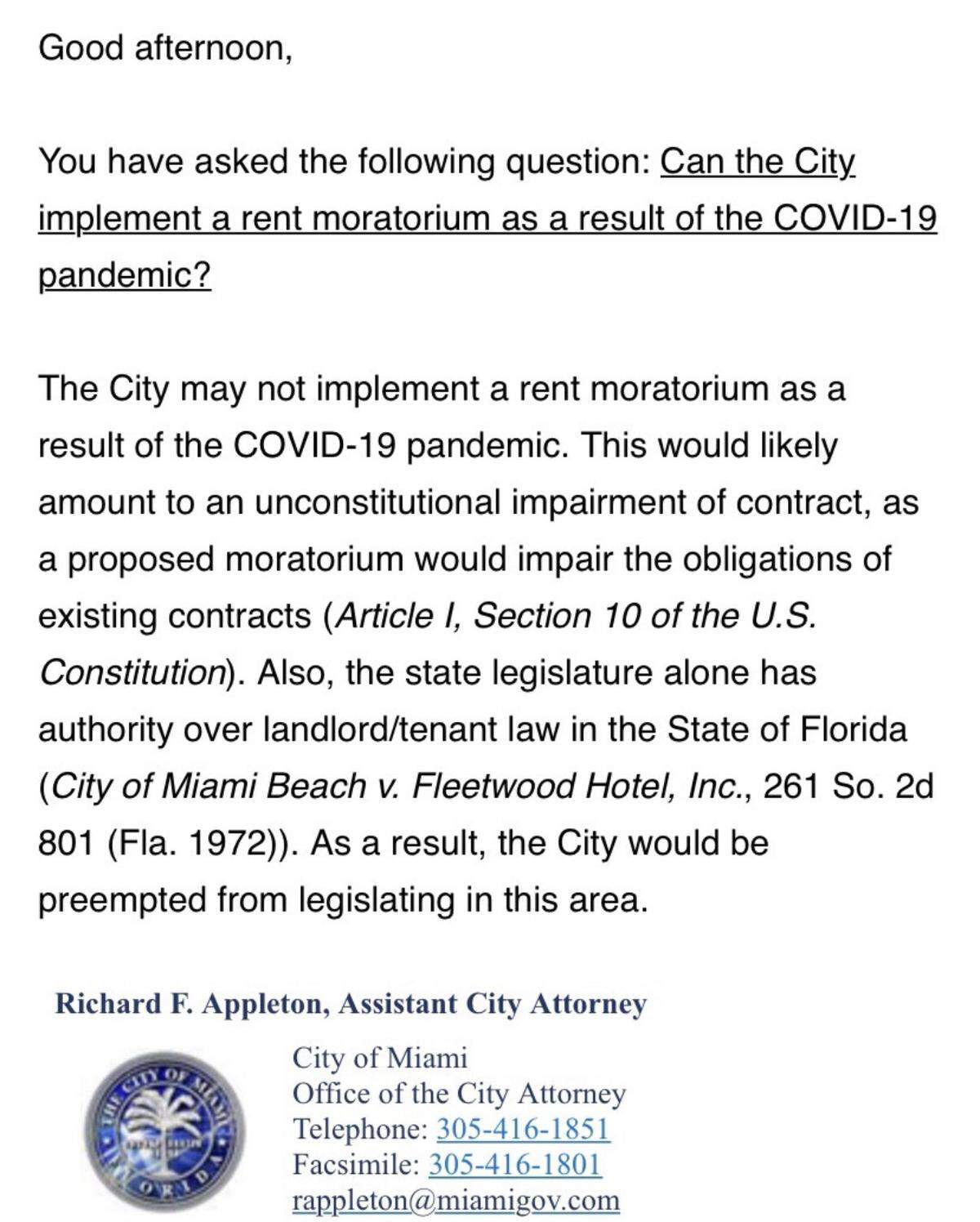
Patty Abril, a spokeswoman for Miami-Dade Mayor Carlos Gimenez, said she doesn’t think “there’s been any plan for delaying or canceling rent payments” at the county level.
(Under state law, local governments in Florida are allowed to declare year-long “housing emergencies” that allow them to enact rent controls but only if voters approve the measure.)
Whatever happens, renters will struggle in South Florida. Bank accounts don’t stretch far here. In the city of Miami, 73 percent of families have less than $2,000 in savings, compared with 52 percent nationally, according to the Urban Institute.
Marina Tapia, who lost her job as a house cleaner when people started self-isolating, says the only thing her family can afford to buy right now is food. The pandemic has also put her husband, a tile installer, out of work. They’ve cut out all their other shopping.
“Not knowing how long it will last is the worst thing,” said Tapia, 55. “When will we be able to get back to work?”
Without jobs, Tapia and her husband don’t know how they will pay the $1,500 monthly rent on their two-bedroom apartment in Aventura. For now, the family, originally from Peru, is relying entirely on income from their oldest daughter, who makes $15 per hour working for a tax preparer. (Their other daughter, a college student, lost her part-time job.)
That money will get them through April. But what about May?
“We have lived here two years and never missed a rent payment,” said Tapia’s husband, Jose Malaga. “We don’t know what to do. They’re telling people to talk to your landlord, but he’s American and we don’t speak English.”
Some landlords are trying to help. They need tenants in place paying some kind of income, even if it’s not the whole rent check.
Daniel Veitia runs a Miami Beach property management firm that oversees 3,000 apartments, most of them in older, low-rise buildings built in the 1950s that are popular with service-industry workers.
Veitia said he has put two programs in place for his tenants. For those who can still pay, he is offering a 10 percent discount on their monthly rent. “That helps keep the cash flow coming to landlords and it also offers tenants an encouragement to keep paying,” he said.
For tenants who can’t pay even the discounted rate, Veitia said he is asking them to pay at least 50 percent of their monthly rent (or however much they can) while helping them enroll in unemployment, health services and food stamp programs to ensure they have some income coming in.
Once people get back to work, he said, whatever rent is still owed will be renegotiated into their lease as part of their monthly payment.
In North Miami Beach, Sara Lauer’s landlord is playing a waiting game. Lauer, 23, lost her job as a waitress and rents an efficiency behind her landlord’s single-family home.
“She said to pay her whatever I can in April and if this is still going on by May 1,” Lauer said, “we’ll have to revisit it.”
This story was originally published April 4, 2020 at 11:42 AM.

_pp%20Cropped.jpg)