Florida lupus patients can’t get their meds after Trump touts drug to fight coronavirus
Mary Killeen-Griffith thought she was prudent when, in early March, she visited CVS, her regular pharmacy, to request refills for all of the medications she takes.
The 47-year-old Miami Shores mom, writer and producer wanted to make sure she was good just in case COVID-19 turned into a pandemic and led to shelter-at-home orders.
But she couldn’t possibly imagine that the one drug she has used for 15 years to treat her lupus — Plaquenil, the brand name for hydroxychloroquine — would suddenly grow in demand and become increasingly difficult to get.
Drug touted by the president
This is the drug President Donald Trump recently touted in an address to the nation “as a game changer” in the race to a cure for COVID-19. The president’s claim was shunned by many scientists — including among his health advisers — who called the initial studies flawed and that his comments were “risky,” Science magazine reported.
Still, researchers in New York, and elsewhere, and the public, started to look at the medication after anecdotal evidence from small studies suggested that hydroxychloroquine and chloroquine drugs may reduce symptoms of COVID-19 and slow down the replication of the virus, according to the Lupus Research Alliance.
Drugs not FDA approved for COVID-19
The Alliance points out that these drugs — which treat lupus and malaria conditions — are not officially approved by the U.S. Food and Drug Administration to treat COVID-19. “Yet some physicians are treating patients with Plaquenil on an ‘off-label’ basis,” the Alliance said.
That’s creating a problem for some and led the Alliance to urge the FDA to address the shortages and take action. The FDA committed to preserve the supply of hydroxychloroquine for patients already taking it as it was intended. Manufacturing has increased, too.
Hydroxychloroquine shortages
Still, patients like Killeen-Griffith are finding it hard to get their medication. Shortages are growing nationwide, especially in New York and California, the Alliance warned, but people in South Florida, too, are getting bad news from their pharmacies when they pick up their prescriptions.
Lupus is a chronic autoimmune disease that can cause inflammation and pain in any part of the body and causes the immune system, which is designed to fight infections, to attack healthy tissue instead, according to the Lupus Foundation of America.
There is no cure. Only treatment.
“The reason I reached out wasn’t due to the Plaquenil, as that wasn’t even on the radar yet, but because I was afraid of a shortage across the board due to COVID — blame my years covering hurricanes. I wanted to be prepared,” Killeen-Griffith said of that initial visit to CVS. “The minute I read an article about ‘a anti-malarial drug’ showing promise, I called my doctor and the pharmacist.”
Killeen-Griffith, a former multimedia manager for the Miami Herald and CBS4 political producer for “Facing South Florida,” said CVS had told they were waiting on an order. So Kileen called a bunch of Walgreens, Publix and Target pharmacies.
None had the Plaquenil she needed. “I even had one pharmacist tell me she was told to tell patients looking for the drug ‘to seek alternative therapies from their doctor.’”
On Wednesday, she was able to get a 90-day supply from her CVS pharmacy.
But Killeen-Griffith said her doctor suggested that she stretch them out by taking half-a-dose.
“So I will be going from 400 mg a day to 200 mg, which is another problem. My diagnosis is mixed connective tissue disease, so I actually have two autoimmune diseases — lupus and rheumatoid arthritis. This is the only medicine that has ever helped me and the side effects are minimal. I have tried others and once ended up in the hospital from side effects,” Killeen-Griffith said.
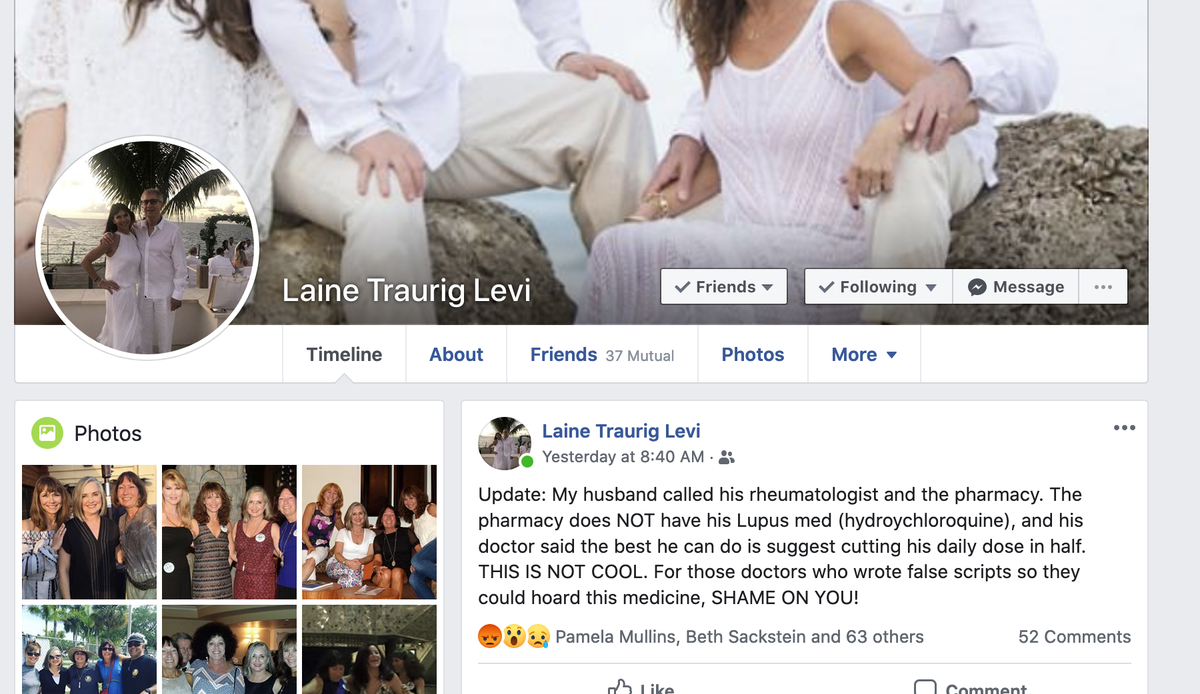
Fernando Levi in Boca Raton was told the same thing by his rheumatologist when he couldn’t find his prescribed hydroxychloroquine, as a result of hoarding, his wife Laine Traurig Levi posted on Facebook.
“For those doctors who wrote false scripts, SHAME ON YOU,” she wrote.
KIlleen-Griffith can empathize.
“To be honest, I am extremely scared, living with an autoimmune disease is a struggle on a good day but to be at the point where I might not get the medicine is a punch in the gut, especially when I am already worried being in the time we are in now,” said Killeen-Griffith, who is in the high-risk group for COVID-19 complications. “This medicine keeps my body from attacking my lungs. I need to keep taking my Plaquenil.”
Response from CVS Health
CVS Health told the Miami Herald it was aware of the growing concern.
“We’re closely monitoring the global pharmaceutical manufacturing environment and working with our suppliers to ensure we can continue filling prescriptions for pharmacy patients and plan members,” said Mike DeAngelis, senior director of corporate communications for CVS Health.
That doesn’t mean CVS isn’t wholly opposed to using hydroxychloroquine or other drugs to treat COVID-19 if studies do bear fruit.
“We’re also balancing the growing interest in off-label use of certain prescription medications or chloroquine, azithromycin, one protease inhibitor and albuterol inhalers to treat COVID-19 pneumonia with the ongoing needs of patients and members who are prescribed these drugs to help manage chronic conditions such as lupus, HIV, rheumatoid arthritis and asthma. Our goal is to limit stockpiling of medication that could result in future shortages and gaps in care,” DeAngelis said.
“Our retail pharmacies are following dispensing guidelines regarding the use of these medications for COVID-19 that have been established in certain states. In states with no guidelines, our pharmacies are limiting the dispensing for COVID-19 treatment to a 10-day supply with no refills,” he added.
Florida doesn’t have guidelines for the use of hydroxychloroquine in treating COVID-19.
Ohio, Texas, Idaho and Nevada have issued prescription guidelines forbidding preventative use of hydroxychloroquine for COVID-19 patients, Florida Today reported.
What you can do
The Arthritis Foundation has the following tips for those with lupus who need prescription drugs like Plaquenil:
▪ Due for a refill? Order it from your pharmacy now. If you need a refill, contact your health care provider.
▪ Request larger supply. If your refill is for 30 days, ask your doctor to write it for a 90-day supply so you have a cushion in case it’s difficult to find later.
(This would also apply to some of your other medications — such as blood pressure or cholesterol pills, for instance — if shelter-in-place orders make it more difficult to get to pharmacies. Or, if you are in a higher risk group, such as seniors, for complications from the coronavirus.)
▪ If your pharmacy can’t fill a full 90-day prescription due to short supply, see if you can take what’s available now and be contacted as soon as new stock comes in.
▪ Try to refill even if it’s too soon according to the insurer’s rules. “Some insurers are waiving the transaction block when a pharmacist tries to refill the prescription before the allowed date,” Mike Ganio, a pharmacist and director of pharmacy practice and quality for the American Society for Health-System Pharmacists, told the Arthritis Foundation.
▪ Ask your pharmacist for help locating a refill if your pharmacist is out of stock. Another location in the same chain may have it or a nearby hospital pharmacy may be able to fill it. This tip would also apply to other prescriptions individual locations run low on sometimes or when you are out of town and need an emergency supply.
▪ Check with compounding pharmacies in your area. If the active ingredient in powder form is available, the specialty pharmacist may be able to make tablets for you, the Arthritis Foundation said. There are several compounding pharmacies in South Florida and through the state.
▪ Ask your doctor for guidance if your pharmacy and others in your area don’t have hydroxychloroquine in stock.
This story was originally published March 28, 2020 at 1:52 PM.