Lost your job? Need food? Internet? These places can help during the coronavirus crisis
COVID-19 has turned South Florida upside down.
Miami-Dade and Broward County have ordered all bars to shut their doors. Restaurants are converting into takeout and delivery. Stores are closing. And people are making less money or suddenly out of work.
If you’re left in need during this time, there are resources available.
How can I help during South Florida’s COVID-19 shutdown?
United Way Miami in partnership with the Miami Herald/el Nuevo Herald has launched Operation Helping Hands to establish the Miami Pandemic Response Fund. The Miami Foundation and Greater Miami Convention and Visitors Bureau have joined United Way in providing seed funding of $350,000 to aid families and small businesses through a network of nonprofit partners responding to the COVID-19 pandemic.
Those interested in donating can:
▪ Visit https://unitedwaymiami.org/ohh_covid19
▪ Call 800-226-3320
▪ Give via Venmo @UnitedWayMiami
▪ Give via PayPal at https://www.paypal.com/fundraiser/charity/2169193
The Miami Foundation has also created a Community Recovery Fund to help local nonprofits whose operations are affected by COVID-19. The foundation has seeded the fund with a $300,000 contribution to support local nonprofits with “long-term recovery, resilience and financial stability,” according to the foundation. Funds will be granted to qualifying Miami-Dade-based nonprofits on a rolling basis, depending on how long fundraising continues.
Nonprofits in need of financial support or individuals, businesses, corporations or donors interested in contributing to the fundraising should visit miamifoundation.org/COVID19Response for more information.
Brad Kilgore, owner of four Miami restaurants, including Wynwood’s Alter, partnered with Miami real estate broker Felix Bendersky to run a fund dedicated to helping former restaurant employees. The Miami Restaurant Employee Relief Fund aims to deliver $250 grants to full-time Miami-Dade employees who have been out of work since governments ordered restaurant dining rooms shut to stop the spread of the novel coronavirus.
Those interested in donating can visit www.gofundme.com/f/miamirestaurantemployeerelieffund
Hands on Miami and Hands on Broward have developed a “Hands on at Home” program that gives people the opportunity to participate in volunteer programs without leaving their couch. The projects will help “support vulnerable residents and nonprofits in need,” according to the organization.
Some of the projects listed include sending handwritten or email letters to those in need, DIY craft projects, and recording a video of yourself reading a children’s book and posting it on Facebook or Instagram. If you’re still in school, service hours are available. To learn more about the program or to make a donation, visit www.handsonbroward.org/at-home
Hands on Broward says Chef Fran and the team at Joseph Dreamhouse are also distributing food to families suffering from food insufficiency during the COVID-19 pandemic on Mondays at 3:30 p.m. to 8:30 p.m. and on Sundays from 12:30 p.m. to 5:30 p.m. at Southwest Ranches.
Those interested in learning more about the food drive or who are interested in volunteering should visit www.handsonbroward.org
The Salvation Army is asking for donations to help continue its COVID-19 response across the country, including food assistance, shelter for those in need, virtual worship and virtual children’s programs. To learn more about the different ways you can donate, visit https://salvationarmyflorida.org/covid19/
What can I do if I’m laid off or not being paid because of COVID-19?

You can apply for Reemployment Assistance (formerly known as unemployment compensation) if you were working in Florida and are now:
▪ Quarantined by a medical professional or a government agency.
▪ Laid off or sent home without pay for an extended period of time because of the COVID-19 pandemic.
▪ Caring for an immediate family member who is diagnosed with COVID-19.
To learn more about the program and how you can apply online, visit http://www.floridajobs.org/Reemployment-Assistance-Service-Center/reemployment-assistance/claimants
Miami-Dade County will also be providing printed applications for unemployment assistance at 26 libraries starting Wednesday, April 7, for those who don’t have Internet or are unable to access or submit the form on the website. The printed applications will be distributed at select libraries every day from 8 a.m. to 7 p.m.
To find the closest participating library, call 305-375-2665 or visit www.miamiherald.com/news/coronavirus/article241822211.html for a full list of participating locations. You can also download and print a copy of the application from DEO’s website at http://floridajobs.org/Reemployment-Assistance-Service-Center/reemployment-assistance/claimants/rapaperapplication and return it to any participating library’s book drop.
The IRS and the Treasury Department say Americans can expect to start receiving their economic impact checks in the next three weeks. The checks are part of $2 trillion COVID-19 rescue package signed by President Donald Trump last week.
Anyone earning up to $75,000 in adjusted gross income and who has a Social Security number will receive a $1,200 payment. Married couples filing joint returns will receive $2,400 if their adjusted gross income is under $150,000. Parents will also receive $500 for each qualifying child.
Most people will have the money directly deposited into their bank account or mailed to them. Those who normally don’t file an income tax return will have to file a “simple tax return” to receive the payment, according to the IRS. This includes low-income taxpayers, senior citizens, Social Security recipients, some veterans and individuals with disabilities who are not required to file taxes.
Learn more at www.irs.gov/newsroom/economic-impact-payments-what-you-need-to-know
Legal Services of Greater Miami says it provides broad-based civil legal services for the poor in Miami-Dade and Monroe counties in the areas of tenants’ rights, homeownership, health income maintenance, employment, special education, tax and consumer rights, and has created a COVID-19 resource page at https://www.legalservicesmiami.org/covid-19.
To apply for legal assistance call 305-576-0080 in Miami-Dade, 866-686-2760 in Monroe or visit https://www.legalservicesmiami.org/self-help
JWorks Miami has moved operations online to continue helping Jewish job-seekers in Miami-Dade County find a job. The program helps residents develop résumés and cover letters, hosts mock interviews (which will be online during the COVID-19 outbreak), and network with potential employers. The program is free to job seekers and employers through a partnership between the Greater Miami Jewish Federation and Jewish Community Services of South Florida.
To learn more, visit jewishmiami.org/jworks/
Supermarket and drugstore chains including Publix, Sedano’s, CVS and Walgreens are planning to hire thousands during the COVID-19 pandemic. You can check out a list of companies hiring in Florida at: https://www.miamiherald.com/news/coronavirus/article241436891.html
The Greater Miami Convention & Visitors Bureau has launched a “Help for Tourism” web page listing resources and opportunities available for workers in the travel and hospitality industry. Relief efforts include the SOBEWFF & FIU Chaplin School Hospitality Industry Relief Fund, United States Bartenders Guild relief campaign and the Restaurant Workers Community Foundation.
It also includes a list of companies that are hiring such as Walmart, Amazon, Zoom and Target.
To learn more, visit www.GMCVB.com/help
COVID-19 has affected my small business. What can I do?
Gov. Ron DeSantis has activated the Florida Small Business Emergency Bridge Loan Program to support small businesses affected by the novel coronavirus. The bridge loan program will provide short-term, interest-free loans to small businesses who were financially impacted by COVID-19.
Applications will be accepted through May 8.
For more information on the program, visit www.floridadisasterloan.org. For questions, contact the Florida Small Business Development Center Network at 866-737-7232 or email Disaster@FloridaSBDC.org.
Florida’s Department of Economic Opportunity is also encouraging business owners to complete the Business Damage Assessment Survey to help officials determine what the best recovery resources for businesses are. To fill out the survey, visit floridadisaster.biz/BusinessDamageAssessments.
Facebook is offering $100 million in cash grants and ad credits to help local small businesses during the COVID-19 pandemic. At least $150K will be available to help 38 local small businesses in Miami-Dade County, according to a Facebook spokeswoman.
The grants can help business owners cover operational costs, rent, maintain employees and connect with customers. Grant eligibility includes being a for-profit company that has been in business for more than a year, employs two to 50 people and has experienced challenges during the COVID-19 situation. To learn more about the grants and how you can apply, visit https://www.facebook.com/business/boost/grants/application-guide
The IRS has established a section on its website to help taxpayers, businesses and others affected by COVID-19. Information you can find on the web page includes:
Details about the Employee Retention Credit program, which will provide a refundable tax credit to qualifying businesses that have kept employees on payroll during the pandemic and have been financially impacted by the disease.
Information about the Families First Coronavirus Response Act, which will reimburse small and midsize employers for the cost of providing COVID-19 related paid leave to employees because of the worker’s own health or to care for family members.
To learn more, visit www.irs.gov/coronavirus
I need help feeding my family during the COVID-19 shutdown. Where can I go?
Public schools in Miami-Dade County and Broward County are providing meals to students in need. Miami-Dade County Public Schools will be providing free hot grab-and-go meals to all students between 4 p.m. and 7 p.m. Monday through Friday at 50 schools across the county. To find a school near you, visit http://api.dadeschools.net/WMSFiles/223/pdfs/M-DCPS%20Meal%20Distribution%20List%20-%20UPDATED2.pdf
Broward County will be providing breakfast and free or reduced lunch to students and their families Monday through Friday until April 15 at 47 schools across the county. Breakfast will be offered from 8 a.m. to 10 a.m. and lunch will be offered from 11 a.m. to 1 p.m.
For a list of schools, visit
Florida Agriculture Commissioner Nikki Fried has activated the Summer BreakSpot website because 71.9 percent of students in Florida public schools receive free or reduced lunches. The program has 934 sites across the state that serve meals to school age children, including in Miami-Dade, Broward and Palm Beach counties. To learn more, visit summerbreakspot.freshfromflorida.com/
Feeding South Florida has launched a COVID-19 Response Fund to help support those in need during the novel coronavirus pandemic. The nonprofit serves Miami-Dade, Broward, Palm Beach and Monroe County and provides “direct-service programs” including benefits application assistance, access to its food pantry and home delivery for qualified individuals.
Those who require assistance can visit feedingsouthflorida.org/benefits-emergency-services/ to apply.
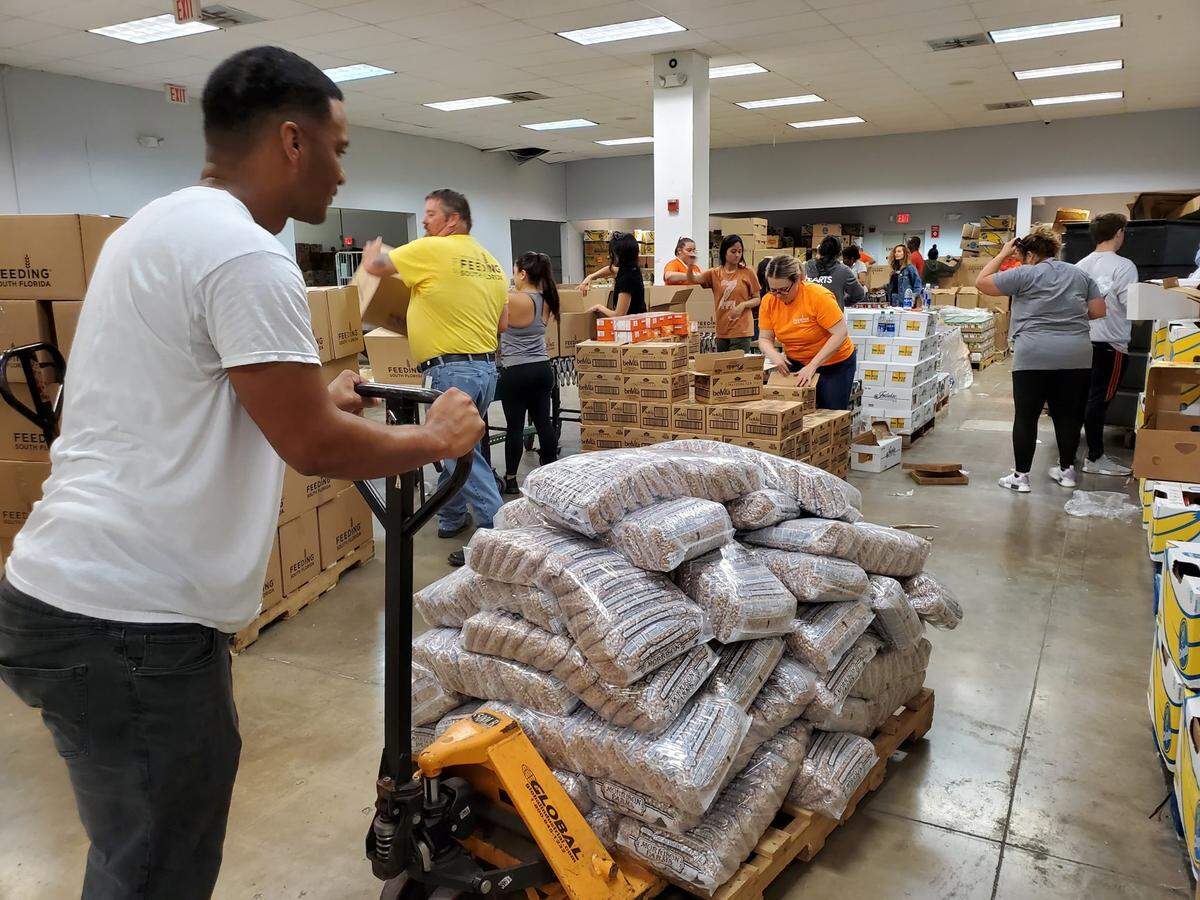
Catholic Charities of the Archdiocese of Miami says it’s talking with local and state government to see where aid is needed and is recommending people stay in contact with their local parishes through the website and social media for updates.
The Archdiocese says its “elderly service” program is still providing meals to those in need who are 60 or older, live independently in their homes and are registered with the program. Instead of serving the food at its 12 senior centers across South Florida, employees are delivering meals to homes.
Jewish Community Services JCS Kosher Food Bank in North Miami Beach remains open. The food bank, which helps provide kosher meals, is by appointment only to keep the privacy of its visitors. Those who are interested should call 305-576-6550 to apply.
The Federation says it’s also looking for healthy volunteers to assist in delivering groceries or medical supplies to members of the community who are at higher risk of falling ill such as senior citizens or are homebound. Those interested in volunteering can email Volunteer@gmjf.org.
Farm Share is hosting several drive-thru only food drives in South Florida to help during the COVID-19 shutdown. To get food, attendees must arrive at the locations in a vehicle that has a trunk or cargo bed.
The nonprofit says it’s also looking to partner with individuals, corporations or municipalities to host additional food drives. Anyone who is interested in more information about the upcoming food drives, wants to donate or partner with Farm Share is asked to visit http://farmshare.org for more information.
Meals on Wheels South Florida provides home meal delivery to homebound seniors who are 60 or older in Broward County. There are a variety of service options including the Older Americans Act funded program (which gives free meals), Complete Cuisine (private pay services) and Medicaid waiver options. The program also has services for emergency meals, food for pets, and grocery shopping assistance.
Those who are interested need to fill out a form at www.mowsoflo.org/home-meal-delivery and wait to be contacted by a social worker for an assessment. You can also call 954-714-6946 to speak with a representative and to fill out the application on the phone.
Miami-Dade County’s “Meal on Wheels” provides home-delivered meals each week to low-income and/or ill individuals who are at least 60 and have disabilities or are homebound. The individual’s spouse may also be eligible for meals along with anyone who is under 60, has disabilities, is dependent for care and lives with an eligible recipient The program provides seven frozen meals each week, along with fresh fruits, milk and other food items.
Call 786-469-4707 to determine eligibility.
I need Internet but can’t pay bills because of COVID-19. What options do I have?

Xfinity and AT&T have opened up Wi-Fi hotspots across the country for the next 60 days so everyone can have access to the Internet for free, including non-customers. To find a hotspot near you visit wifi.xfinity.com and att.com/support/article/wireless/KM1103818/
Verizon and Xfinity have also agreed to waive late fees and not terminate the service of any customer who can’t pay their bill because of the novel coronavirus pandemic.
AT&T has also promised to waive late fees and not terminate the service of any wireless, home phone or broadband residential or small business customer who is unable to pay their bills because of the novel coronavirus pandemic. It’s also giving unlimited internet data to its home internet wireless and fixed internet customers.
T-mobile is giving all current T-Mobile and Metro by T-Mobile customers unlimited data for the next 60 days (excluding roaming), an additional 20GB of mobile hotspot/tethering service, and free international calling to any country listed as a Level 3 during the pandemic. As of Wednesday, the CDC lists the following countries as Level 3: China, Iran, South Korea and most European countries, including the United Kingdom and Ireland.
T-mobile says it is also working to provide customers extra free data up to 5GB per month over the next two months for its Lifeline customers.
I’m an essential employee during COVID-19. Where can I drop off my child?
Select YMCAs in both Miami-Dade and Broward will be providing child care services for kids of first responders and healthcare workers as well as city and county staffers. Some YMCAs have a broader criteria.
To find a YMCA near you and to learn more about the program, visit https://ymcasouthflorida.org/schools-out/
I think someone is trying to scam me. How do I report it?
If you see price-gouging:
The items covered under Florida’s price-gouging law during the COVID-19 state emergency are:
▪ Protective masks used to protect you from others if you are sick
▪ Sanitizing and disinfecting supplies, like hand sanitizer, gel, wipes, surface cleaning supplies and all commercial cleaning supplies
▪ All personal protective equipment, including gowns, booties, gloves and other protective gear.
If you come across a price gouging scam, you can call one of the following:
▪ Miami-Dade State Attorney Price Gouging Hotline — 305-547-3300
▪ State Attorney General Price Gouging Hotline — 1-866-966-7226
Pembroke Pines recommends you take a picture of the advertised prices, receipts, signs or price tags and keep copies of any estimates, invoices, receipts or bills before you report the price-gouging. You should also write down the name and address of the business or individual selling the more expensive item.
If you are able to, the city recommends having previous receipts readily available if it is a place you frequently visit or buy the item from. The city also recommends taking pictures or writing down information about other businesses in the area that are selling the same or similar product with a cheaper price.
You can always check a company’s Better Business Bureau rating, accreditation, customer reviews and any recent complaints at www.bbb.org. The BBB also has a variety of reporting tools you can use to report problems and scams:
If you see a misleading or confusing ad, report it by using the BBB AdTruth page at www.bbb.org/ad-truth/report-a-bad-ad/
If you were scammed or came across a scam, you can report it by using the BBB Scam Tracker Tool at www.bbb.org/scamtracker. You can also check for scams that are popping up around your area.
If you had a problem with a business (did not deliver service or product, broken contract, etc.) you can file a complaint with the BBB Complaint Tool at www.bbb.org/consumer-complaints/file-a-complaint/get-started. Filing a complaint will sometimes help you get the service or product you initially agreed upon or will help you get your money back.
Crisis Intervention Hotlines to know during COVID-19 outbreak
Call 211 for help in connecting to the various health and human resources available in Miami-Dade and Monroe counties, including food banks, financial assistance and domestic violence hotlines. The 24-hour helpline provides information in English, Spanish and Creole. Remember, for emergencies, call 911.
You can also call 211 in Broward County for help finding food, housing, healthcare, senior services, child care, and additional services.
The University of Miami Health System, Baptist Health South Florida and Chrysallis Health are offering telemedicine services for mental health. To learn more about the services, visit https://www.miamiherald.com/news/coronavirus/article241890876.html
The Salvation Army has launched a national hotline to provide emotional and spiritual care to anyone impacted by the COVID-19 pandemic. Those looking for spirtual guidance, local services or in need of talking to someone, can call 1-844-458-HOPE (4673) from 9 a.m. to 9 p.m. to speak with Salvation Army officers who are pastors and emotional-care personnel.
Counselors speak English and Spanish. If you call after hours, leave a voicemail and someone will get back to you. You can also visit https://salvationarmyflorida.org/pray/ to have a pastor contact you.
Greater Miami Jewish Federation Emergency Hotline for emergency counseling, financial aid, food, domestic abuse assistance and other services — 305-576-6550
Domestic Violence Hotline — 800-962-2873
Rape Hotline — 305-585-7273
Suicide Prevention /SAFENET — 305-358-HELP (4357)
Department of Children and Families — 305-377-5773
Elder Help Line (8 a.m.-5 p.m.) — 305-670-4357
This article will be updated with additional resources as they become available. If you know of any services that can help those in need or would like to share how your life has been impacted by COVID-19, email mmarchante@miamiherald.com
This story was originally published March 18, 2020 at 11:34 AM.