
How many people in Florida have coronavirus? We’ve tested too few to say
Phoebe hadn’t paid much attention to the news until her grandmother began to cough up blood.
A week earlier, the 81-year-old had been doing yard work. Now she could barely breathe.
At Brandon Regional Hospital, tubes swirled from her body. Doctors said she had sepsis, secondary pneumonia and an infected mass of pus on her lungs.
Phoebe, 24, just wanted to know: Could it be coronavirus?
The doctors, she remembers, said they could not test for it.
• • •
President Donald Trump said there would be a coronavirus test for every American who wanted one.
The reality in Florida, the third-biggest state in the country, is a knotty and convoluted health care system in which only people who meet specific criteria get a test. Others are left wondering.
Through Saturday morning, Florida health officials had reported testing 699 people for coronavirus. That’s since just before March 1, when Gov. Ron DeSantis announced the first two cases in Florida, or an average of about 50 tests a day.
DeSantis said as of late this week, private labs had started processing tests, meaning more may have been conducted or are pending than the state can report.
In Ohio, a top health official estimated that as many as 100,000 people could already have coronavirus, even though as of Friday doctors had confirmed only 13 infected patients in that state. In Florida, 71 people have tested positive as of early Saturday.
U.S. testing has not matched other countries, a fact that has prompted the president to say he hopes to more widely offer drive-thru testing. South Korea has conducted more than 10,000 tests a day. The United Kingdom has reported testing nearly 38,000 people. As of Saturday evening, The Atlantic’s coronavirus tracking project listed the United States as having tested a little more than half that, just under 21,000 people.But the low number in a state of 21 million people stems from a problem that extends well beyond Florida, evidence that the United States is flunking a crucial assignment.
“The system is not really geared to what we need right now,” said Dr. Anthony Fauci, director of the National Institute of Allergy and Infectious Diseases, appearing before federal lawmakers this week. “That is a failing. Let’s admit it.”
It means even as the governor and top health officials look to reassure Floridians that the risk is low, they can’t say precisely how many people have coronavirus. That makes it harder to figure out a plan to fight the disease. It also is more difficult to know if people are unwittingly spreading it farther.
Many people getting sick right now wonder if they have the coronavirus, but it can be hard to get an answer.
The federal government initially struggled to distribute test kits and even now the number of labs that can do the testing is limited. Partially in fear of running out of kits, health officials set rigid guidelines to allow testing only for those showing symptoms who had traveled to select risk areas or had direct exposure.
At Brandon Regional, when asked about people being denied tests, a spokeswoman said the hospital has followed guidance from the local health department.
“They have very strict criteria in which they are doing tests,” said Debra McKell, spokeswoman for the HCA West Florida Division, on Friday. “But I hear that might be changing any time now.”
Guidelines and confusion about who can get tested may be part of why state officials say Florida has not exceeded its daily capacity for testing.
“None of the folks referred for tests have not been able to get tests,” DeSantis said. “We’ve had capacity to meet the folks who have been referred.”
The Tampa Bay Times talked to several Floridians who wanted to be tested after experiencing a cough, fever or sore throat but who said they were confused by where to go or whether they were eligible. They knew they might not have the disease, which has infected more than 155,000 people across the world and killed more than 5,800. But they didn’t want to take a chance, worried about spreading it in a state with a greater share of at-risk elderly people than any other.
When Jeannine Kwasnik, 58, developed a wheezing cough after a cruise from Port Tampa Bay, she went to her doctor for a test on Feb. 27 in New Port Richey.
“He said, ‘We don’t have access to the testing, we couldn’t test you even if we wanted to,’” she said. Weeks later, she sometimes still has a low-grade fever but has returned to volunteering.
Doctors have said the disease, known as COVID-19, causes symptoms similar to the flu and respiratory infections, mild for some people, but potentially fatal for the oldest patients and those with chronic health conditions.
The state is scrambling to buy test kits and get private and hospital laboratories to help. Residents are left skeptical, frustrated and confused — trying to square travel bans, the cancellation of major sports leagues and the reduction of public life with official reports of fewer than 100 sick people.
• • •
In the United States, early manufacturing issues with the Centers for Disease Control and Prevention’s coronavirus test delayed the disbursement of kits. For Florida, testing started with only the three state public health laboratories.
Guidance of who should be tested has evolved, but early recommendations were particularly strict, focusing on those with symptoms who’d recently returned from China or who’d been in close contact with someone with a confirmed case.
The restrictive guidance may have delayed some people with coronavirus from getting tested.
Among Florida’s first two cases was a 63-year-old Manatee County man who had been hospitalized for five days before he was tested. He had not traveled abroad, the state said, and did not fit the criteria for a coronavirus test until the CDC expanded its guidelines to include patients with respiratory infections of unknown origin.
The CDC has now changed its guidance to emphasize that doctors and others should use their judgment to determine whether someone needs to be tested.
Florida took longer to loosen its guidance, saying it did not have enough test kits.
The state’s current guidance, updated this week, says people who have had close contact with a confirmed case and are experiencing symptoms themselves would qualify to be tested by the state’s public health labs. Others would be eligible if they are part of an outbreak of suspected coronavirus; have unexplained respiratory illness; or traveled to or from a region with widespread community transmission of the virus and are showing signs of the disease. Other cases outside those criteria could go to commercial labs.
But even as the pool of people eligible for testing has grown, limited resources and confusion appear to be keeping some people from being tested. And even those that are tested have to wait a day or more for results.
On Friday, BayCare Health System’s chief medical officer said that “the dearth of test processing sites” is still causing a challenge and “necessitates that health care providers reserve the testing for the highest risk patients.”
More testing would let the community have a better understanding of the scope of the coronavirus spread and therefore how to manage it, Dr. Nishant Anand, the chief medical officer, said in an email.
People trying to get tested here say they have run into difficulty, while politicians like Miami’s mayor quickly got tested and heard results.
Karina Amante Gabriel, 37, said she tried to get tested in Hillsborough County after her children’s school, Farnell Middle, was canceled due to potential coronavirus exposure. She said she had a dry cough and a tingle in her throat, and her husband was about to go visit relatives in New York and New Jersey. Wanting to be sure, she tried a doctor but was told she’d have to wait two to three weeks. She then went to urgent care, where she said a worker told her to go to the county health department. But the office they pointed her to handled a nutrition program for women, infants and children, she said. Gabriel, doubting she had coronavirus anyway, gave up.
“Even if it’s just allergies that I have, it’s better to take that precaution,” she said.
George Papabeis, 62, said he started feeling mild chest congestion and a faintly sore throat this week. He called the Department of Health in Hillsborough County, he said, to report his symptoms, even if it didn’t mean he would get tested. The call taker, he said, did not ask for his address or age but told him to visit his doctor. Papabeis said he does not have insurance and decided to stay inside, just to be safe, even if health officials did not seem that alarmed.
“I’m not going out,” he said. “I’m not going to risk infecting other people.”
• • •
Getting facts about Florida’s testing has been difficult in the couple of weeks since the governor announced the first case.
The tally of cases on the Florida Department of Health’s website has changed format several times, and the number of people who have been tested is not always updated as quickly as the number of positive cases.
Meanwhile, the state has not responded to questions posed by reporters looking for clarity.
Other states experiencing outbreaks, including California and Washington, provided prompt responses. As of Friday, California health officials had tested 1,912 people for coronavirus. Washington by Friday afternoon had tested more than 6,500.
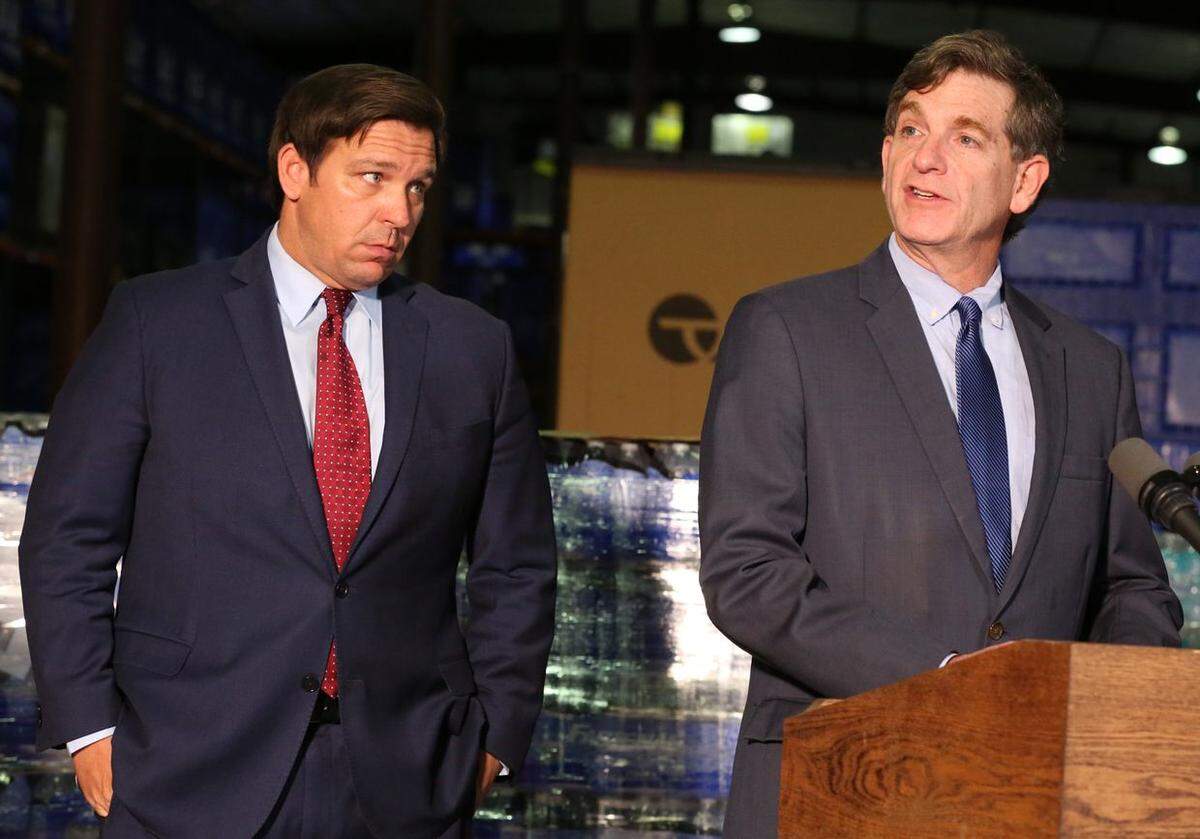
Standing in a state supply warehouse Friday, pallets of water stacked behind him, DeSantis rolled through the status of testing here.
He said he’d directed Emergency Management Director Jared Moskowitz to order 2,500 testing kits, which he said could test up to 625,000 more Floridians for the disease. Each kit carries the potential to do 500 tests, and DeSantis said you need at least two tests per person.
He said Florida’s three health labs in Tampa, Miami and Jacksonville could test 300 patients per day, and that with the new kits, another 50 certified labs could soon be able to handle 100 more tests per day.
Less clear was how many kits the state had before that purchase. Or whether the additional 100 tests per day was for each lab or an overall number.
DeSantis did say Florida is committed to aggressively expanding testing.
Already 1,000 kits had arrived, DeSantis said, and health officials would distribute them first to counties with the highest need, chiefly Broward County, where at least 20 people had likely been infected by Saturday morning.
“If you have the symptoms and a doctor recommends it, then you can receive a test and we want folks to be doing that if they’re experiencing the symptoms,” DeSantis said.
In addition to boosting the number of kits available, doctors and scientists are trying to develop tests that provide quicker results.
Tampa General Hospital has created a modified test that returns results within 12 hours, said spokesman Curtis Krueger, and doctors there can conduct 100 tests per day.
“We have tested a number of patients, and at this time TGH has no COVID-19 patients,” Krueger said in an email.
As an added step, DeSantis said he directed Surgeon General Scott Rivkees to start “sentinel testing,” a process he described as voluntary, involving people with mild symptoms who doctors test to get a better sense of how widespread the virus is.
“There are certainly people out there in our state and throughout the country who have very mild symptoms, who may have a cough for a few days, and they’re not even thinking about calling a physician,” the governor said.
The number of coronavirus patients is going to grow in Florida, DeSantis said, not just because the illness is spreading but because doctors are able to better measure how insidious it already is.
The state reported surges in cases this week as testing ticked up, released in midnight news blasts.
On Saturday, residents awoke to word of the biggest uptick yet, 25 new cases.
This story was originally published March 15, 2020 at 8:30 AM.