Booked on a cruise? Here’s what you need to know in the time of coronavirus
The U.S. State Department has issued an advisory warning U.S. citizens, “particularly travelers with underlying health conditions, should not travel by cruise ship.”
Cruise lines and travel advisors argue the advisory doesn’t take the reality into account. Tuesday ASTA, the American Society of Travel Advisors, will testify before a house committee.
Vicky Garcia, COO and co-owner of South Florida-based Cruise Planners, noted that most cruise passengers and ships have not been directly affected and it remains a viable vacation option for people who are otherwise healthy, so long as everyone follows hygiene protocols.
“Cruise lines have been implementing strict policies as well as working closely with the CDC and WHO (World Health Organization),” Garcia said in an email. “The health, safety and comfort of guests and the crew remain their highest priority. There are hundreds of ships and thousands of passengers around the world who have cruised recently without contracting COVID-19 – and while there are outliers, for healthy passengers, we are seeing many cruise lovers still wanting to go, while maintaining good travel hygiene.”
For consumers, the question is what to do next? Here are the answers to frequently asked questions from travelers planning to cruise from Florida’s PortMiami and PortEverglades. Note that the situation is fluid, so it pays to check back regularly for the latest news. (This story will be updated as conditions change.)
Q: What if I’m set to fly in the near future?
Policies vary by airline.
On its website, American Airlines, Miami’s biggest carrier, noted that it is waiving change fees on nonrefundable fares for flights booked between March 1 and 31. In addition, it will refund fares for flights that have been canceled.
Jetblue has posted on its website that it is waiving change fees for new bookings from March 6-31.
Miramar-based Spirit Airlines Monday night issued a flexible travel policy for passengers affected by COVID-19 that allows them to make a one-time free modification or receive a reservation credit for the full value of their ticket, to be used within 6 months, provided the change is required by COVID-19.
Best advice: Call your airline or check its website.
It’s worth noting that polices can change at a moment’s notice. David Swanson, immediate past president of SATW, the Society of American Travel Writers, suggests taking a screen shot of the airline or cruise policy posted on the website; your cell phone will mark the time, so you can prove that was the policy in effect when you booked.
Q: Do I have to “self-isolate” if I’m coming from outside the U.S.?
It depends on where you’re coming from. Monday, Florida officials revised a policy issued earlier in the day that would have subjected all travelers from outside the U.S. to a two-week self-quarantine, which would left tourists stuck in hotel rooms instead of out on cruises or visiting the sights. Now that policy applies only to visitors arriving from Level 3 hot zones — currently Italy, China, South Korea and Iran.
Q: Under what conditions will cruise lines be making refunds or allowing rebooking?
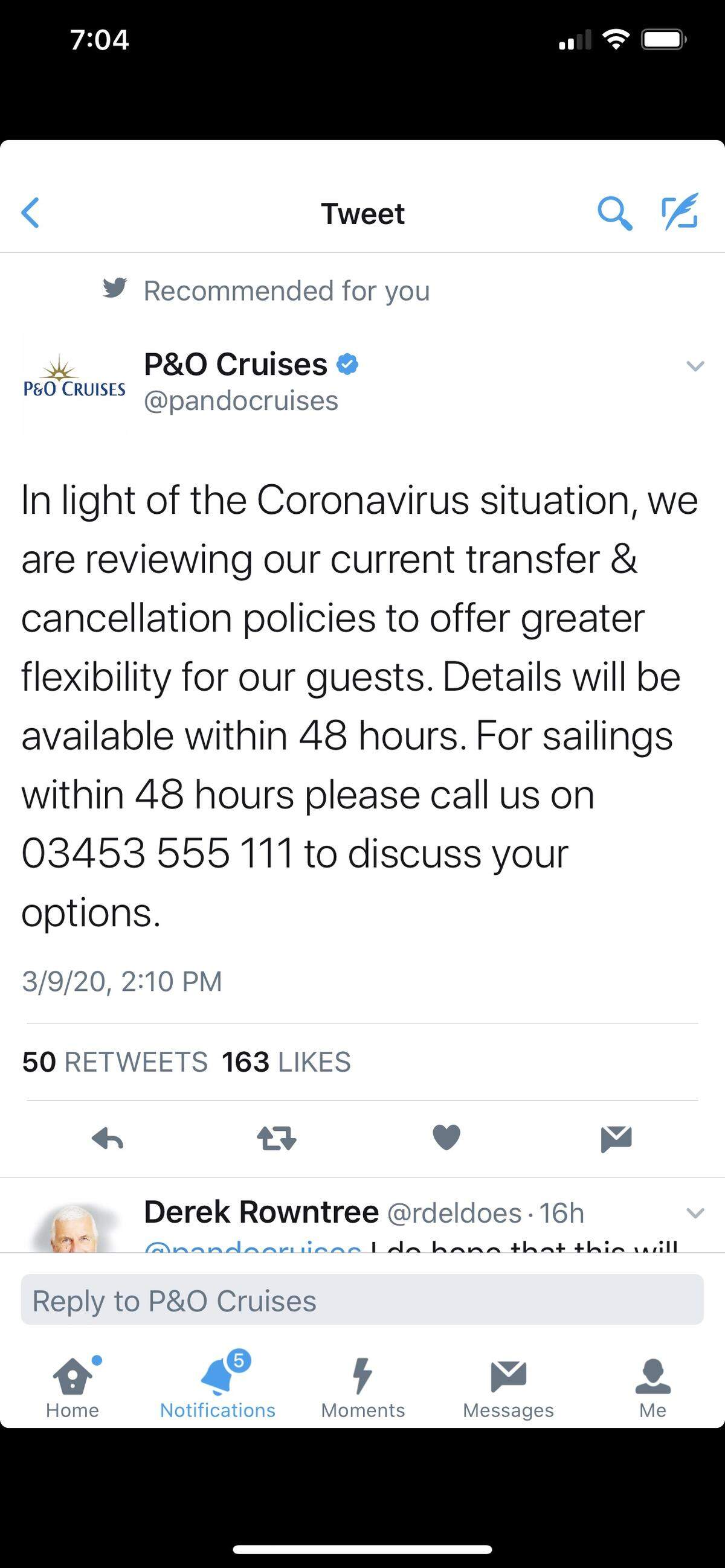
Most cruise lines have enacted relaxed, flexible refund and rebooking programs in response to the coronavirus crisis. The specifics vary from line to line and are being updated frequently. Tuesday morning, for instance, UK-based P&O Cruises, which is owned by Carnival Corp., tweeted that it was reviewing its policies to allow for greater flexibility.
Royal Caribbean’s new Cruise with Confidence policy, for example, allows cruisers to cancel up to 48 hours before sailing. Those who cancel will receive a full credit for their fare, usable on any future sailing in 2020 or 2021. Anyone booking a Norwegian Cruise Line sailing through September 30, 2020 can cancel up to 48 hours prior to sailing for a full credit good through the end of 2022.
Disney Cruise Line will allow cruisers booked to travel between March 6 and May 31, 2020 to change a reservation up until the day before embarkation for full credit on a future sailing within 12 months.
Carnival has a tiered policy that depends on departure date.
Cruisecritic.com has a comprehensive list of refund policies.
Q: Many cruise lines are offering good deals as incentives. How risky is that?
Some are offering free cancellations for new bookings within a specified period. For instance, Holland America Line is letting passengers who book by April 30 to cancel for any reason for sailings before Oct. 15. Azamara’s new policy allows cruisers to cancel up to 48 hours before sailing for cruises on or before July 31, 2020.
Q: Will travel insurance cover my trip if I cancel?
It depends on your specific policy and when you purchased it. Many travel insurance companies disallowed coronavirus as a covered reason for canceling a trip after Jan. 21, when the U.S. announced the first case here, says Julie Loffredi, media relations manager for Insuremytrip.com, which sells insurance by about 30 companies.
But what if you purchased travel insurance prior to Jan. 21 for a cruise that starts after the U.S. travel warning was issued? That will likely depend on your insurance company. Though few travelers noticed, “epidemic” was not included as a reason for cancellation by many insurancers; others have deemed Covid-19 a “foreseeable” event. (Translation: They aren’t paying.)
One big company, Allianz Global Assistance, has decided to loosen up some of its rules and honor claims for emergency medical care for customers who become ill with COVID-19 while on insured trips, to honor trip cancellation and interruption claims for customers who become ill with Covid-19 either before or during their trips, and to provide coverage of nonrefundable trip experiences if they purchased insurance prior to Jan. 22, 2020 for trips that include stops in Mainland China, South Korea or the Lombardy or Veneto regions of Italy, whose trips begin prior to April 1, 2020.
What about those “cancel for any reason” policies? If you bought one of those, you’re in good shape. But look out: Some companies may quit selling them, warns Loffredi.
Q: What extra steps are cruise lines taking to clean their ships? What’s effective?
Royal Caribbean and other cruise lines adhere to a protocol known as Outbreak Prevention Plan, developed at the Centers for Disease Control and Prevention, that calls for enhanced deep cleaning and sanitizing precautions.
Ships are routinely cleaned top to bottom on each turnaround day with electrostatic sprayers that apply a cleaner or disinfectant with an electric charge to fully covers surfaces. In addition, to prevent the spread of novel coronavirus, Royal Caribbean is treating its ships on a regular schedule with sanitizing products shown to prevent the spread of COVID-19. When shipboard venues are closed, they are fogged using the same products.
Q: If I’m on a cruise, what steps can I take to stay healthy?
Follow the same recommendations the Centers for Disease Control has disseminated, cruise line operators say: Practice good sanitation. Wash hands frequently and thoroughly for at least 20 seconds. Use alcohol-based sanitizer. Cover your mouth when coughing and sneezing. Avoid close contact with anyone showing respiratory symptoms. Visit the medical facility if feeling flu-like symptoms.
Q: What should I do if I’m booked to cruise in the next 30 days?
Carnival Corp., Royal Caribbean and other cruise operators have implemented enhanced screening protocols for anyone who boarding their ships. Passengers, crew and others are being asked if they have traveled to heavily affected countries or been in contact with people with COVID-19. They will also be scanned for high temperatures. Those who don’t pass can be denied boarding, so the cruise lines are asking passengers to check protocols at their websites to ensure they can comply. Royal Caribbean says those denied boarding will be compensated.
Q: What if I’m booked to sail this summer or later?
The same protocols as above may still apply, so check periodically with the cruise line or its website for updates.
This story was originally published March 10, 2020 at 7:47 AM.