
By renting their homes, locals will make $24 million as the Super Bowl comes to town
During last year’s Super Bowl in Atlanta, one in four hosts who rented out their homes on Airbnb were doing so for the first time.
It’s safe to expect more of the same this year, as about 61,000 guests fill Airbnb rooms in South Florida during the Big Game week of Jan. 27 to Feb. 3.
With rooms going for an average of $170 per day in Miami-Dade County and $118 in Broward County, there’s definitely big money to be made renting out your home or apartment.
So far, renters are on track to make $23.6 million during the week of the Super Bowl. And about 75% of units in Miami-Dade and Broward counties are already booked.
“Airbnb welcomes the many South Florida residents looking to take advantage of the large economic opportunity around hosting for the Big Game — but cautions that responsibility and safety should be top of mind,” Tom Martinelli, Florida policy director for Airbnb, said in a statement.
If you’re looking to get a cut of the short-term-rental market, Airbnb has some tips for you:
Be mindful of local laws governing short-term rentals
“Many cities and counties require owners or operators of certain businesses to apply for and obtain a license before the business can be operated,” reads a passage on responsible hosting on the Airbnb website. “Many local governments have sections of their websites explaining the business licensing process, and providing you with relevant forms and information. Contact your city or county for more information.”
Prospective hosts living in unincorporated Miami-Dade County are required to obtain a certificate of use from the county. Enforcement of this rule is not consistent, however, and in 2019 hundreds of unregistered homes were for rent on Airbnb.
In Fort Lauderdale, hosts need a business tax receipt from the city and the county, a certificate of registration from the Florida Department of Revenue and a Florida Department of Business and Professional Regulation license.
The vacation rental registration fee alone can run you $350.
In Miami, the city requires hosts to obtain a business license.
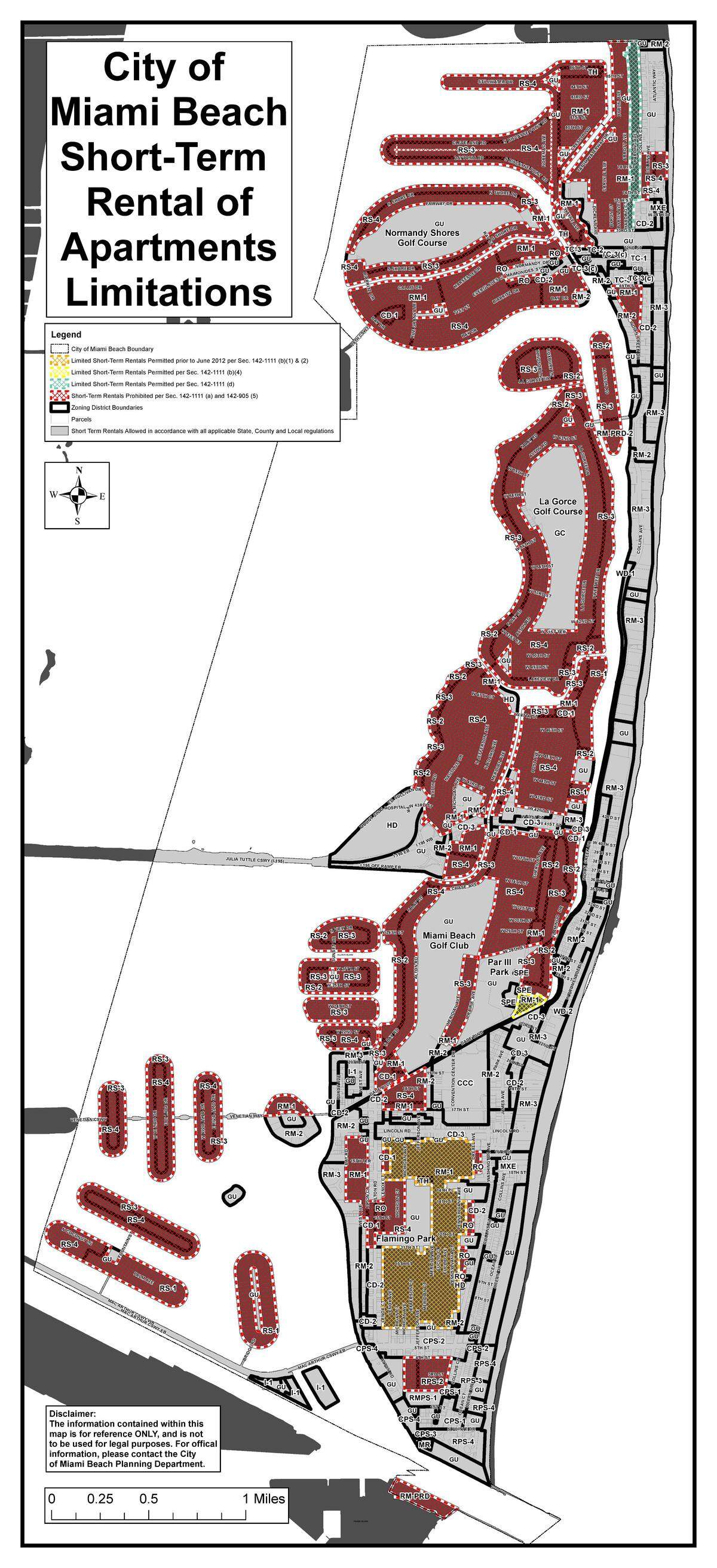
Those trying to rent out their homes in Miami Beach, which will experience an influx of visitors for Super Bowl-related events and parties, will quickly find that the city has the most stringent laws governing short-term rentals in South Florida.
Most of the island city is off limits, unless you want to risk a $20,000 fine from the city.
And once you find an eligible spot, hosts are required to obtain a Florida Vacation Rental Dwelling License and, from the city, a Business Tax Receipt number and Tax Certificate number. The Business Tax Receipt alone can take up to four weeks to complete.
A map embedded below shows much of the city’s eastern reaches and residential areas prohibit short-term rentals. Two pockets of the city, in Flamingo Park and on Harding Avenue, are carved out of the ban.
Short-term rentals are permitted on much of Collins Avenue, but buildings often have rules against them, a city spokeswoman said.
If South Florida hosts another Super Bowl, the rules on Miami Beach may change. In October, a Miami-Dade circuit judge struck down the city’s hefty fines. If the ruling stands — the city is appealing — the City Commission may be preempted from implementing any new laws regulating the market.
Natalie Nichols, a Miami Beach property owner, is the plaintiff in the active lawsuit against the city, which she filed in 2018.
While she has two properties available for rent, on Stillwater Drive and 86th Street, she cannot legally host guests there.
She said the city will be missing out on a big payday come time for the Super Bowl.
“The Super Bowl is a great opportunity for most of Miami-Dade County, but it’s a big waste of an opportunity for Miami Beach,” she said.
Guests who can’t find an Airbnb in Miami Beach won’t head to the more expensive hotels in the city, she said.
“They don’t go to the Fontainebleau or the W, they go to Fort Lauderdale,” she said.
When in doubt, hosts can visit Airbnb’s online portal for “responsible hosting.”
Safety tips for hosts
▪ Communication is key: Airbnb advises hosts and guests to communicate through the platform, both to familiarize themselves with the other and to avoid miscommunications and scams. From its website: “Bad actors may try to take advantage of the surge in activity during big events like this by luring people into offline scams where Airbnb can no longer protect hosts. Hosts and guests can help protect themselves from these scams by staying on the Airbnb platform throughout the entire process — from communication, to booking, to payment.”
▪ Safety Equipment: Make sure your rentals come with working smoke and carbon monoxide detectors, and a fire extinguisher and first aid kit.
▪ Expectations: Set clear expectations for guests about what amenities your home includes, and what conduct guidelines guests should follow. Are parties allowed? How about smoking?
▪ If things go wrong: Airbnb offers 24/7 customer support in 11 languages to assist hosts and guests. The company provides rebooking assistance, refunds and a host-protection insurance program. Learn more on their website. In anticipation of the booking surges in Miami-Dade and Broward counties for the Super Bowl, Airbnb on Wednesday announced it would designate a “specialized customer support team” to focus on addressing booking and other guest or host issues in the area.
Where are guests coming from?
If you decide to open up your home to guests for this upcoming Super Bowl, they may be coming from New York or Buenos Aires. Airbnb released a list of the most common departure locations for guests visiting Miami-Dade and Broward counties for the Super Bowl.
Topping both lists were New York City. Two cities from South America, Buenos Aires and Santiago in Chile, made the top five. Only one city represented by the two Super Bowl teams, Kansas City, cracked the top ten. And both Miami and Fort Lauderdale curiously made the list, which could be a matter of locals booking for relatives or trying to get closer to the action for the Big Game, a spokesman for Airbnb said.
Miami-Dade County
▪ New York City
▪ Buenos Aires
▪ Miami
▪ Chicago
▪ Santiago, Chile
▪ Atlanta
▪ Los Angeles
▪ Toronto
▪ London
▪ Mexico City
Broward County
▪ New York City
▪ Chicago
▪ Buenos Aires
▪ Santiago
▪ Kansas City, Missouri
▪ Boston
▪ Toronto
▪ Fort Lauderdale
▪ Baltimore
▪ Dallas
.JPG)