
Miami mayor drops legal fight against reviving Coconut Grove Playhouse. When will shows resume at historic venue?
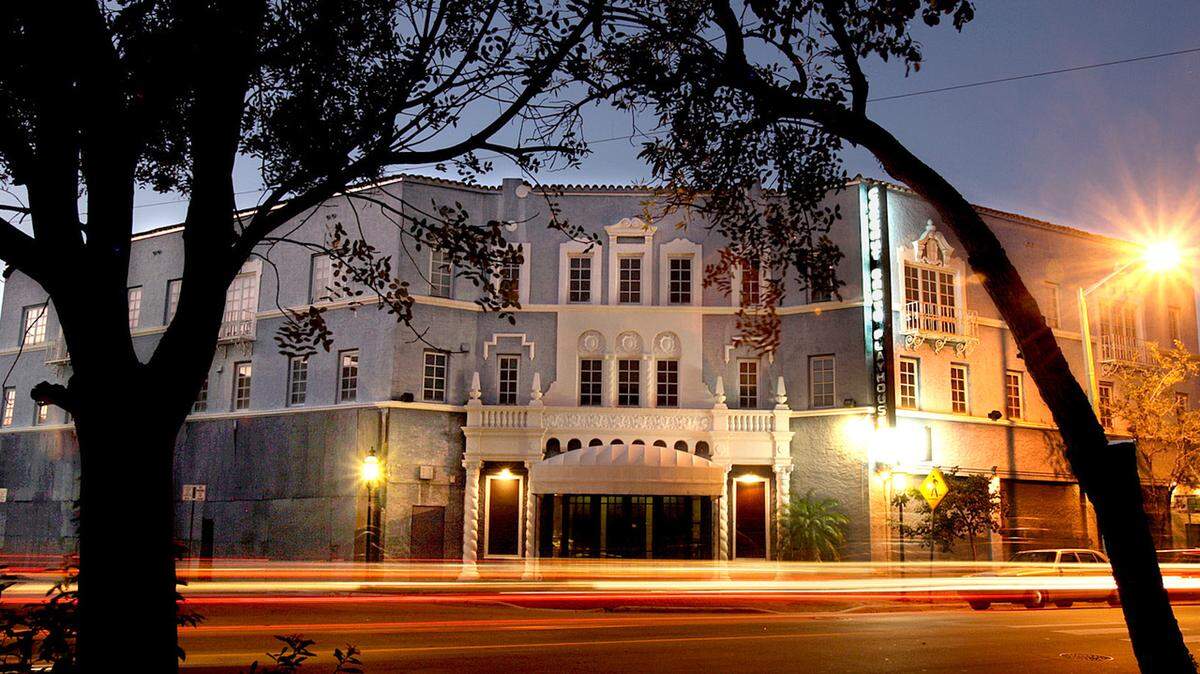
The city of Miami and Mayor Francis Suarez have conceded defeat in a yearslong legal and political battle over the fate of the long-closed Coconut Grove Playhouse, likely clearing the way for Miami-Dade County to revive the legendary theater by partially preserving and replacing its 1927 building.
Sixteen years after the playhouse went dark, county officials say they can now finally move ahead with a plan that could see live theater return to the Grove in three years or so. That would in part entail construction of a $20-million-plus standalone theater in place of the old auditorium at the rear of the historic playhouse, widely regarded as one of South Florida’s chief cultural and architectural landmarks.
Suarez, whose 2019 veto of city commission approval of the Miami-Dade County plan set off three years of litigation between the city and county, opted not to pursue any further legal action by a court-imposed deadline on Monday.
The deadline came and went a month after an appellate court ruled in the county’s favor for a second time. It was the latest in a string of court losses for Suarez in what has been a tangled and protracted legal struggle between his administration and two successive Miami-Dade mayors over how much of the historic playhouse should be preserved.
Unless something unexpected arises to derail it, Miami-Dade officials said the city’s decision to drop its legal appeals effectively means the county plan to remake and reopen the historic playhouse has a green light from Miami officials. The county controls the playhouse, which closed abruptly in 2006 amid mounting financial woes, under a long-term 2014 agreement with the state of Florida, owner of the Grove property.
Miami-Dade Commissioner Raquel Regalado, whose district includes Coconut Grove and who unsuccessfully sought to broker a compromise with the city, said the county had done all it could to come up with what she called a “beautiful and financially viable” plan. She warned city commissioners in recent individual meetings that if the Suarez administration filed another legal appeal, the county would pull the plug on its plan, return the property to the state and reallocate the $20 million set aside for the theater project. She said she’s glad that didn’t happen.
“I’m absolutely thrilled,” Regalado said via email Tuesday. “People are passionate about this theater and I think everyone involved did their best to create a plan that we can all be proud of while respecting the needs of the area.”
Suarez was attending to a personal matter on Wednesday and unable to comment, a spokeswoman said. Miami-Dade Mayor Daniella Levine Cava did not respond to a request for comment.
The county’s complex plan, released at the end of 2016 after a year of planning, calls for preserving and restoring the playhouse’s defining, wing-shaped three-story Mediterranean front building, while demolishing its auditorium. Miami-Dade officials and hired consultants say the auditorium has no architectural value, is obsolete and, with 1,100 seats, is too large to be financially sustainable. In its place, the county intends to build a $23 million, standalone modern theater with 300 seats that would sit behind the historic structure and a new public plaza and park.
That new construction would be paid for with county funds long set aside for the purpose, most of it proceeds from bond programs, augmented by a $2 million grant from the Knight Foundation and money from other sources.
One new question: whether $23 million will still suffice amid construction costs that have risen sharply since the county developed its plan. Jimmy Morales, Miami-Dade’s chief operating officer, said the county will ask its project cost estimators to review the figures, a process he said should take “about a month.” The county has been setting aside capital funds for approved projects to meet those rising building costs.
As part of the plan, a new garage with ground-floor retail would be built on the playhouse parking lot by the city’s parking authority, generating revenue for renovation of the historic front building and theater operations.
The new playhouse would be run jointly by Florida International University and its theater department and GableStage, a highly regarded small company now based at the Biltmore Hotel in Coral Gables.
The county’s redevelopment plan, subject to city building and zoning approvals, stalled amid a series of legal, cultural and political skirmishes that turned into a long-running saga packed with twists and turns.
The plan, first proposed under the administration of Miami-Dade Mayor Carlos Gimenez, split preservationists, Grove residents and theater people, generating strong support from many who agreed a smaller auditorium and a new theater with technical capabilities for modern productions that the old auditorium could not accommodate would be the surest route to financial and artistic success — and without a need for operating subsidies from taxpayers.
But the plan also generated fierce opposition from some who demanded the original auditorium, housed in an undecorated shell with no exterior architectural features, be fully preserved as well. Though the playhouse is protected as a historic landmark by the city, the designation explicitly excludes the theater’s interior because it had been substantially altered several times.
Still, critics of the county plan cited the history of the theater, designed by the famed architectural firm Kiehnel and Elliott, who are credited with introducing the Mediterranean style of design to Miami, in arguing that preserving the playhouse requires keeping and restoring all of its elements.
Originally a movie house, it was later converted into live theater, hosted the U.S. premiere of Samuel Beckett’s “Waiting for Godot” — half the audience walked out during the performance — and saw many a Broadway and Hollywood star strut its stage. For a few years in the 1980s, the playhouse was run by legendary actor Jose Ferrer. But the theater folded as a for-profit venture, and a nonprofit company that followed didn’t fare much better, unable to sell enough tickets to meet mounting bills and closing down for good in the middle of a production in 2006.
One backstage subplot in the drama over its subsequent fate was a long rivalry between Gimenez and former Miami Mayor and then-Miami-Dade Commissioner Xavier Suarez, father of the present Miami mayor.
Two Grove residents sued to stop the county, but their case was dismissed. Prominent attorney and cultural patron Mike Eidson floated an alternate concept for a larger, 700-seat Broadway-style theater within the shell of the old one that would have cost an estimated $20 million more than the county plan. Eidson also touted that since-disgraced actor and director Kevin Spacey was interested in running it.
Eidson, a top political fundraiser for Xavier Suarez, who has since retired, could not come up with the money by a deadline Gimenez imposed, but he continued lobbying for his version of the playhouse behind the scenes.

The city’s historic-preservation board first backed the county plan, but amid the delays and a changed board membership, reversed course and voted against it. City commissioners then overruled the preservation board, narrowly approving the county’s plan in 2019 by a 3-2 vote.
By then, veteran city commissioner Francis Suarez had ascended to the mayor’s post, and he wielded his mayoral power to veto the commission approval, insisting the entire original playhouse building should be renovated, including the auditorium, to fully preserve its cultural integrity. A sit-down between Gimenez and Suarez following the veto only cemented their disagreement. That set off three years of court battles as the county sued to reverse the Suarez veto.
The county’s ultimately successful argument: That following the commission vote, Suarez improperly received and considered comments from critics of the county plan while pondering whether to veto the approval. Because commission votes on zoning matters are quasi-judicial proceedings, they’re subject to similar rules of evidence as civil courts, meaning elected officials can consider only facts and testimony aired during public hearings. By failing to disclose the so-called “ex-parte” communications, the courts ruled, Suarez violated the county’s right to due process.
Suarez won the first round. The city’s attorneys persuaded a Miami-Dade Circuit Court appellate division judge to dismiss the county suit by arguing the issue was moot because Suarez did not solicit the comments. But the Third District Court of Appeal, in a sharply worded decision, overruled the circuit court and ordered it to reconsider the case. Suarez appealed again when the court’s new decision, as expected, favored the county.

The legal end of the road for Suarez and the city came in a 2-1 decision by an appellate judicial panel that rejected the Miami mayor’s latest appeal. The ruling was issued with no written majority decision or comment, though it generated a dissent from the third judge.
In a last-gasp effort, Suarez then asked the appellate court for an extension on a deadline to challenge the latest order. The mayor — who in an unusual move had the city hire a private attorney to represent his office in dealings with the city commission and city agencies in place of the city attorney’s office — dispatched his legal representative, Eddy Leal, to ask commissioners for an OK to file yet another legal challenge on May 12.
Leal did not get a friendly hearing.
Commissioner Manolo Reyes first asked city attorney Victoria Mendez whether the city could split the legal matter in two parts, giving up on the playhouse plan challenge while asking for reconsideration of the validity of Suarez’s actions, an approach Leal backed. But when Mendez and a deputy said the two legal issues were “inextricably” linked, Reyes had heard enough.
Reyes, who had voted for the county plan when it came before the commission, said any further appeals would be pointless and simply “trying to please the mayor’s ego.”
“There are already two courts that said no, so I’m not going to waste time on that,” he said, adding later: “I don’t want to be beating that dead horse any more.”
Commissioner Joe Carollo, who had also voted in favor of the county plan, suggested he would not back further legal challenges by Suarez, either.
“I don’t want the lose the monies, the millions of dollars for this project. Then everyone loses,” Carollo said. “We won’t have the money to rebuild the playhouse or do any kind of project there.”
Leal then withdrew his request without further comment.
Carollo may have been heeding the warnings from Regalado, the daughter of former Miami Mayor Tomas Regalado. She was elected to the county commission in 2020, succeeding the elder Suarez.
During her campaign, Regalado had backed preservation of the full playhouse building. But after assuming office, she said, she realized the county plan was the most realistic option. She got the county’s consultants to embrace modifications to make the garage shorter, add greenery and replace the new theater’s stone facade with wood, but failed to sway critics. When she was rebuffed, Regalado sent a letter to Suarez and city officials asking them for alternative ideas. Suarez never responded, she said.
In all the time he pursued legal challenges, Regalado noted, the city never proposed any alternative options or plan, nor offered funding to support Suarez’s wish for a larger theater project.
“They had zero interest and zero budget,” Regalado said. “So I said no más. It was getting ridiculous.”
Miami-Dade cultural affairs director Michael Spring, who has spearheaded the theater project, said Tuesday in an email to playhouse stakeholders the county has already submitted permit applications with the city to shore up the theater’s deteriorating Mediterranean front building, remove asbestos and demolish the auditorium at its rear.
It’s unclear when work could commence or how long the new theater will take to build, although Spring has said that getting permits, bidding out contracting and carrying out construction could take three years.
This story was originally published June 8, 2022 at 4:25 PM.