
Developers pay road impact fees. County wants to use that money differently

County officials want to radically change the way millions of dollars in fees paid by real estate developers are used to improve traffic patterns and public transit around the community.
On May 11, the Department of Regulatory and Economic Resources (RER) held the first of four public workshops for its “Miami-Dade County Mobility Fee Study,” which aims to replace the current roadway impact fees paid by developers with a mobility fee.
The change would give the county the discretion to spend the funds on things other than road construction and improvement.
Officials say the roadway impact fee has not been significantly updated since it was created in 1988, when it took minutes instead of an hour to drive across the Brickell Avenue Bridge during rush hour.
“Conditions have changed in the county and so have priorities,” said Jerry Bell, assistant director for the planning division at RER. “The idea is to take the impact fee and modernize it from the simple perspective of land use. This is a way to make the roadway impact fee more holistic.”
Currently, roadway impact fees are calculated via a complicated formula that estimates the number of daily trips generated by residential, office and retail developments. But the funds can only be used to improve roads, sidewalks and street drainage systems within the district of each project.
Under the proposed mobility fee, the funds could be used for the full range of transportation options such as pedestrian walkways, bike lanes, the Strategic Miami Area Rapid Transit (SMART) plan and other forms of corridors that provide an alternative to streets and highways.
The Community Planning Act, approved by the Florida Legislature in 2011, granted local governments the ability to determine the most appropriate use and development of land within their jurisdictions. The mobility fee plan, which was born out of that legislation, has been implemented in more than 20 cities and jurisdictions around the state, including Jacksonville, Orlando and Sarasota.
Positive early reaction
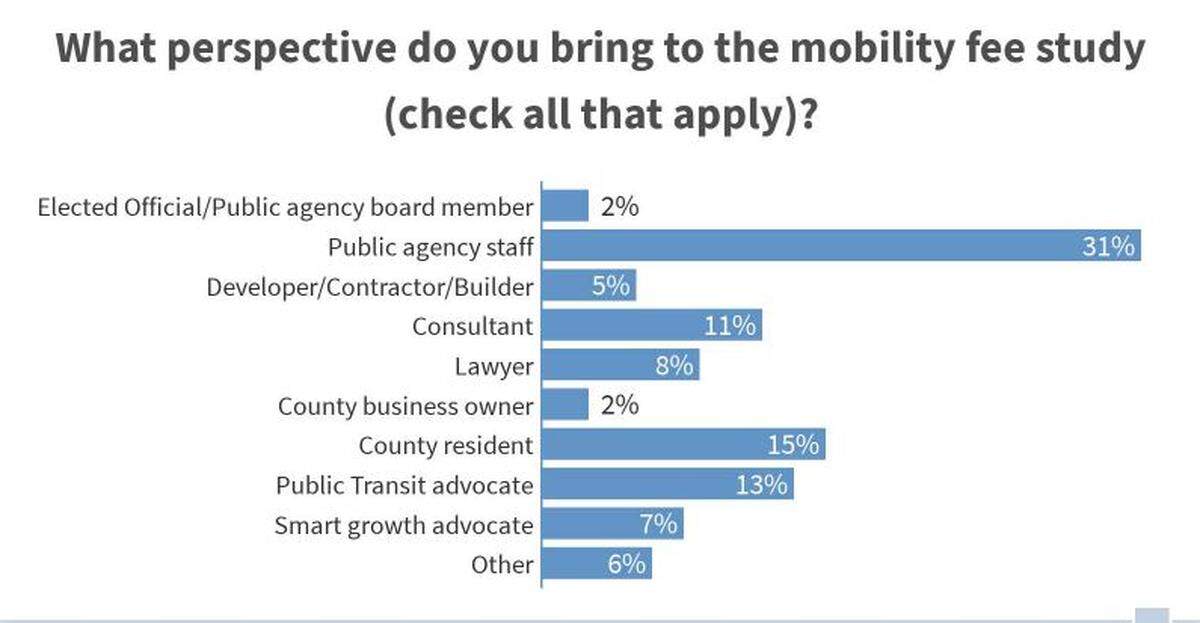
In the study’s workshop, which was held virtually, participants included public agency staff, developers, consultants, community advocates and private citizens. Using online polling, 68 percent of the participants strongly agreed on revising the current roadway impact fee to include multi-modal transportation. Concerns were raised about how the funds would be allocated and the importance of educating the public to the policy change.
Nearly all the participants agreed that mobility fee funds should be used to address travel and transportation issues in any part of the county.
The funds are considerable. For the fiscal year 2016-2017, the county collected $93,338,348 in roadway impact fees. The amount grew to $108,569,287 in 2017-2018 and $117,509,550 in 2018-2019.
According to Bell, the estimated road impact fees for a 100-unit high-rise inside the Urban Infill Area (basically east of the Palmetto Expressway) would be a little over $400,000.
“We have collected all this money using road impact fees but we don’t know where to spend it because there’s nowhere left to pave in the downtown area, where much of the new construction has occurred,” said Vinod Sandanasamy, section supervisor of transportation and metropolitan planning in the Miami-Dade County Planning Department. “We’re not able to put that money to good use right now, and we badly need funds for more transit options.”
The next public workshop in the study has not yet been scheduled. Bell said the study, which officially launched in December 2019, will take two years to complete.
This story was originally published May 15, 2020 at 7:00 AM.
_pp%20Cropped.jpg)