
Are you eligible for these tax credits? See the requirements to get money
AI-generated summary reviewed by our newsroom.
- Unable to translate. Please try again.
- Unable to translate. Please try again.
- Unable to translate. Please try again.
Now that it’s tax prep season, you could increase your refund by hundreds of dollars thanks to a commonly overlooked tax credit.
The earned income tax credit is designed to benefit workers, said Julio Borges, a professor who has taught accounting and personal taxes at Miami Dade College for 23 years.
But one in five people who are eligible for the credit don’t claim it, according to the Internal Revenue Service.
“In the past people left millions of dollars on the table,” Borges said.
The tax credit was created for low-income workers and can result in payments from the government even when the taxpayer owes nothing to the IRS.
Claiming the credit is an incentive to file a tax return because it can increase an IRS refund. It’s especially beneficial for larger families because the credit grows with the number of children.
Who can claim the earned income tax credit
To qualify, a taxpayer must have earned income from wages, salary, tips, or self-employment, be a U.S. citizen or resident, and have a Social Security number.
A worker must be between 25 and 64 years old. And anyone claiming this credit cannot have investment income exceeding $11,950.
In addition to income, family size matters. A single person with no children must have an adjusted gross income below $19,104, and married couples filing jointly must be below $26,214. In that case, the maximum earned income tax credit is $649.
If you have one child and earn up to $50,434, you may receive a maximum credit of $4,328; with two children and income up to $57,310, you may receive up to $7,152; with three or more children and income up to $61,555, the maximum credit is $8,046.
Borges notes that a common error when claiming this credit is listing a child who doesn’t have resident immigration status.
Credits that benefit families
The child tax credit increased to $2,200 in 2025, and the refundable portion permanently rose to $1,700. Starting in 2026 it will continue to increase with inflation.
It’s available for each qualifying child under 17. Previously, the tax code allowed claiming the child credit if the child or dependent had a Social Security number. The new law now requires the parent to also have a Social Security number to claim the credit for a dependent child.
There’s also tax relief for taxpayers who pay for child care — day care, a nanny, preschool or summer camp.
The child and dependent care tax credit is intended for people who work or are looking for work and who have children under 13.
You can claim up to $3,000 in care expenses for one child/dependent, or $6,000 for two or more. This is a nonrefundable credit that reduces tax liability dollar for dollar. To claim it, provide the care provider’s identification number to the tax preparer.
If you plan to file through the VITA program, bring all original documents: Social Security card or ITIN; dates of birth for the primary taxpayer, spouse, and dependents; income forms (W-2, W-2G, 1099-R); Form 1095-A for health coverage; mortgage interest and property tax statements; interest and dividend statements (Form 1099); and retirement distribution documentation (Form W-9).
You should also bring a blank check or your bank routing and account numbers to request direct deposit. If you file electronically and request direct deposit, refunds typically arrive within 21 days or less.
For taxpayers claiming the earned income tax credit and the child tax credit, refunds cannot be issued until mid-February because the IRS must verify the information provided to prevent fraudulent filings.
When can you get free tax preparation help in Miami?
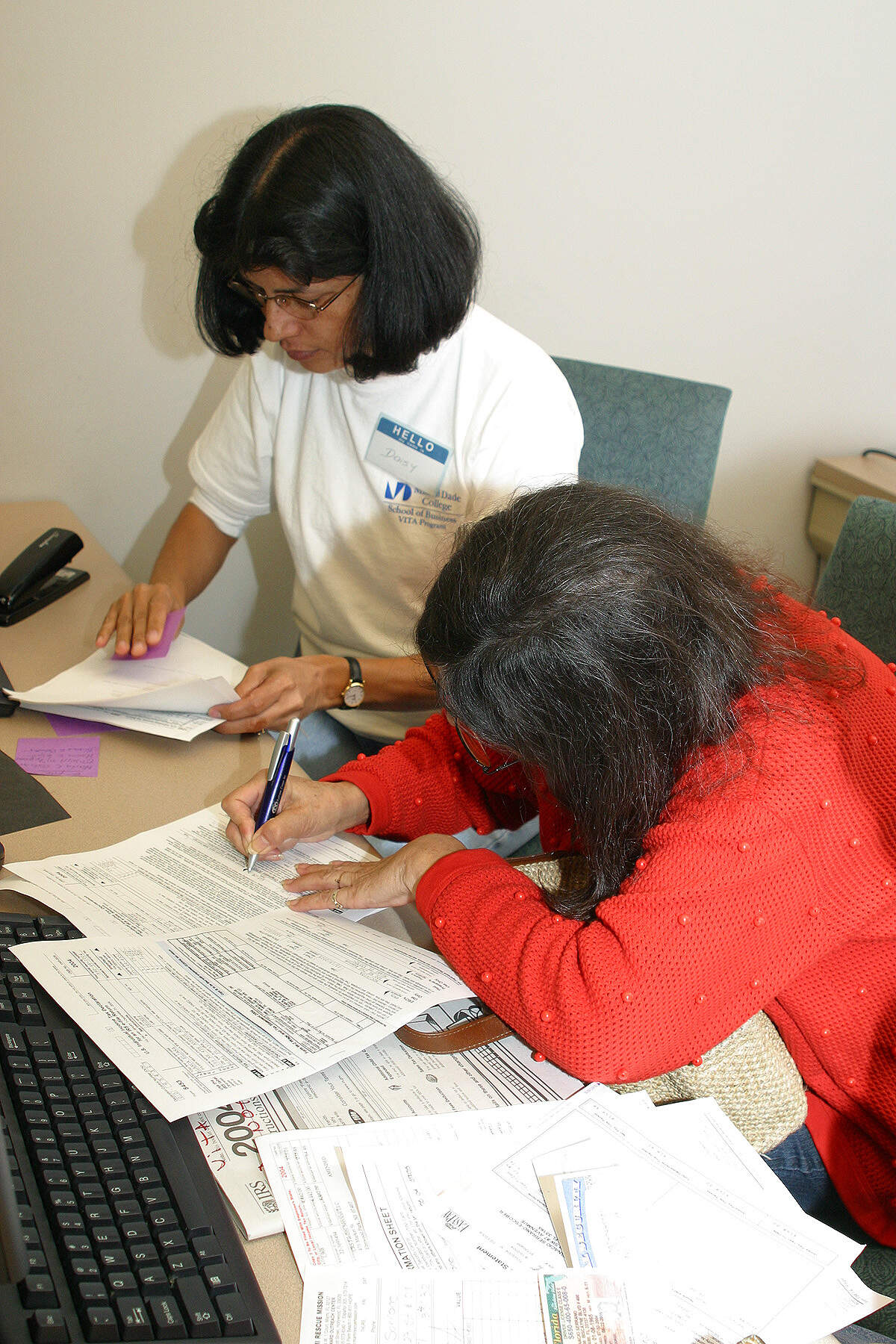
Free tax-preparation services are offered at Miami Dade College through the IRS Volunteer Income Tax Assistance Program, known as VITA.
The program is open from February through early April at six MDC campuses for taxpayers who earned $67,000 or less in 2025.
Trained students and faculty help taxpayers prepare electronic returns in English, Spanish and Creole. The Creole preparers are available at the North and Wolfson campuses.
