
How ‘little booty’ tequila and Cuban rum are changing Miami’s drinking world
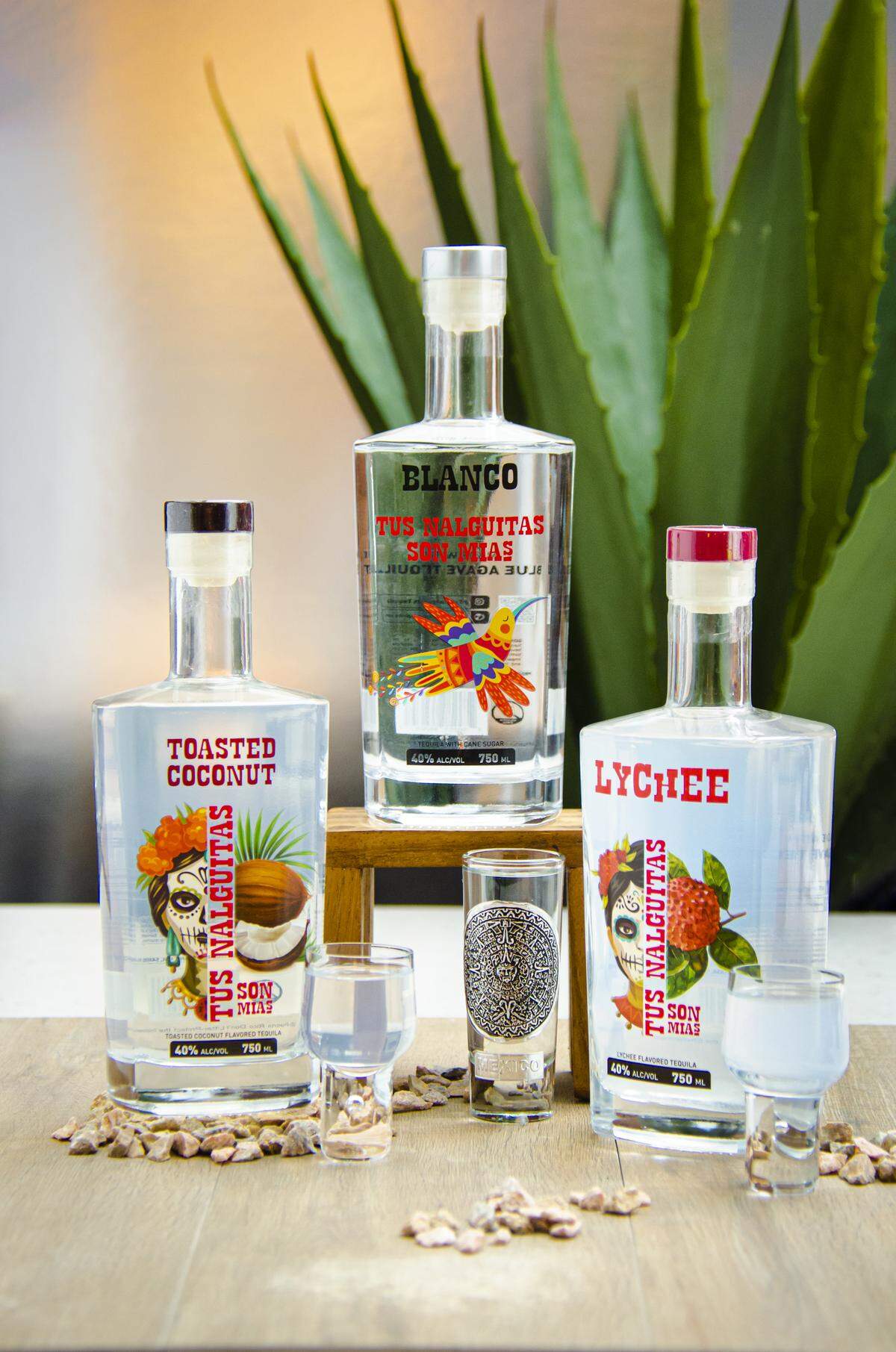
Tony Haber realized his tequila resonated with the public when people arrived at a tasting at a South Florida Total Wine store and burst out laughing after he said: “Do you want to try Tus Nalguitas Son Mías?”
A male customer would put on a tough-guy face that seemed to say: What are you telling my wife?
The brand name translates to: Your little booty is mine.
Then, when the Cuban-American entrepreneur or one of his colleagues at Ocean Cask Spirits shows them the tequila and pours a sample, it becomes a conversation piece — and the couple ask to have their photo taken with the bottle.
“We wanted to create a moment of laughter, because when people drink they’re celebrating something — a wedding, a birthday, a party,” Haber said of the original concept for Tus Nalguitas Son Mías, which comes in lychee, tamarind, hibiscus, toasted coconut and reposado flavors.
The label features one of Mexico’s most popular figures, the catrina, the calavera popularized by engraver José Guadalupe Posada that is now associated with Día de los Muertos and other Mexican celebrations around the world.
A business of renewing brands Cuba
Haber markets Cuban products in Miami whose rights he acquires through the U.S. Patent and Trademark Office. He now also owns his own brands unrelated to Cuba, such as the Tus Nalguitas Son Mías taquila.
The tequila is produced at a distillery in Islamorada in the Florida Keys using raw material from the Tequila region in the Mexican state of Jalisco.
Before the tequila he first launched a wine called Tus Nalguitas, which didn’t take off. He then released canned margaritas in different flavors under the same Tus Nalguitas Son Mías name, which are sold in Miami supermarkets.
He later focused on Tus Nalguitas Son Mías because tequila occupies a significant segment of the beverage market in the United States, which receives 83% of the tequila Mexico exports.
Tequila from Mexico, with a Guatemalan flavor
.jpg "IMG_4651 (1).jpg")
Through his company Ocean Cask Spirits, Haber partnered with Guatemalan businessman Andrés González, who has experience in marketing and beverage import-export. He comes from a family with a long tradition of rum production in Guatemala, including Ron Zacapa.
“I really like Mexico,” González said. “I come from a family of rum makers, but what I drink is tequila.”
González’s great-great-grandfather, owner of plantations and sugar mills, was one of the founders of the liquor consortium in Guatemala from which Ron Zacapa later emerged with its original rope-wrapped finish, a tribute to the bottles countryside workers used to hang from their saddles.
“When we started brainstorming tequila ideas, I said: ‘We have to make exotic tequilas using all the Mexican products that carry so much culture and weight across Central America and bring them to the world,’ ” González said.
He invited Dunia Miranda — who for 22 years was Guatemala’s commercial representative in the southeastern United States and later vice consul in Miami — into the venture.
Now retired from diplomatic work, Miranda became the brand ambassador for Tus Nalguitas Son Mías and today creates recipes and cocktails to pair with dishes that use the tequila as an ingredient.
“It’s a very versatile spirit; it adds notes to traditional recipes and everyone gets excited when you serve it and they ask: ‘This has tequila in it?’ ” Miranda says.
Her tequila-marinated fajitas, tamarind pork, pears and arroz con leche with hints of tequila are popular with Total Wine customers, where she frequently does demos.
“I learned to cook with my mother, who used to tell me: ‘If you don’t know how to cook, they’ll send you back,’ ” Miranda said.
The team is rounded out by attorney Will Trueba, legal counsel on several aspects of Ocean Cask Spirits’ beverage business. For Tus Nalguitas Son Mías, the name poses a challenge in the international market, because some countries have rules that bar registering names that could be considered “scandalous.”
They didn’t face that obstacle in the United States because the Supreme Court eliminated in 2019 the prohibition on using brand names that might be deemed “immoral” or “scandalous,” Trueba noted.
Guayabita del Pinar in Miami
.JPG "68effbc3-841c-491f-b83d-61fc4710d860 (1).JPG")
In his work recovering brands that hold emotional and nostalgic value for Cubans — many of which were created by businesses confiscated by the Cuban regime after 1959 — Haber has just launched Guayabita del Pinar in Miami.
Originally from Pinar del Río, where the shrub that produces the small guava used for this liqueur grows, Guayabita del Pinar is one of Cubans’ favorite drinks, especially in its sweet variant. It was born in 1892 at the Casa Garay distillery in Pinar del Río, founded by Basque merchant Lucio Garay Zavala with partners.
The Guayabita del Pinar made in Miami by Haber also comes in seco and añejo styles and is sold at Total Wine stores in Florida, Georgia, South Carolina and Tennessee.
Cuba has allowed many trademarks to expire in the United States in order to form other companies outside the island, sometimes in partnership with companies from other countries, selling the brands in the United States and violating the U.S. embargo on Cuban products, Haber explained.
The Cuban government let the Guayabita del Pinar trademark lapse in 2010 and he acquired it in 2023.
In December year, President Joe Biden signed a law prohibiting recognition in the United States of trademarks confiscated by the Cuban government.
Backed by that decision, Haber plans to expand his company’s beverage portfolio with the launch of the rums Arecha and Santero, the latter based on tafia, a popular aguardiente also used in Yoruba religious ceremonies.
“The rums will resurrect the story of Cuba from 60 years ago,” Haber said, adding that the goal is “to recover for Cubans what was once stolen from them.
“It makes no sense for a government to keep stealing if we have the opportunity to take back from the government what it once took from the Cuban people.”
