
Miami-Dade tax collector vows to crack down on businesses violating Cuba embargo
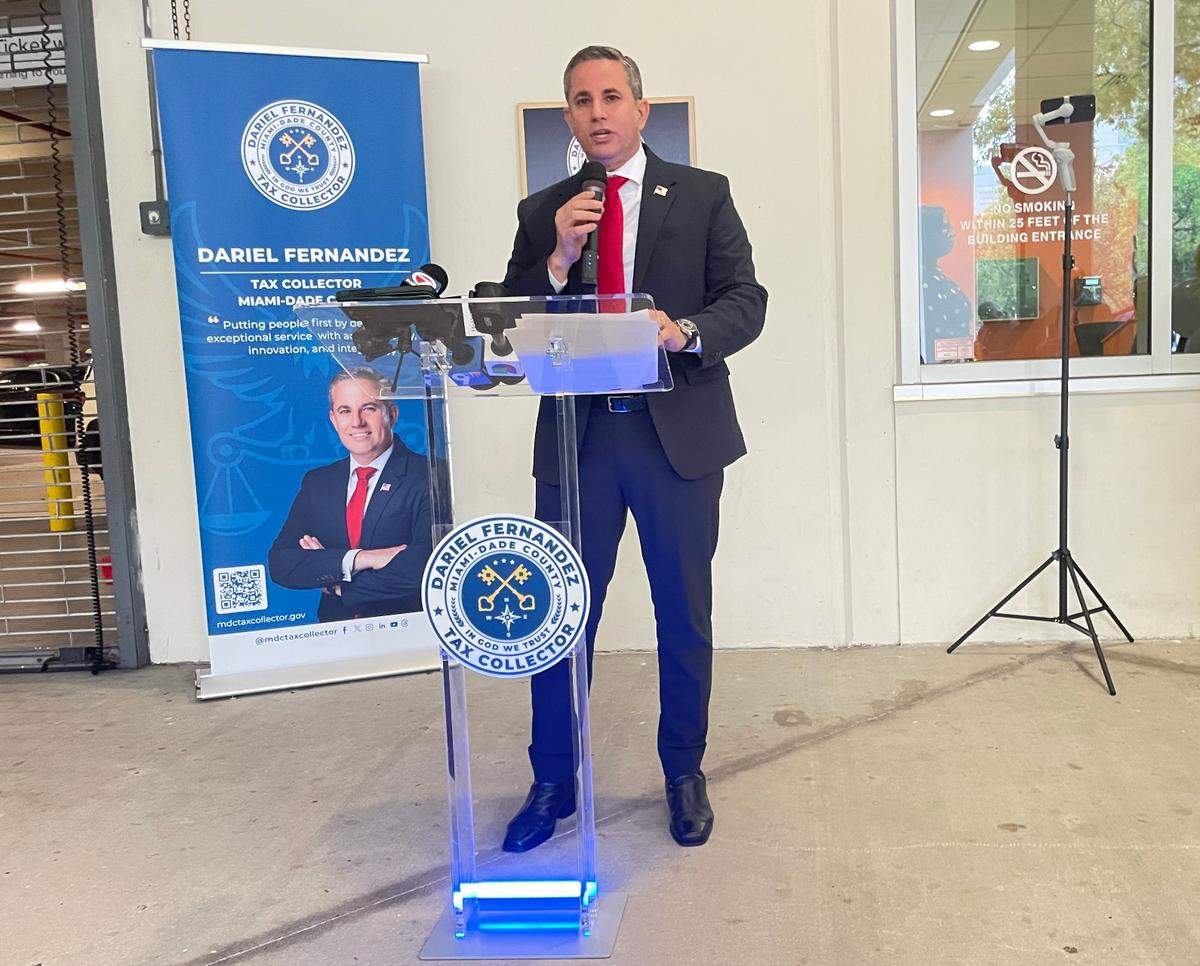
The first elected Miami-Dade county tax collector has issued a stern warning to local businesses violating U.S. sanctions on Cuba.
“I will be cracking down on businesses that illegally engage in commerce with the murderous communist regime in Cuba,” Tax Collector Dariel Fernandez said in a statement. “We know who they are and where they are, and we will take every necessary action to protect our community and uphold the rule of law.”
Citing a 1993 Florida law statute and a Miami Dade County ordinance, Fernandez said his office will revoke or refuse to renew local business tax receipts, formerly known as occupational licenses, for people or entities engaging in unauthorized business activities with Cuba. These are documents required to conduct business in the county.
Fernandez announced he will start sending letters to violators in the coming weeks, “upon written confirmation from the Office of Foreign Assets Control that the entity lacks a valid federal license or has had such license revoked or suspended without successful appeal.” OFAC is the Treasury Department agency that enforces several sanctions programs, including the U.S. embargo against Cuba.
“If you do not comply, our enforcement unit will begin closing these businesses in any part of Miami-Dade County,” the statement adds.
What Florida law says
Fernandez told the Miami Herald that he could not explain why this state provision hasn’t been enforced in the past. The Florida statute says, “Any local governing authority issuing a business tax receipt to any individual, business, or entity under this chapter may revoke or refuse to renew such receipt if the individual, business, or entity, or parent company of such individual, business, or entity, is doing business with Cuba.”
Fernandez, a Cuban-American man who has been involved in activism promoting a democratic transition in Cuba, said he has been in touch with the State Department, the Treasury, and members of the Miami Republican congressional delegation on the matter. He did not elaborate on the details about how his office will carry out the plan but noted that the office already has its own investigating unit to ensure businesses comply with laws and regulations.
“This is an issue that affects more than just Miami-Dade County and affects many exiles. How can these companies continue to provide oxygen to this dictatorship?” he said in an interview with the Herald.
Letter from U.S. Rep. Salazar
His announcement follows a letter sent by Miami Republican Congresswoman María Elvira Salazar last month asking the Department of the Treasury to investigate recently created companies in South Florida, offering services such as tourism packages, logistics, door-to-door shipping and car sales “whose principal purpose is the evasion of sanctions on the communist regime in Cuba.”
Salazar’s office did not say whether the congresswoman had flagged some companies for investigation but an office spokesperson said they have received many complaints by members of her constituency.
The drive to crack down on businesses tied to Cuba comes at a time when changes in the regulations and the growth of a private sector on the island have driven an increase in U.S. exports to Cuba.
The U.S. embargo generally prohibits trade with Cuba. But certain activities have been authorized by Congress, including the export of food and medicine, as well as humanitarian donations. The Department of the Treasury can also allow specific activities, like selling cars to Cubans on the island, with a license. Tourism remains prohibited.
U.S.-Cuba marketplace
The Biden administration broadened a license exception that authorizes exports to Cuba if they are sold to the Cuban private sector or to Cubans on the island for their personal use. But the items cannot be used “primarily” to generate revenue for the state or “contribute to the operation of the state, including through the construction or renovation of state-owned buildings.”
Many Cuban private enterprises have turned to the U.S. market to import supplies and goods. Data compiled by the U.S. Cuba Trade and Economic Council shows that U.S. companies exported $38 million in food and agricultural products and $12 million in used cars in June, the most recent available data.
But some local politicians and Cuban exiles have expressed fear that many, if not all, Cuban private enterprises, and U.S. companies that supply them, are somehow connected to the Cuban government or government officials, or benefiting them.
In her letter, Salazar said that many of the new companies she is flagging are owned by “regime accomplices and that “in the communist totalitarian system in Cuba, nothing can be imported to the island without the regime taking its cut.” The Cuban government requires all private enterprises to use state importing agencies as intermediaries.
“For example, in the case of Jorge Javier Rodríguez Cabrera, who was recently detained by U.S. Immigration and Customs Enforcement, it has been revealed that he is a close associate of one of Raúl Castro’s grandchildren,” Salazar mentioned in the letter. “It is not unthinkable that many of these companies have been created with the knowledge and consent of the communist regime.”
The Trump administration has vowed to increase pressure on the Cuban government. Senior administration officials have told the Herald that the administration intends to continue supporting the Cuban people and allowing humanitarian aid to flow to the country.