How do you get 5,000 tech nerds to relocate to Miami? ‘Hack Week’ may have the answer
Earlier this year, Tyler Cowen, an economist and columnist for Bloomberg, wrote after a visit to Miami that while he was “surprised” at the strides the city had made toward becoming a tech hub, it still fell short. For one thing, Cowen said, “the city does not have much of what I would call ‘nerd culture.’”
Soon, that may no longer be the case.
This week saw about 400 tech professionals, most of them software engineers, descend on the Magic City for Miami Hack Week, an initiative organized by a group of like-minded locals and envisioned as a way to plug the hundreds of new job openings Miami’s tech boom has created.
“Miami Hack Week represents a trend that other cities would kill for,” Brian Brackeen, general partner at Lightship Capital, a longtime fixture of Miami’s tech scene, and a Hack Week demonstration day judge, said in an email. “Organic groups popping up to organize, then presenting a bold hackathon idea, and having that idea supported strongly by sponsors.
According to LinkedIn, there are now nearly 2,000 job openings for software engineers in the Miami-Fort Lauderdale area. Another recent study found Miami had seen the biggest jump in tech job growth among large metro areas (though not among all metros) in the second quarter of 2021.
More freedom
On Wednesday evening, more than a half-dozen software engineers huddled over laptops in one of the dozen houses organized for the week. This one, located in Little Haiti, was sponsored by QuickNode, a Miami-born blockchain technology company that is now backed by SoftBank’s SB Opportunity Fund and Alexis Ohanian, founder of reddit and currently founder at Seven Seven Six venture group.
That day, the “devs,” as they are known in tech parlance, embarked on a broad-ranging discussion on the future of cryptocurrencies, blockchain (QuickNode continues to add support for blockchains beyond Bitcoin, including one called Solana) and what is being called Web 3.0. That latter concept has been variously described as a more decentralized, trustless and open version of the internet that will allow users to bypass intermediaries, whether it be so-called Big Tech, governmental entities or current payment processors.
Miami, they agreed, is poised, at a minimum, to become a crypto hub by nature of being removed from the influence of Big Tech and its inclination toward a more free-market world view.
“More and more, companies and startups are here,” said Amol Shah, QuickNode’s Vice President of Revenue. Although Shah himself is, for now, continuing to reside in New York. “That points to the fact that this is an emerging tech hub. And for crypto, in some ways it’s uniquely suited — there’s a libertarian streak in crypto that you don’t get in California, in New York, you do feel like it’s more in keeping with here [in Miami].”
And it attracted people like Phoebe Yao, a Stanford grad and California resident looking to grow her new startup, Pareto, a project management startup.
“Miami is a breath of fresh air,” Yao said. “I live a nomadic lifestyle and had never been to Miami before — but now it’s going to be a major stop for me.”
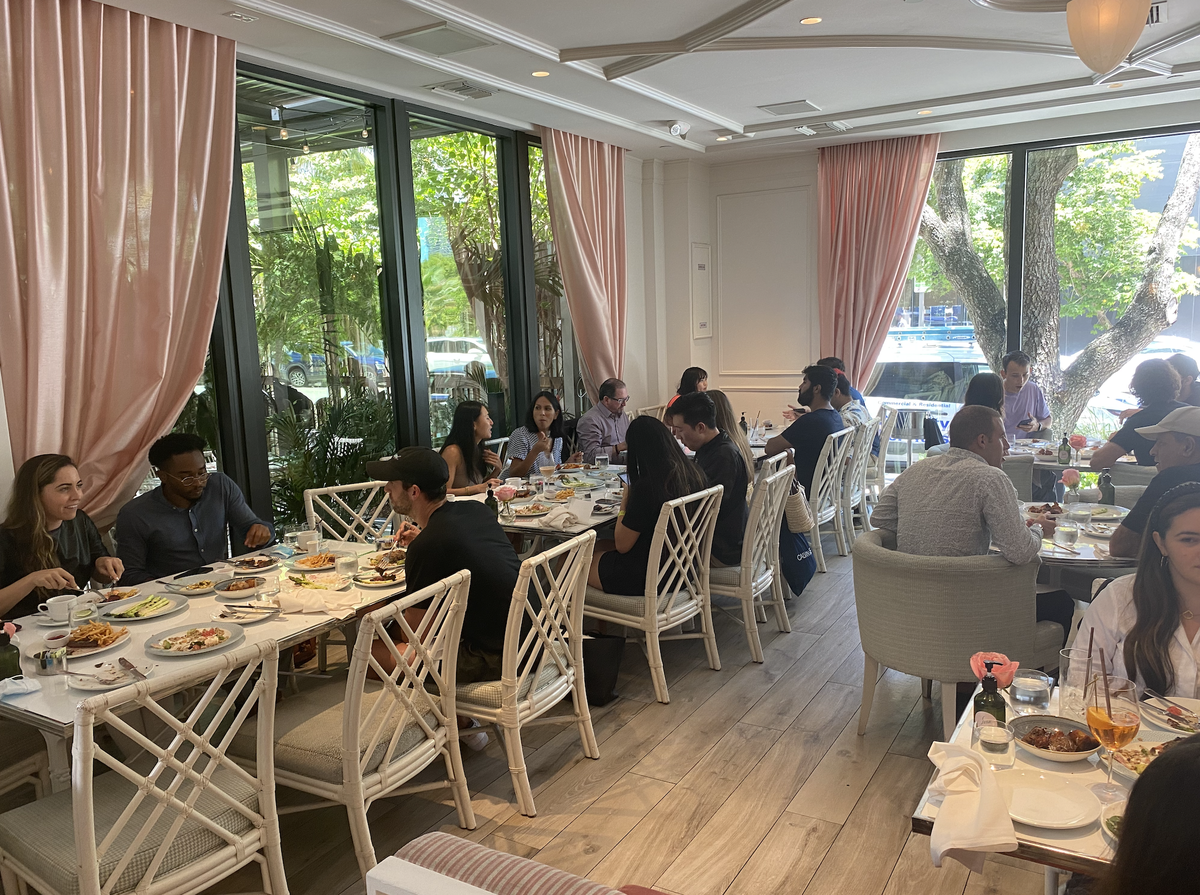
Hack Week started out with ambitious goals — co-organizer Dave Fontenot previously told the Miami Herald he hoped to bring 5,000 software professionals here in the next few years — and no expense was spared in showcasing the best of Miami. At least two of the homes hosting “hackers” were on Venetian Island, and sponsored events have included ones at upscale brunch spot Swan, courtesy of the Design District, parties at nightclubs and an after-party event sponsored by Formula One.
Not surprisingly, Hack Week has the endorsement of Miami Mayor Francis Suarez, whom many of the newcomers credit with selling the city as a new tech destination. In a written statement, Suarez said: “#MiamiHackWeek highlights the best of what’s happening in our Miami Tech ecosystem especially around engineering talent. I am proud of Ja’dan Johnson, Lucy Guo and Dave Fontenot for bringing together local founders and new folks to create a welcoming environment for technical talent through these very Miami style Hack Houses. 400+ engineers have chosen to spend the first week of August in Miami building at #MiamiHackWeek and this is just year one.”
Palantir controversy roils Miami tech Twitter
Among the most well-known sponsors of the week is Palantir, a big data firm based in Colorado. Palantir has come under fire in the past from left-leaning activists for working with U.S. Immigration and Customs Enforcement; Palantir’s involvement in Miami Hack Week led some Miami natives to tweet they would not be participating in the event.
A Miami Hack Week representative declined to comment on Palantir’s involvement. A Palantir representative did not immediately respond to a request for comment.
A source familiar with the Palantir arrangement who requested anonymity to speak freely said the firm was brought on at the last minute to plug a budget hole, and pointed out that almost everyone involved in organizing Miami Hack Week is either an immigrant or from an immigrant family.
Changing city
For a region whose existence has long been premised on fun-and-sun, the nearly overnight shift in its tech trajectory is readily apparent. Ernesto Freyre, a Cuba native who has lived in Miami for nearly three years, said you can now visit any cafe or Starbucks and see people coding.
“That was unheard of two years ago,” he said.
As a result of the pandemic, location became a less relevant factor for work, Freyre noted. So for workers with the ability to work from anywhere — a set-up suited to the tech industry — Miami, with its favorable business and meteorological climates, became a destination of choice.
Freyre’s own situation is indicative in another way: He continues to work remotely for a California-based company. It shows that up until very recently, anyone with Miami connections had to look west, or north, if they wanted a tech job. Indeed, other individuals show the transition toward a more job-friendly landscape is not yet complete — and the need for greater outreach among recent tech arrivals to the longstanding community.
Kevin Amézaga, a 19-year-old coder, said he has been turned away by dozens of employers hiring for Miami jobs since he began looking in May. He believes that the bar has now been raised beyond what is even possible for someone who grew up in the area and lacked the means to travel outside the region to pursue an internship.
“I think that a lot companies moving here are looking for something different than what Miami has,” Amézaga said. “You have companies moving from San Francisco or New York, and they expect tech workers to have backgrounds in major companies that we don’t have in Miami, like Google or Dell, when most Miamians don’t have access to those unless they can fly across the country.”
But he may not be out of a job for much longer.
Michael Melikian is co-founder of 305 Ventures and a recent Miami transplant from California. 305 Ventures is focused solely on investing in and hiring for companies that are in Miami, or ones that plan to be. The company has already invested in 25 Miami-connected companies since it was launched earlier this year.
“One thing we’re all looking for is great engineers — whether you’re looking to hire one employee or fill out an entire team,” he said. “We’ve been focused on having one-on-one meetings ...and building a database of awesome engineers.”
For Brackeen, something like Miami Hack Week is unique.
“[The organizers] have attracted a diverse set of engineers from Hialeah to Houston… all excited to come to Miami to hone their craft,” he said. “We are writing a new playbook on ecosystem development.”
This story was originally published August 6, 2021 at 6:00 AM.