Safety steps for Lyft’s self-driving rides
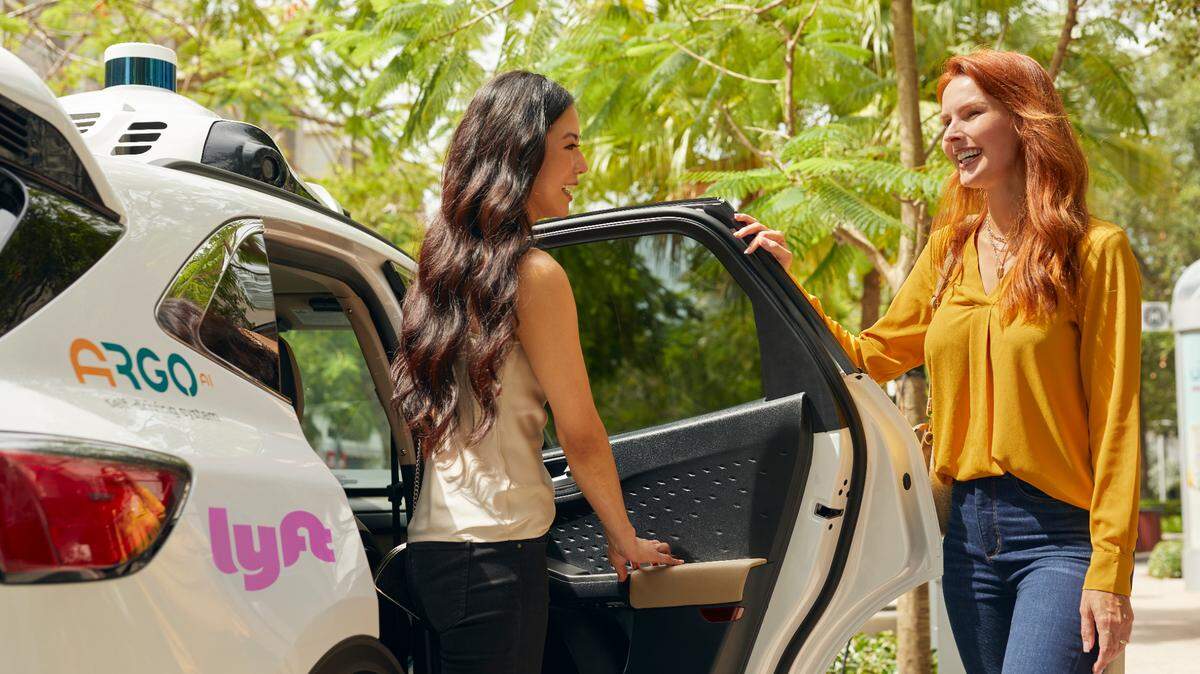
Hailing a Lyft self-driving ride? First of all, you won’t be alone in the vehicle.
Despite the announcement Wednesday that Ford, Lyft, and Argo AI will be teaming up to bring so-called robotaxis to select parts of Miami-Dade later this year, passengers will still notice that there’s a driver in the front seat.
According to the Society of Automotive Engineers, that means the technology remains short of the fifth, or highest, level of automation that sees a car operating completely autonomously. An Argo AI spokesman said Level 5 is not needed to be reached to deploy its technology commercially, and that Argo AI-enabled vehicles are already capable of operating at Level 4, meaning they can perform all driving tasks without humans under specific circumstances.
Instead, Lyft’s Fords will still come with a safety driver who will mostly be letting the car drive itself, but who can instantly grab the wheel if the technology misfires — or, more likely, if the car encounters one of South Florida’s numerous and notorious unpredictable drivers. The cars will also have on board an additional Argo AI employee monitoring the technology. According to Reuters, the first truly driverless cars aren’t expected to launch until 2023.
That level of sophistication, wrote Argo AI founder and CEO Bryan Salesky in a blog post published Wednesday, “requires validating that the technology is achieving a level of self-driving performance deemed safer than what we see on the streets today.”
Salesky says that for now, his team has begun been building a database of public local collision data from multiple sources in order to measure the performance of its technology versus human drivers, on a street-by-street basis.
“Our partnership with Lyft will add a critical layer of knowledge about the safety, or lack thereof, of our streets,” Salesky continued. “Armed with this information, we’ll be able to measure the performance of the Argo self-driving system on specific streets, and to create what we call a ‘geonet,’ or a network of streets, where we can safely operate driverlessly.”
In other words: The companies will let its robots take over once they are deemed safer than human drivers. And we’re not there yet.
This story has been updated to clarify that only Argo AI employees are operating the test fleets.
This story was originally published July 21, 2021 at 12:23 PM.