‘What kind of scam is that?’ How a high-flying, big-spending money manager landed in jail
The weapons allegedly used in one of the biggest bank heists in recent history were bogus investment agreements, according to federal prosecutors and the banks who say they were ripped off.
Wellington, Florida private equity manager Elliot Smerling faces criminal charges for allegedly using falsified financial documents and fake pledges by the endowment fund at New York University and multiple major financial institutions to obtain a $150 million line of credit from Silicon Valley Bank earlier this year on behalf of his firm JES Global Capital.
Smerling used lists of purported investors in his fund, including New York Mets owner and hedge fund billionaire Steve Cohen, the University of Miami’s endowment fund and a private equity firm co-owned by NFL Hall of Fame quarterback Steve Young, to win approval of more than $200 million in loans from multiple banks, according to court documents.
South Florida has attracted many fraudsters and con men, but Smerling’s alleged scheme stands out for its scope and brazenness.
An extensive review of criminal and civil court filings, public records and interviews with former colleagues, neighbors and purported investors suggests that Smerling’s alleged falsehoods could extend far beyond the criminal charges he faces. They raise questions about whether Smerling’s supposed multibillion-dollar private equity empire — and key details of his biography — were more than a mirage.
The Miami Herald contacted more than a dozen financial institutions and individuals who Smerling indicated had invested millions in one or more of JES Global Capital’s funds and didn’t find a single purported investor who said they had invested a nickel.
Fredrick Guess, a New Orleans painter originally from Florida who Smerling said had invested $20 million in his funds, said he recalled getting paperwork related to a supposed investment in the fund a few years ago but had thrown it in the trash.
“I got a FedEx envelope, I don’t know how long ago it was, saying I needed to wire him $10 million and I said, ‘What kind of scam is that?’ ” Guess recalled.
A spokesperson for Mets owner Cohen said that neither he nor any related entities had ever invested with Smerling. Same for BNY Mellon and Santander Bank, all pegged by Smerling as investors in materials he submitted to the banks, according to court records.
Steven Berrard, the former CEO of AutoNation and Blockbuster who Smerling claimed had invested $13.5 million in three of his funds, told the Herald earlier this year, “Never invested in any of his funds, didn’t know anything about him.”
Private equity firms typically pool cash from investors to buy large stakes in privately held companies whose performance they believe they can improve, with the goal of eventually selling those companies at a higher price or taking them public and profiting from the public offering. These firms have increasingly relied on low-interest loans from banks to help them better time their investments and, in the process, reap higher fees.
But It isn’t clear whether Smerling’s funds actually invested in any of the companies they claimed to have. His funds indicated in materials they provided to the banks that they had invested in businesses that were actually out of business or owned by other companies at the time of the supposed investment, according to court records. One of the funds told Citizens Bank that it had invested $9 million in NextLife Recycling in 2018, several years after the company appears to have gone out of business. There’s no indication the company has since resumed operations. Another of Smerling’s funds told Silicon Valley Bank it had invested $35 million in Midwest Cellular, a network of AT&T wireless stores, in 2018. Midwest Cellular was acquired by GameStop in 2016, and the network of stores was subsequently acquired by Prime Communications in 2019.
Smerling is currently in federal custody in New York, held without bail as he awaits trial on criminal charges of wire fraud, bank fraud and aggravated identity theft.
Subsequent lawsuits by Silicon Valley Bank and Citizens Bank contend that he presented fake lists of investors and fake financial documents to win approval for more than $200 million in credit. Some of that money was to repay an earlier line of credit from the Japanese bank Sumitomo Mitsui Banking Corporation, according to court filings, though that bank hasn’t indicated exactly how much credit it extended to Smerling.
Smerling’s attorneys declined to comment for this story. He pleaded not guilty to the charges last Friday. A trial date will be set this week.
Smerling was first arrested in South Florida on Feb. 26, but his indirect transfer between South Florida and New York included more than a month in the Grady County Jail in Oklahoma, where he contracted COVID-19 during what was supposed to be a limited stopover.
If convicted, Smerling faces the prospect of more than a decade in prison and more than $100 million in fines. Many of his assets have been frozen as courts pick through Smerling’s finances trying to secure money that the banks say was obtained fraudulently, and his investment firm appears to have shut its doors.
Fraud experts say Smerling has every incentive to strike a deal.
“It’s easily provable and the sentencing is going to be harsh,” said Vic Hartman, a former FBI agent who used to investigate fraud. “This isn’t a case to roll the dice on, because he will lose.”
‘A billion dollar fund’
Smerling followed a well-worn path from Long Island to Florida, moving south to attend the University of Tampa, from which he graduated in 1989 with a degree in political science and plans to become a stockbroker. He was a registered securities broker for the next two decades, but he seemed to see the launch of JES Global Capital as his chance to hit the big time.

“He always told me he was going to have a billion-dollar fund,” a former colleague recalled him saying around the time Smerling first registered JES Global Capital in the summer of 2012.
By last year, Smerling appeared to have achieved his goal and then some, reporting to the Securities and Exchange Commission that his funds held more than $1.8 billion in assets.
Smerling lived the life of a wealthy investment manager, with a fleet of luxury cars, including a Ferrari, Porsche, Corvette and Cadillac Escalade and a $1.8 million waterfront home south of Wellington.
Before starting JES Global Capital, property records in Broward County and Palm Beach County show Smerling regularly sought additional cash, taking out seven additional mortgages and lines of credit on two homes that he had previously purchased. His father had co-signed the 2005 mortgage for the first home Smerling purchased after getting married. After Smerling started JES Global Capital, he and his wife purchased the $1.8 million Palm Beach County home in 2016 outright with cash.
But there were early cracks in the firm’s facade.
Smerling publicly launched the company in 2014 listing two co-founders, attorney Jeff Wasserman and Miami real estate developer Jeff Schottenstein, according to an archived copy of a web page for the launch. Schottenstein is a member of the Ohio-based Schottenstein family that made a fortune through ownership of Value City Furniture and clothing brands like American Eagle.
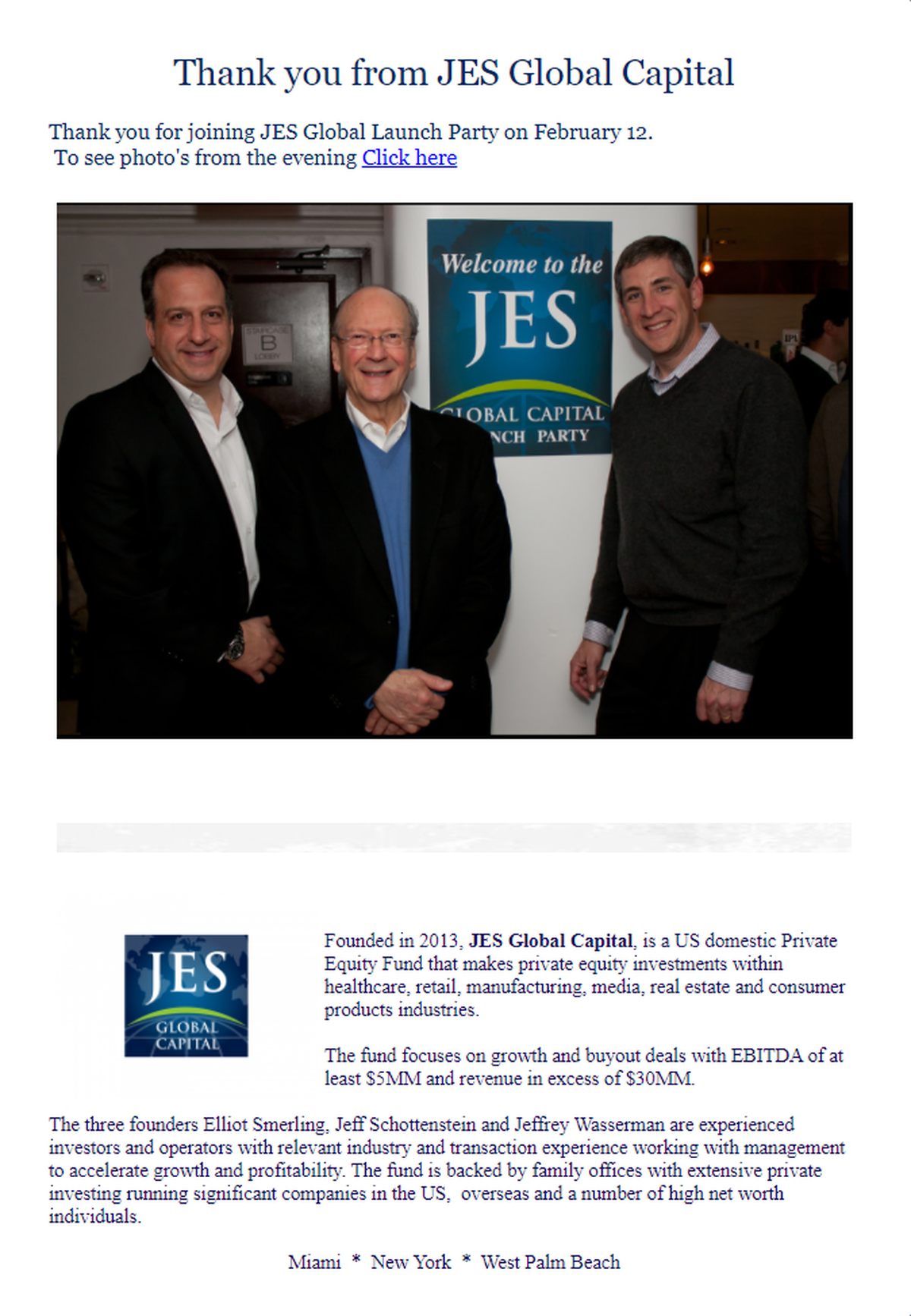
Wasserman parted ways soon after the launch. All he would say of the split, through an attorney, was that “he has not had anything to do with the company or Mr. Smerling since shortly after the launch of the company.”
Schottenstein’s name was absent from materials Smerling submitted years later to secure loans, according to the civil suits. It isn’t clear if he left the company. Schottenstein didn’t respond to multiple requests for comment.
When Smerling’s company filed its first securities offering with the SEC in April 2016, the company listed two different executive officers alongside Smerling: Lionel Sacon and John Havelka, both Smerling’s former business school classmates at the University of Miami, where he got his master’s degree. Neither responded to numerous requests for comment.
Still, the company was, to all outward appearances, a success. Each of the four investment funds issued by the firm was bigger than the last, according to the company’s filings with the SEC. Its most recent fund, JES Special Opportunities VentureFund, L.P., reported in June 2020 that it had raised $900 million from investors.
JES Global Capital was a financial supporter of the University of Miami’s Business Plan Competition and listed as a platinum sponsor, the highest level, of the business school’s corporate associates program in the fall of 2018. Smerling was appointed to the business school’s entrepreneurship advisory board.

According to Smerling, the university returned the favor: He indicated in documents provided to Silicon Valley Bank and Citizens Bank that UM’s endowment fund had invested a total of $40 million across three of JES Global Capital’s funds, the suits filed by the two banks allege. The university has declined to say whether it invested in any of Smerling’s funds or how much Smerling and his companies contributed to the university over the years. Michael Wilson, the current director of entrepreneurship programs at Miami’s business school, didn’t respond to multiple requests for comment. The university previously said that Smerling is no longer on the entrepreneurship board.
Managing perception
The appearance of success might explain how Smerling was able to secure loans from banks despite the apparent red flags that have subsequently appeared in his loan applications. The materials one of his funds submitted for one of the loans, for example, allegedly listed an outdated address for the company that had reportedly conducted a financial audit of the firm.
Jim Richards, the former global director of financial crimes risk management at Wells Fargo and founder of RegTech consulting, said that if the allegations are true, credit officers might have fallen prey to the same flawed logic in Smerling’s case that led investors and regulators to ignore concerns about the investment strategies of Ponzi schemer Bernie Madoff.
“ ‘Everybody seems OK with Madoff, so why would I worry about it?’ ” Richards said. “ ‘Everybody seems OK with Elliot Smerling, so why would I worry about it?’ ”
He said that loans as big as the ones approved for Smerling’s funds would typically require review by senior credit officers who should have tried to verify the information the funds provided.
Smerling’s arrest in February came as a shock to neighbors and former colleagues.
Multiple neighbors said they knew little of Smerling’s work, and to the extent that they knew him at all he was seen as a devoted parent and husband to his wife, Elaine.
“Great family man, good father, good husband,” said Steve Annunziata, one of Smerling’s neighbors.
Elaine Smerling declined to comment, saying she was too upset by everything happening.
At her husband’s initial court appearance, she said he was the best person she had ever met, an outstanding father and very generous, providing assistance to her friends in need in her native Brazil when they hit economic troubles. She said she knew little about her husband’s work and the details of the family’s finances.
Smerling was known at work as a devoted family man and a whiz with numbers, but also had a shrewd sense of how to manage public perception, according to former colleagues at Laser Partners, the now defunct private equity firm where he worked as chief investment officer before starting JES Global Capital and which shut its doors in 2014 according to state corporation records. They requested anonymity because of the ongoing legal proceedings.
But Smerling also had an edge.
“He had a temper, big time,” one colleague recalls. “I was told never to confront him.”
And he also had a tendency to brag, which became even more pronounced as Smerling began to make plans for JES Global Capital.
“It’s going to blow Laser out of the water,” one of the former colleagues recalls Smerling saying around the time that Smerling was first dreaming up his new fund.
When he learned that Smerling had been arrested, another former colleague said that while he was shocked at the level of alleged fraud he was struck that Smerling didn’t seem to have taken the right lessons from the demise of Laser Partners, about the importance of betting on the right companies.
“The concept that Elliot would eventually cut corners rather than fail, I was remarkably unsurprised by that,” he said.
Biographical holes
Smerling’s alleged fabrications weren’t limited to the investors and investments of JES Global Capital.
The biographies he submitted to banks as part of his loan applications appear to contain numerous falsehoods about his work experience.
Smerling wrote that he had previously served as the chief investment officer at Huntsman Gay Partners, seemingly a reference to the multibillion-dollar private equity firm known now as HGGC and co-owned by NFL Hall of Fame quarterback Steve Young. Not so, the company said. Nor did it invest $50 million in his third fund, as Smerling told Silicon Valley Bank.
HGGC invested $8 million in a company affiliated with Laser Partners, according to court records, but Smerling was never an employee of HGGC, the company said.
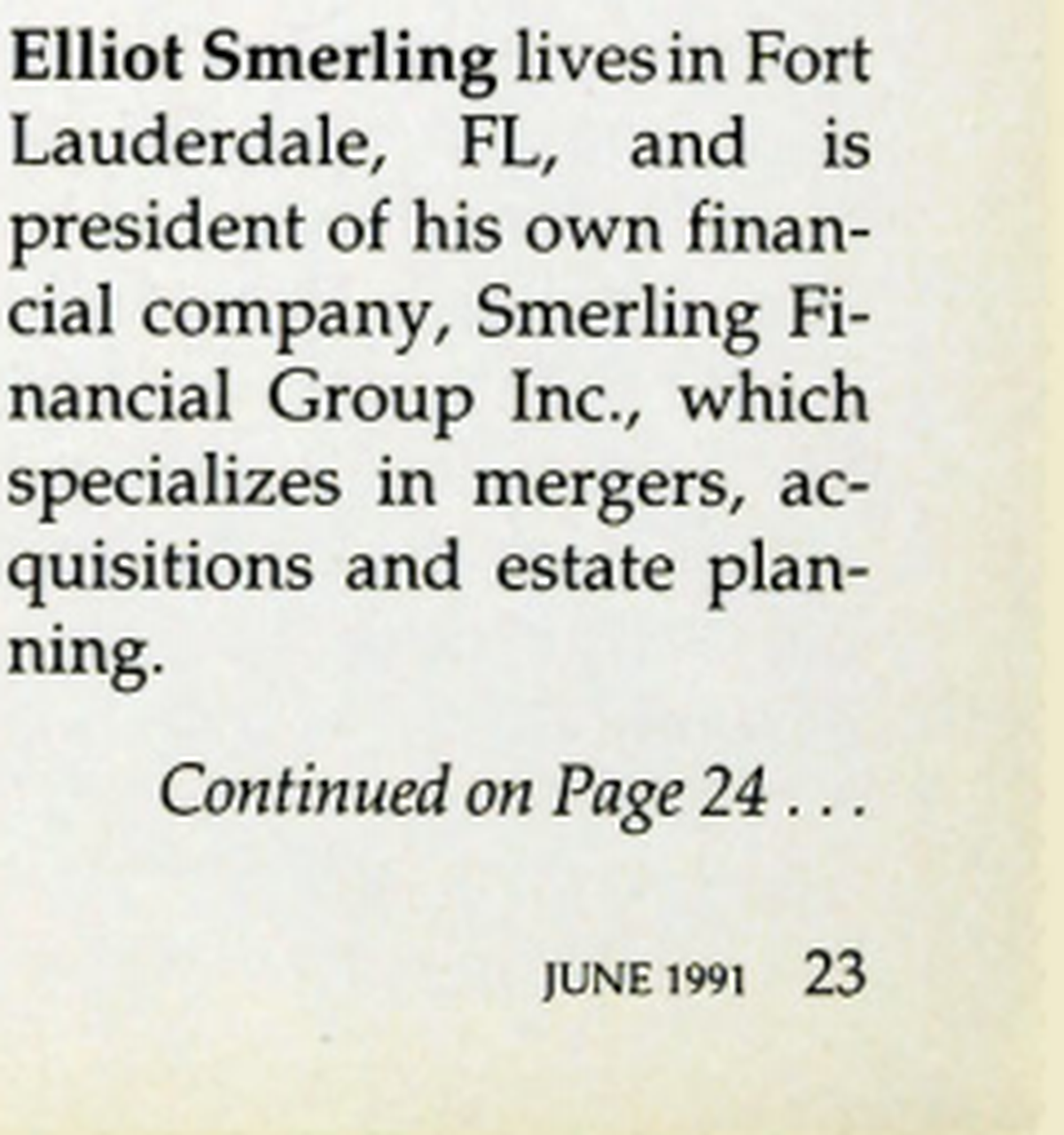
His biography also referenced senior banking positions in London and Hong Kong, seemingly a reference to a position at the Advisory Services Corporation in the early 1990s that he lists on his LinkedIn profile. Two senior executives who worked at that time at the Palm Beach Gardens-based financial consulting company said they had no recollection of Smerling. At the time, Smerling wrote in to the University of Tampa’s alumni magazine that he was living in Fort Lauderdale and running his own financial firm.
He also listed employees at JES Global Capital who told the Herald they had nothing to do with the firm.
Pedro Soares, for example, was listed as one of the company’s top executives in materials Smerling submitted to the banks. But Soares said he has nothing to do with the company and has not spoken to Smerling “in many years.”
Smerling’s arrest has led to a reckoning among lenders who cater to private equity firms, and Richards, the former Wells Fargo risk chief, said that the fact that Smerling was able to secure such large loans is a sign that the banks failed to do proper due diligence.
“You can’t count how many people screwed up on this,” he said.
‘It was crazy’
While it isn’t clear what Smerling did with the bulk of the money that’s allegedly still outstanding, property records and state and local financial records suggest where some of the money might have gone.
As Smerling’s funds reportedly drew more investors — and Smerling secured increasingly large bank loans — he expanded his footprint in the neighborhood he and his family had moved to in 2016.
In June of that year, Smerling purchased the $1.8 million waterfront home in the unincorporated Palm Beach County neighborhood of Homeland. Five months later, a company tied to him bought the vacant, uncleared five-acre lot across the water.
Like Wellington, its flashier neighbor to the north, Homeland is described by many as horse country with heavily wooded five-acre lots that provide plenty of space for horses to roam and privacy for the residents who live there.
“We loved the idea of having space and having nature,” said Ana Silva, an endocrinologist who bought a home with her husband in the neighborhood last year. “We see deer in our yard every morning and every afternoon. We have otters in our pond.”
Last summer, Smerling appeared to double down on the neighborhood. Companies tied to Smerling started aggressively pursuing other nearby unoccupied lots, buying a total of three neighboring lots in late August for more than $2 million.
“He called me for four straight days, it was crazy. And every day was $50,000 more” said Pablo Ledesma, who sold him one of the properties. Smerling’s company paid Ledesma $550,000 for the undeveloped land, $200,000 more than Ledesma had paid for it nine months earlier.
Robert Fessler, who sold the neighboring lot to a company tied to Smerling, said it seemed as though Smerling was in a hurry to put his money into the properties.
“The property wasn’t for sale,” Fessler said. “He offered me 600 [thousand], I said no. Within two weeks he offered me 700.”
Other transactions involving companies tied to Smerling showed that the lines between personal and professional spending were often blurred.
Palm Beach property records show that two companies tied to Smerling issued mortgages to companies controlled by a JES Global Capital employee, Jennifer Hebrock, and one of Smerling’s friends, Reddick Brown. Neither is accused of wrongdoing and both declined to comment. Neither transaction was mentioned in the court records for the criminal or civil cases. Brown testified as a character witness at Smerling’s initial court appearance, saying his children called Smerling “Uncle” and that he considered him family. He didn’t mention the loan.
This story was originally published June 2, 2021 at 7:30 AM.