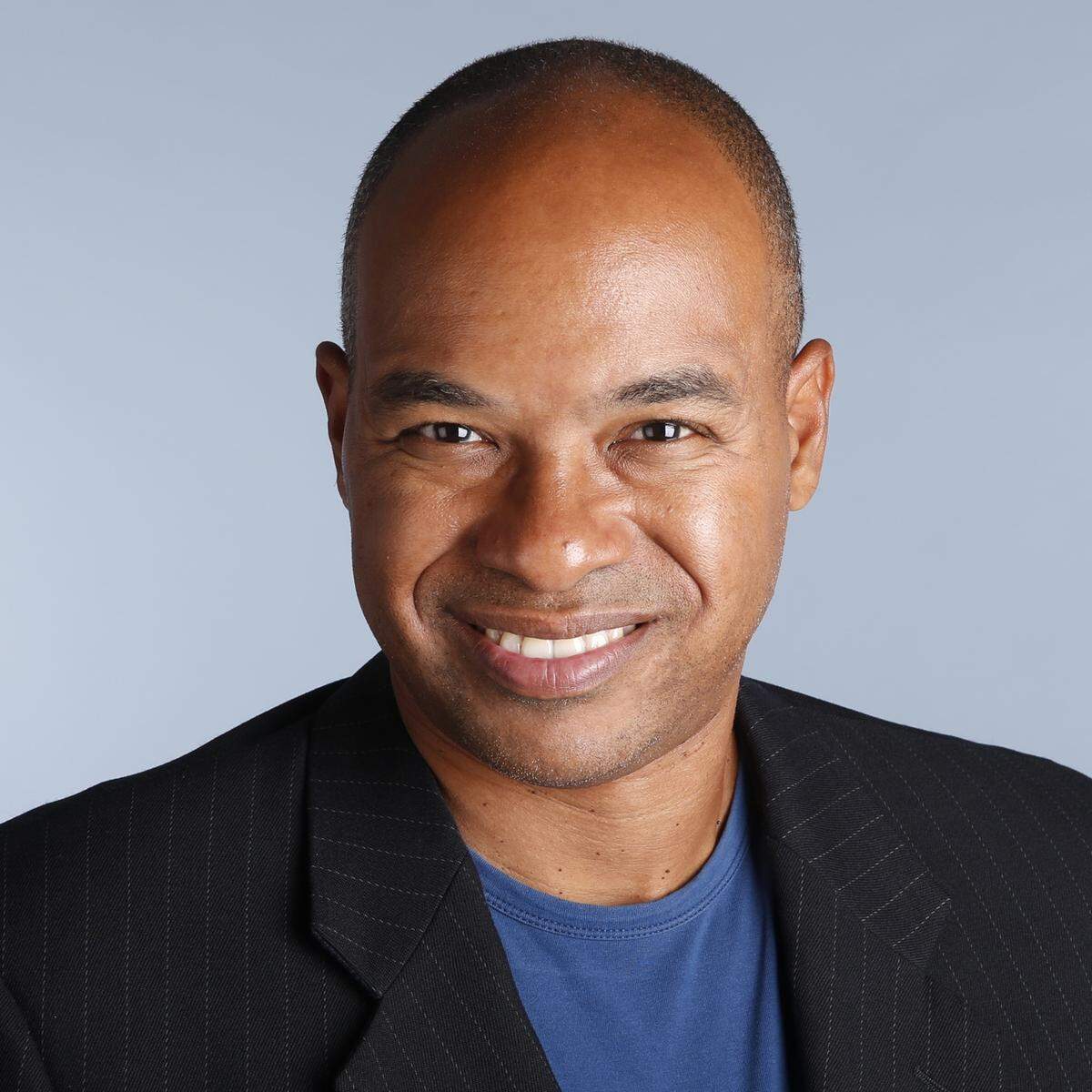
Manager of Miami hedge fund that he started with UM professors admits $1.3 million fraud
The criminal side of David Coggins’ Coral Gables Asset Management fraud didn’t take long. Indicted on Dec. 29, Coggins pleaded guilty earlier this month to securities fraud, and everything will be wrapped up after he learns his prison time and restitution.
Sentencing for the 42-year-old is scheduled for May 14 in Miami federal court. The civil side to the Coral Gables Asset Management mess is a little more complicated.
Some investors still want a financial piece of Coggins, as well as the men with whom he started the hedge fund: University of Miami Herbert Business School finance professor Alok Kumar and former University of Miami and current Cornell University assistant professor of finance Jawal Addoum. All three are defendants in a Miami-Dade County civil suit.
Two federal civil suits, one by Portuguese investor Nuno Alpendre and another by California investor Steven Smith, name Coggins as the lone defendant.
In September, the Securities and Exchange Commission gained a judgment against Coggins that requires he, Coral Gables Asset Management and related companies “pay disgorgement of ill-gotten gains” with interest.
The Coral Gables Asset Management crime
State records say Coggins, Kumar and Addoum founded Coral Gables Asset Management (CGAM) in 2014. It was based out of Kumar’s Pinecrest home.
“Together they marketed the Fund to friends and business associates as an algorithmic trading strategy,” says Coggins’ factual proffer statement, the admission of facts with a guilty plea.
Kumar and Addoum left in 2016 (more on that later). Coggins continued to manage CGAM and its related companies, such as Coral Gables Asset Holdings.
Coggins’ factual proffer focuses on his scamming of “Investor A,” mostly through emailed lies. Cross referencing the factual proffer with the civil suits identifies “Investor A” as Alpendre.
By December 2019, when Alpendre emailed CGAM at the email address on the website, the company was a fraud down to the name — it was in Miami and had never been in Coral Gables and Coggins was managing its assets into his pocket.
Coggins began his relationship by lying to Alpendre, saying he was with “Investor Relations” for CGAM. Perhaps, that could be scored as technically true — Coggins was CGAM’s only employee. He told Alpendre that CGAM had more than $100 million in assets under management. CGAM never had more than $2 million.
He showed Alpendre that Hedge Fund Data Service A awarded Coral Gables Asset Holdings its “#1 Top Performing Hedge Fund Equity Market Neutral – Past Three Years.” Coggins didn’t say he knew that award was Garbage Out based on the Garbage In of bad financial data that he’d fed Hedge Fund Data Service.
In February, he emailed Alpendre a faux 2018 audit report for CGAM by fabricating an audit report and opinion letter on the letterhead for an imaginary audit firm. The faux audit said CGAM had $52,904,796 in total assets at the end of 2018. It actually had $1.4 million.
Alpendre invested $200,000 by wire transfer on Feb. 7. When he asked for the investment back in June, Coggins went dark on Alpendre while spending Alpendre’s cash.
“From on or about September 2016 through on or about December 2020, Coggins misappropriated investor funds for his personal purposes and concealed from investors the Fund’s performance losses and his misappropriation of Fund assets to avoid detection and further his unjust enrichment,” Coggins’ admission states.
“Specifically, Coggins did not tell the investors that the net asset value of the Fund was nearly zero in 2020. The loss to investors who were unable to recover their investments as a result of the scheme is $1,305,000.”
What did they know and when did they know it?
The investors in the Miami-Dade civil lawsuit — Ted Christakos; Targeted Investments, Christakos’ company with Mario Facella; and Robert Schwarz, a trustee for the Helen H. Kleban Irrevocable Trust — feel as seduced by Kumar and Addoum as Coggins.
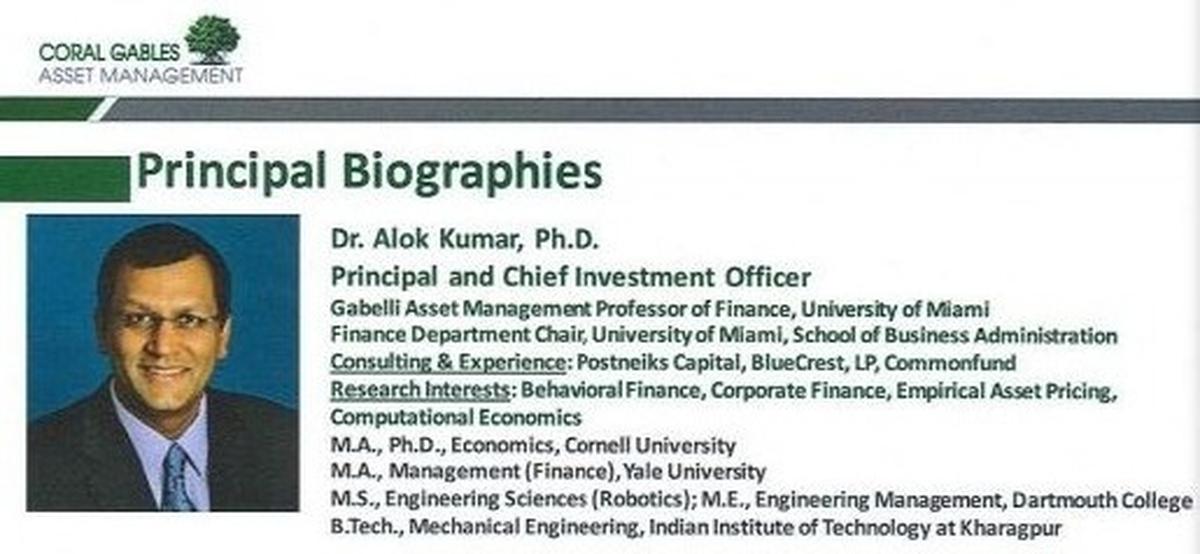
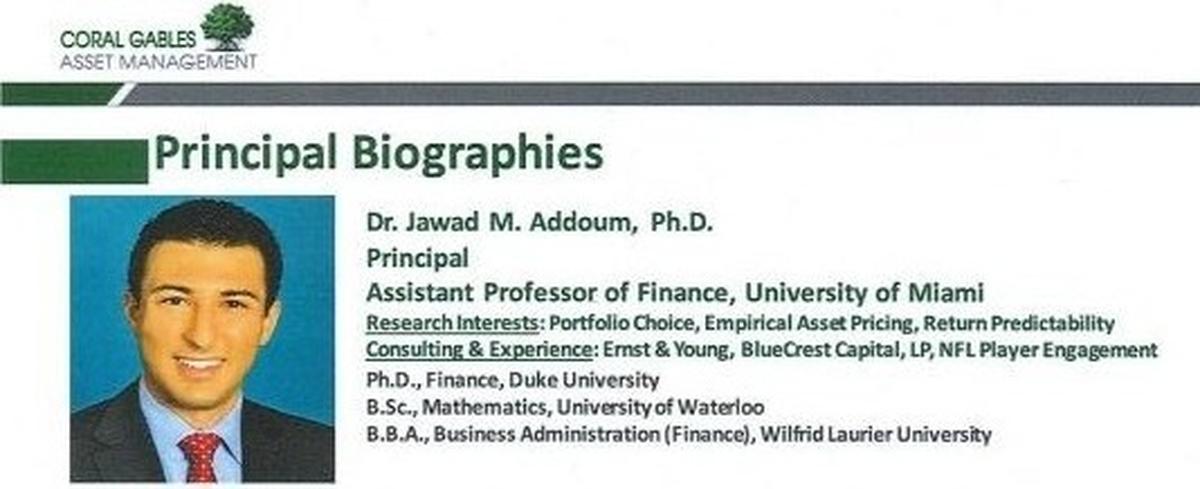
The professors brought heavyweight credentials. Kumar was the UM business school’s Finance Department chair. Addoum was a UM assistant professor of finance. With CGAM, Kumar would be the chief investment officer (a role he still listed on his UM online bio as of Monday night).
Kumar’s CGAM biography, which appeared on the website, said, “He heads the research and investment team of the partnership and assists in all portfolio management and research functions.”
Addoum’s CGAM biography said he would handle “the implementation of all trading strategies, daily operations, fund rebalancing, risk management and investor relations” as well as “help oversee the direction of the fund’s strategy and investment philosophy.”
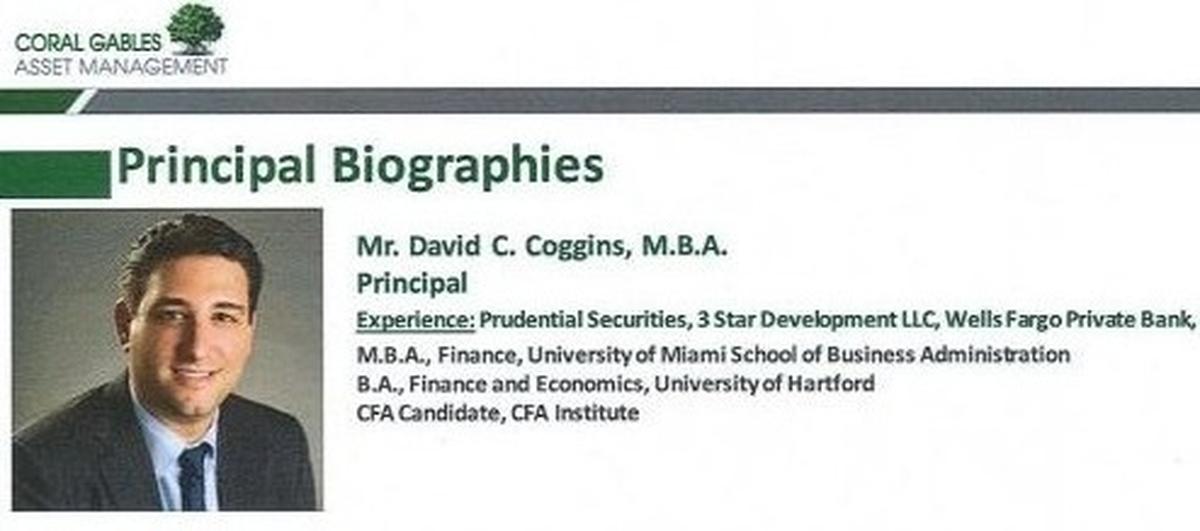
Coggins’ CGAM biolgraphy says he would be the chief operating officer and chief financial officer, but didn’t break down what that would mean.
The lawsuit says Kumar, Addoum and Coggins “utilized various representations in a way to make it seem to investors ... that the University of Miami was involved with and provided the support and research for the creation of the unique, behavorial-based systematic market neutral long-short “Hedge Fund” with uniquely created strategic quantitative analysis, trading systemic strategies, consulting, portfolio management and risk management.”
Coggins’ fraud began in September 2016 (if not before) and Kumar and Addoum left CGAM late in 2016. The lawsuit says they violated their fiduciary duty to the investors by tiptoeing away from the company on the down low.
“In fact, plaintiffs did not learn that Kumar and Addoum had left the fund until Aug. 7, 2019,” the suit claims. “In the minimum, Kumar and Addoum had the fiduciary duty to place plaintiffs on notice of the fraudulent acts of Coggins, to have advised plaintiffs that they had received their investments out of the “Hedge Fund” and that they had allegedly removed themselves from their positions as founders, managers, officers, principals and/or partners.”
The Miami Herald emailed Kumar, Addoum and their attorneys asking, among other things, how much did they know about Coggins when they went into CGAM with him? Why did they leave CGAM in late 2016? And did they tell investors when they left CGAM?
Neither of the instructors nor any of their attorneys have answered.
This story was originally published March 16, 2021 at 8:19 AM.