
Why are Miami wages so low? 'No. 1 startup city' comes with a downside
The city with the most people working for themselves.
What does it add up to? Low wages and a shrinking middle class, according to a new Florida International University study on the Miami-Dade County economy.
Businesses five years or younger now account for 18 percent of total employment in the county, according to the school's Metropolitan Center. Twenty-two percent of working-age adults in Miami-Dade are starting or running new businesses, compared to the national average of 13 percent, the study says. Four out of 10 establishments in Miami-Dade are younger than five years.
But the average wage in a firm four years old or less in Miami-Dade is only about $42,000, according to report co-author Maria Ilcheva. The median Miami-Dade county wage is about $47,000.
The report helps clarify what a "startup" truly means by showing why they are started. In the U.S., 11 percent of startups are founded out of necessity, rather than opportunity. But in Miami-Dade, that figure stands at 19 percent — despite the fact that a larger percentage of entrepreneurs in Miami, 24 percent, have at least some graduate education compared to the national average, 19 percent.
“Not all entrepreneurship and not all small businesses contribute to the economy equally,” Jacqueline Bueno Sousa, regional director of the Florida SBDC at FIU, said in the report.
Most Miami-Dade workers now work in businesses with fewer than 500 employees. Compared with other major metros, Miami now has an inordinate share of small businesses comprising its economy; 81 percent of the county's 73,764 firms employ fewer than 10 people.
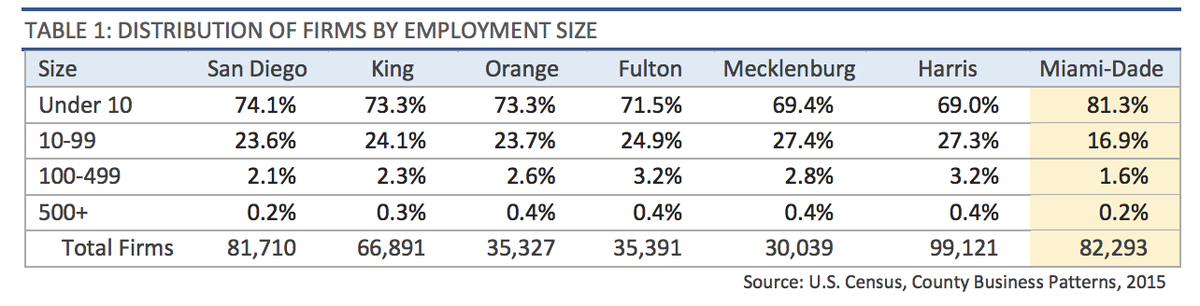
"While the region is adding new businesses at a rapid rate, those companies are not necessarily producing jobs," FIU says. "The report shows that between 2005 and 2015, the number of non-employer establishments in the Miami-Dade area rose 55.9 percent, almost three times the national rate."
And the median aggregate wage at firms with fewer than 10 people in Miami-Dade county was less than $30,000 in 2015, the benchmark year used by the study.
One factor driving low-wage startups in Miami-Dade is high immigration.
"The influx of foreign immigrants ... brings entrepreneurs from abroad," said Ilcheva, research assistant professor at the Metropolitan Center. Between 2010 and 2017 over half a million people moved to South Florida from abroad, and many established their own businesses.
Even if many of these immigrants bring higher skills than migrant workers common to other parts of the country, as long they are founding new businesses, their incomes are likely to remain low in their first years, if not longer.
The study also found a decline in small business loan amounts being given out to Miami-Dade businesses. While there was an overall increase in the number of loans to businesses with $1 million in revenues or less, the average loan amount decreased by almost 50 percent to $16,000.
"The lower job growth in small businesses, lower wages and trends in loan amounts are all related," the report said. "Small businesses need a support system to grow. For a small business that does not have adequate access to capital, it would be challenging to expand, in terms of product or service offering, hiring new employees and increasing sales.
That is not to say that it is only access to capital they need, the report said. Many of them very likely need technical assistance in the form of business plan development, financial management, and access to trade channels.

But the biggest driver of the county economy has simply been the shift toward more "gig"-oriented work. Miami is on the front lines of a national trend that has seen a boom in low-wage service work.
"We don't have the same traditional sectors, including government work, manufacturing — the stable sectors that used to provide jobs maybe 20 years ago," Ilcheva said.
This story was originally published May 23, 2018 at 7:00 AM with the headline "Why are Miami wages so low? 'No. 1 startup city' comes with a downside."