On Miami charity’s 40th anniversary, keeping up with the needs of the neediest
It was the year of a lovable extraterrestrial named E.T., gas at 91 cents a gallon, and a rock group that blessed “the rains down in Africa.”
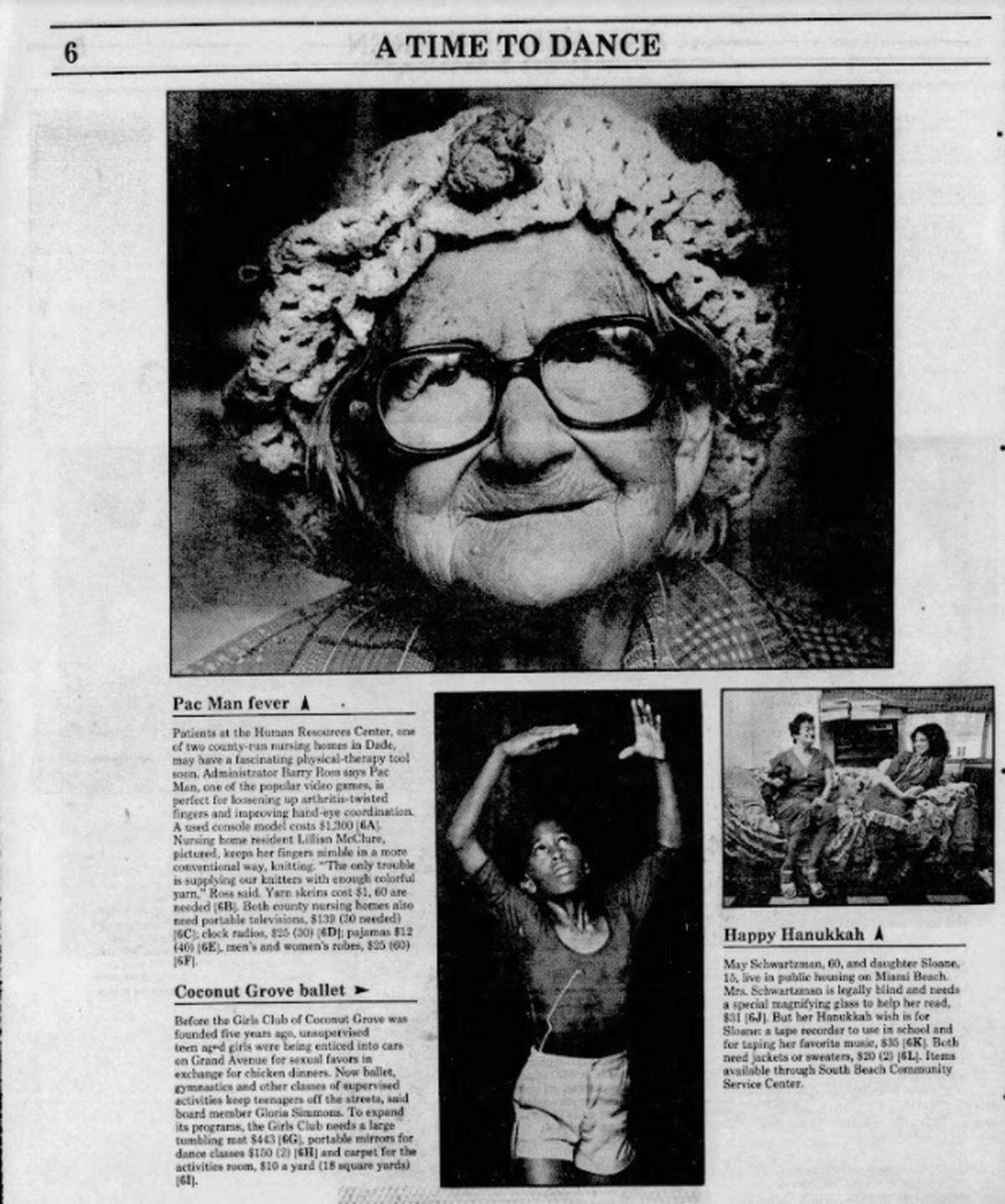
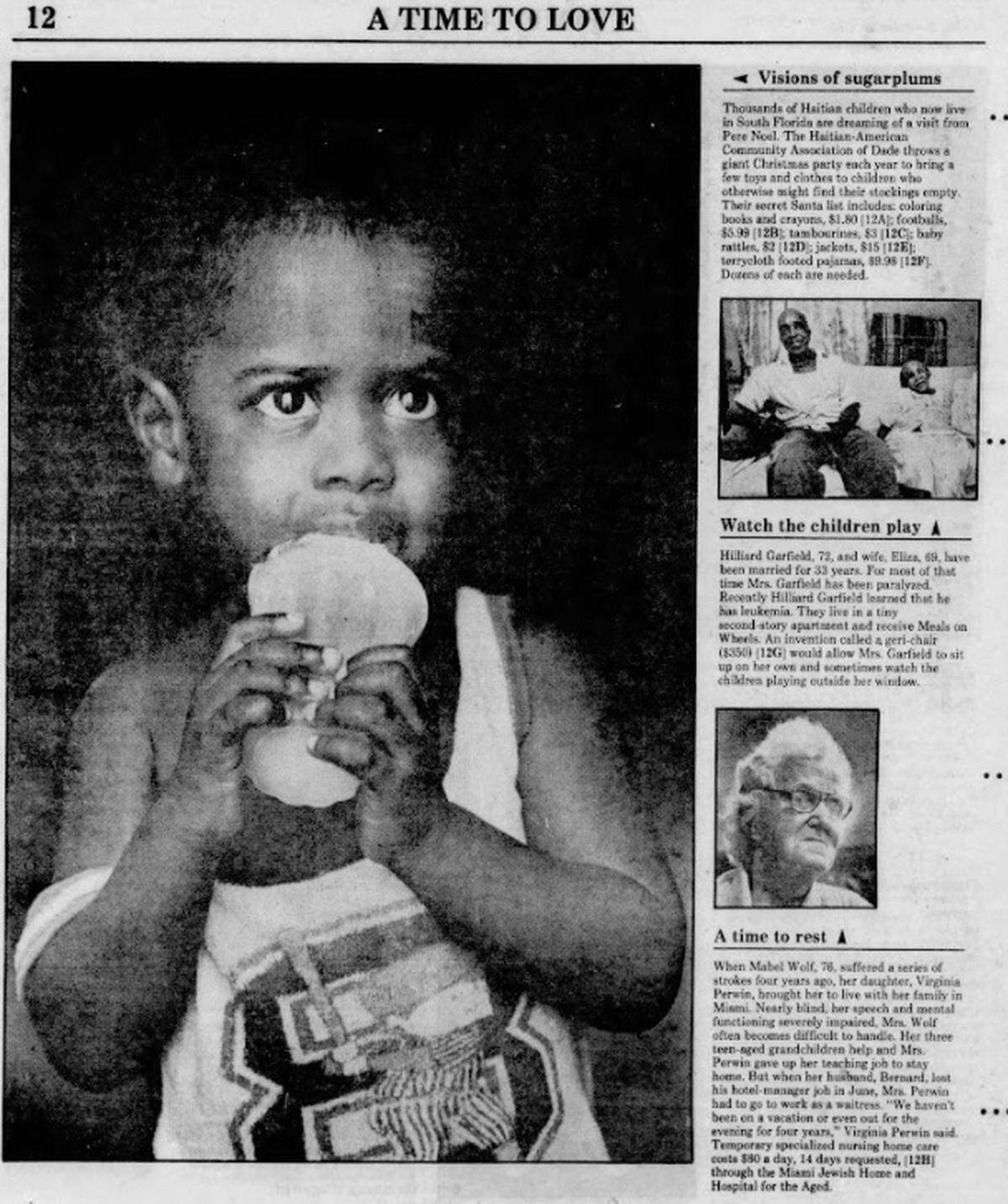
Forty seasons ago, amid pleasant distractions like “Pac Man Fever” and the release of a “Thriller,” 1982 was also the year Miami Herald Charities created and launched its annual Wish Book package, initially as a keepsake special section published on Sunday, Nov. 28, 1982.
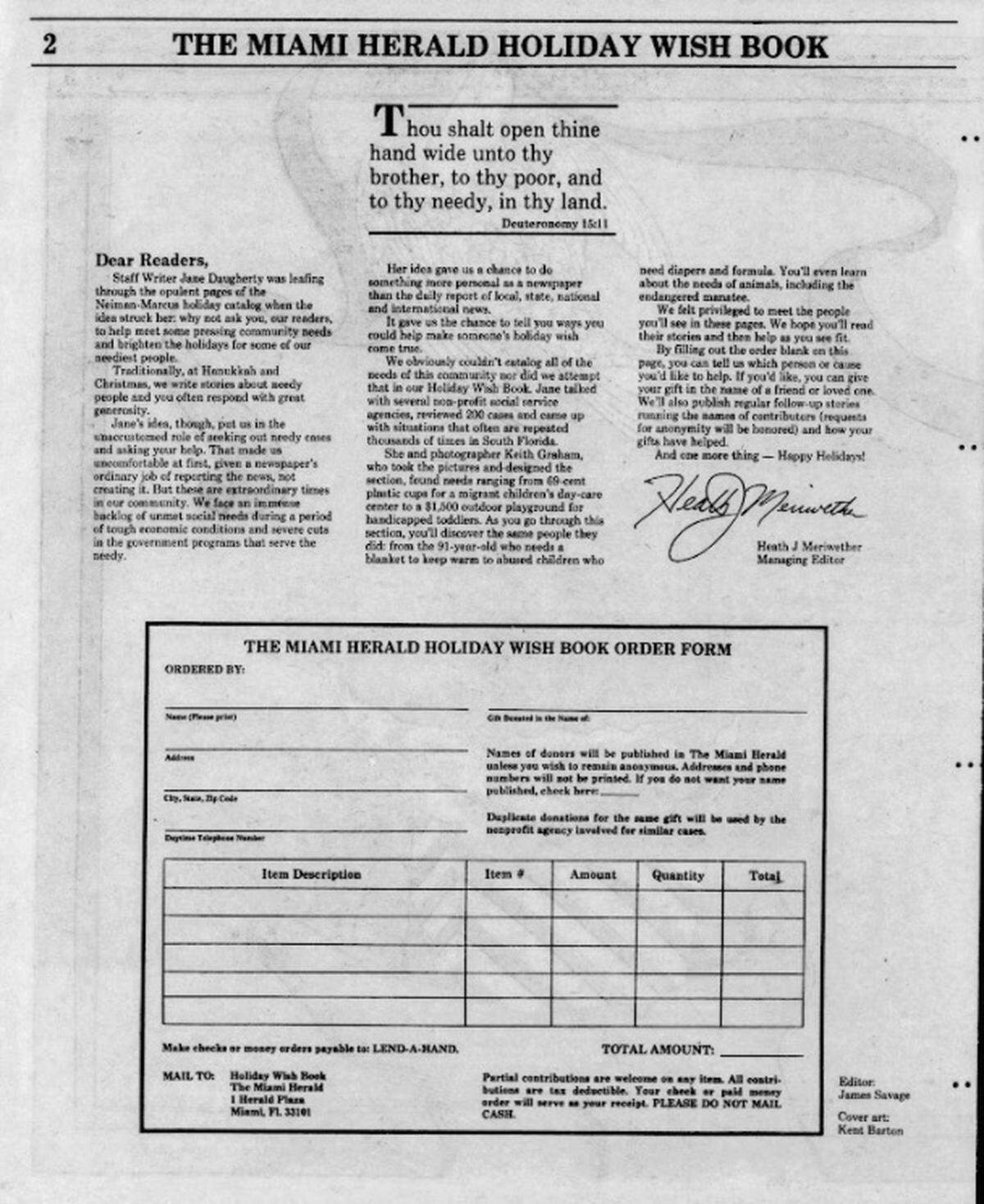
The idea was inspired by the opulent Neiman Marcus holiday catalog, the goods it featured out of reach of many Miami-Dade residents. Jane Daugherty, then a Miami Herald reporter, was paging through it when the idea struck her: Why not ask Herald readers to brighten the holidays for some of Miami’s neediest people?
Daugherty talked to several nonprofit social service agencies and reviewed about 200 cases and selected a representative number of people to write profiles on situations common to thousands in South Florida.
At first, Herald management was uncomfortable with the idea.
As Heath Meriwether, then the Herald’s managing editor, wrote: “A newspaper’s job is reporting the news, not creating it. But these are extraordinary times in our community. We face an immense backlog of unmet social needs during a period of tough economic conditions and severe cuts in the government programs that serve the needy.”
Championing the cause
“For 40 years the Miami Herald and el Nuevo Herald have championed the cause of the needs of the less fortunate in our community through the Wish Book Program,” said Roberta DiPietro, Wish Book’s coordinator. “While its early years were mostly serving the nominees with holiday cheer, it is now evident that while still providing some basic level of help for the holidays, the Wish Book is now charged with more complicated and involved wishes,” DiPietro said.
Meeting some of these contemporary needs DiPietro cites will include helping veterans with housing and job placement possibilities and giving a helping hand to children aging out of foster care so they can make it on their own. Wish Book donors will also help provide medical services and equipment for those facing health challenges and technology to support educational aspirations and remote learning.
The 40th year — which began with Early Giving and Give Miami Day on Nov. 18 and in earnest on Thanksgiving Day — will also focus on food and housing insecurity, given the dilemmas nearly two years of a pandemic have wrought on communities here and abroad.
“From the small beginnings to the extensive program of 2021, Wish Book has been a bright light, not only for the needy in our community, but certainly it is heartwarming to see that the readership has continued to step up to the plate and provide the funds needed to help those less fortunate,” DiPietro said.
A 1982 columnist’s opinion
Nearly 40 years ago, in December 1982, Miami Herald columnist Bea Hines wrote these words for the first column to celebrate the premiere Wish Book section’s success:
I’m not ashamed to admit that I still believe in Christmas and people and miracles.
Here’s why:
Several weeks ago, The Herald published its Holiday Wish Book, a list of some of South Florida’s neediest people.
Thousands of people, touched by the spirit of Christmas, have donated more than $160,000.
Hines recounted a story about a family of five that was struggling to get by on a weekly salary of less than $170. There was no money for the rent due on Christmas Day, let alone Christmas dinner and gifts.
Then a miracle happened.
People — some as far away as Stuart — were touched by the family’s plight, Hines wrote in 1982.
By Christmas, the rent had been paid. There was food in the house, gifts under the tree and a few dollars to carry the family over the holidays.
The gifts came in $10, $30 and $100 checks. One man, who asked to remain anonymous, sent a check for $500. By the time Hines’ column ran, the family had received more than $1,300 — not enough to make the family rich, Hines wrote, but enough to give them a little peace of mind. More than anything, it is a testimonial to the kinds of people who live in South Florida.
Numbers then and now
That first campaign brought in contributions totaling $173,177 from more than 3,114 Herald readers.
Over the last couple of decades, el Nuevo Herald and the Miami Herald’s Wish Book campaign has turned from the publication of a single stand-alone print section into dozens of stories published in print and online regularly from Thanksgiving into the new year.
Since 1999, the Wish Book program has received more than 4,800 nominations of individuals and families, representing more than 14,700 people. That year nomination requests were sent to 82 agencies; this year 1,016 agencies were contacted to nominate their clients with the greatest needs.
Records of Wish Book’s early years are incomplete, but in the last 22 seasons, “records reflect that more than 42,800 donors have made cash donations in excess of $7.3 million and generous members of our community have donated items with a value of more than $1.6 million,” DiPietro said.
Last year, the Wish Book 2020 campaign raised more than $496,000 from 1,826 donors amid the COVID-19 pandemic. That was about $50,000 more than the same time period the previous year.
Miami Foundation CEO and president Rebecca Fishman Lipsey, whose organization just celebrated the 10th anniversary of its Give Miami Day, sees parallels between the success of its day devoted to local philanthropy and the Herald’s Wish Book.
“It’s become a transformational habit that in our community we are generous and we step up for issues that we care about and we give,” Lipsey said. “I see Miami as a place of gratitude. People fled here from all over the world and from all over this country. And I think there’s a humility that comes out of a city that was built so much on people who came here by choice because they wanted an opportunity that Miami provides.
“When the chance comes at the end of the year to give back, people take it seriously,” Lipsey said. “And I think they understand what it means to live in a place that takes care of its own.”
Gifts then and now
The gifts have kept pace with the times and technological developments. In 1982, we certainly were not asking little round dots named Alexa to turn on our lights or to monitor an aging loved one’s well-being the way we do now.
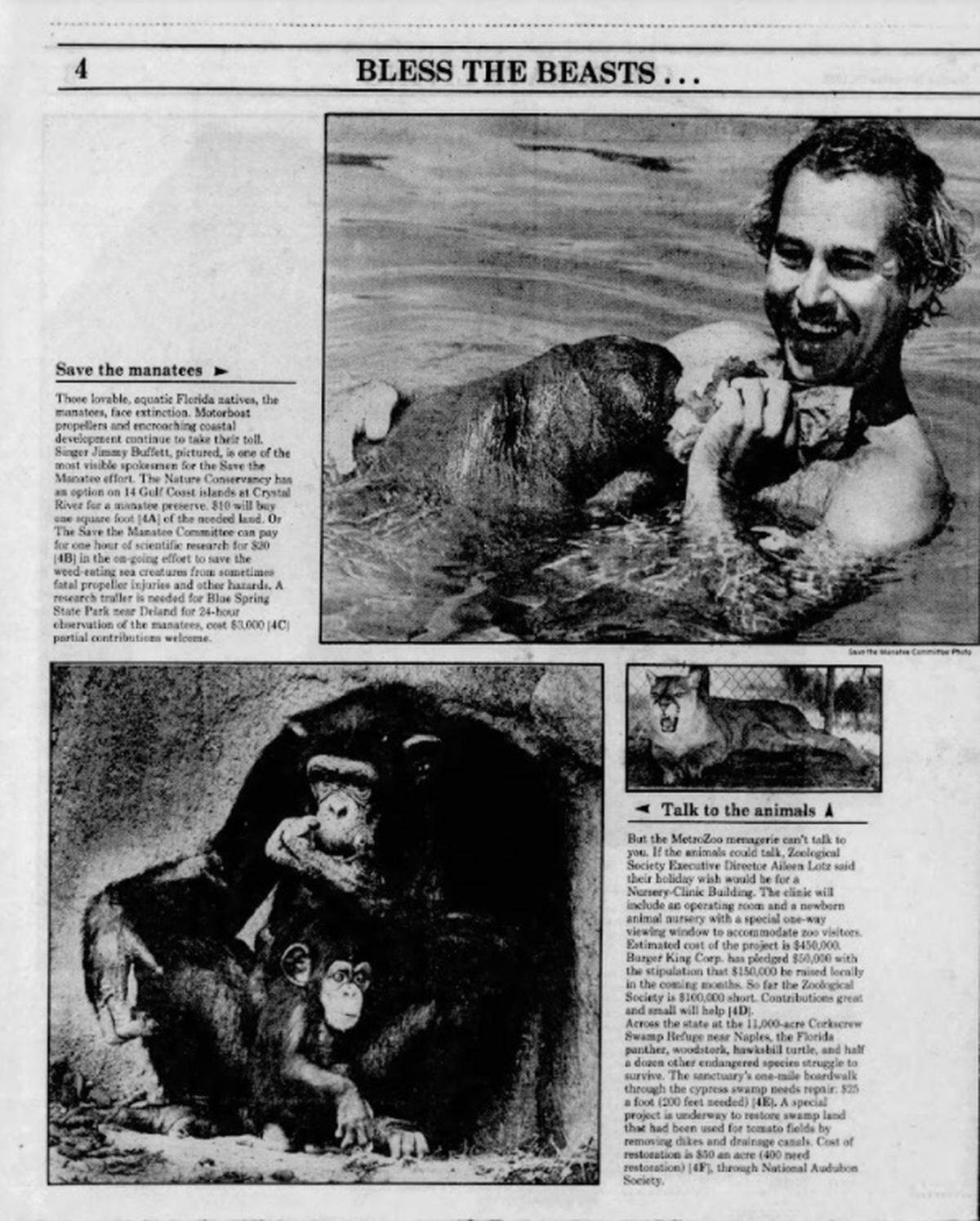
In the early days of the program, DiPietro said, the most donated items were bicycles, radios, TVs and a popular new appliance — the microwave.
“Throughout the years the needs became more basic and funding was able to provide many necessary items, including jobs, at least five full college scholarships, three neurosurgery operations, and facilitated the donation of a heart and a kidney,” DiPietro said.
Other items that have been donated through Wish Book include wheelchairs — electric and manual — as well as handicapped-accessible vehicles, modifications to make homes accessible, a variety of medical equipment, like Hoyer Lifts, and therapy for recently paralyzed nominees.
”The requests for computers and laptops have grown immensely,” DiPietro said. “Since the beginning of the COVID-19 pandemic the laptop has been the most requested item for students that have no resources at home. Due to the pandemic we are also seeing more needs for basic items including housing, food and help with gasoline, especially for those with the need to travel for medical care.”
Said Monica Richardson, Miami Herald executive editor and McClatchy’s Florida regional editor: “Giving to others can be as simple as a kind word, smile or a thoughtful gesture. The Wish Book is and has been our way of giving to the community by spotlighting the needs of individuals in South Florida.
“Giving connects us to others, creating stronger communities and helping to build a better society for everyone,” Richardson said. “The Miami Herald’s Wish Book has been an expression of 40 years of kindness, 40 years of glue connecting individual happiness with wider community and societal well-being. ... Nothing is more powerful than a movement that gives each of us an opportunity to make a difference in a neighbor’s life.
“I’m so proud of the Herald for this work but I’m even more proud of all the people who have given to this effort over the years, helping elderly, children and people in need. We say Wish Book readers have changed lives one story at a time. And it’s true!’’ Richardson said.
One family’s story
Take the Acuna family. In 2007, Ana Alvarez and Juan Acuna fled their home in El Salvador, citing the rise of gang violence. They eventually made a home in a small Hialeah apartment that came to include their sons Mateo, 6, and Juan David, 13. But, like many, they faced financial hardship last year due to the COVID-19 pandemic.
Last year, after the Acunas’ Wish Book story ran, the response overwhelmed the family. One person paid three months of the family’s rent. They received a new couch and love seat and kitchen table. They also received computers, electronic tablets and toys for the children. And, Mateo, who had been sleeping between his mom and dad in their bed, received a bed of his own.
“We were really surprised,” Alvarez said. “I couldn’t stop crying.”
“I am grateful to all the people who provided this. It changes lives,” Acuna said.
“Miami is a community of neighbor helping neighbor and Wish Book turning 40 is a testament of our community’s ongoing story of generosity and kindness,” said Miami Herald President Nancy Meyer. “Our readers believe in our mission of giving back and their support has touched so many over the years, whether it’s in the smiling eyes of a child who now has toys under the tree, helping a family to have a place to call home or providing much needed medical equipment.
“Wish Book lifts the spirit of our neighbors in need. The feeling of giving and the ability to help give a better life to our neighbors is the best wish of the season.”
A 2021 columnist’s opinion
Forty years later, Hines still believes in goodness.
“Recently I was asked if I still believed in Christmas and people and miracles. I didn’t have to think twice about my answer. It is a resounding ‘Yes!’ Let me tell you why,” she wrote in an email response to the Herald.
“I have heard of and been a witness to the goodness of others. Like the man who paid for my groceries when I forgot my wallet and wouldn’t give me an address so I could pay him back. And like the anonymous person who pays for my car to be washed every week. And the neighbor who lets me know that she is praying for me. It is through giving people like these that I see miracles at work every day.”
Today, Hines wrote, “We are often surrounded by dark clouds of hate. Yet the love of God still prevails, and miracles happen every day. I believe the goodness in people outweighs the bad in them.
“Over the past 40 years of Wish Book, I have seen this love manifested over and over, as people reach into their hearts, and their pockets to make dreams come true for hundreds of struggling people, regardless of their faith or racial ethnicity. To me, that is a modern-day miracle. To me, it says: the spirit of Christmas is alive and well. This gives me hope.”
How to help
To help this nominee and 150 other nominees who are in need this year:
▪ To donate, use the coupon found in the newspaper or pay securely online through www.MiamiHerald.com/wishbook
▪ For more information, call 305-376-2906 or emailWishbook@MiamiHerald.com
▪ The most requested items are often laptops and tablets for school, furniture, and accessible vans
▪ Read all Wish Book stories on www.MiamiHerald.com/wishbook
Miami Herald staff writer David Goodhue and columnist Bea Hines contributed to this story.