
July 10, 2005: Sad songs in hell
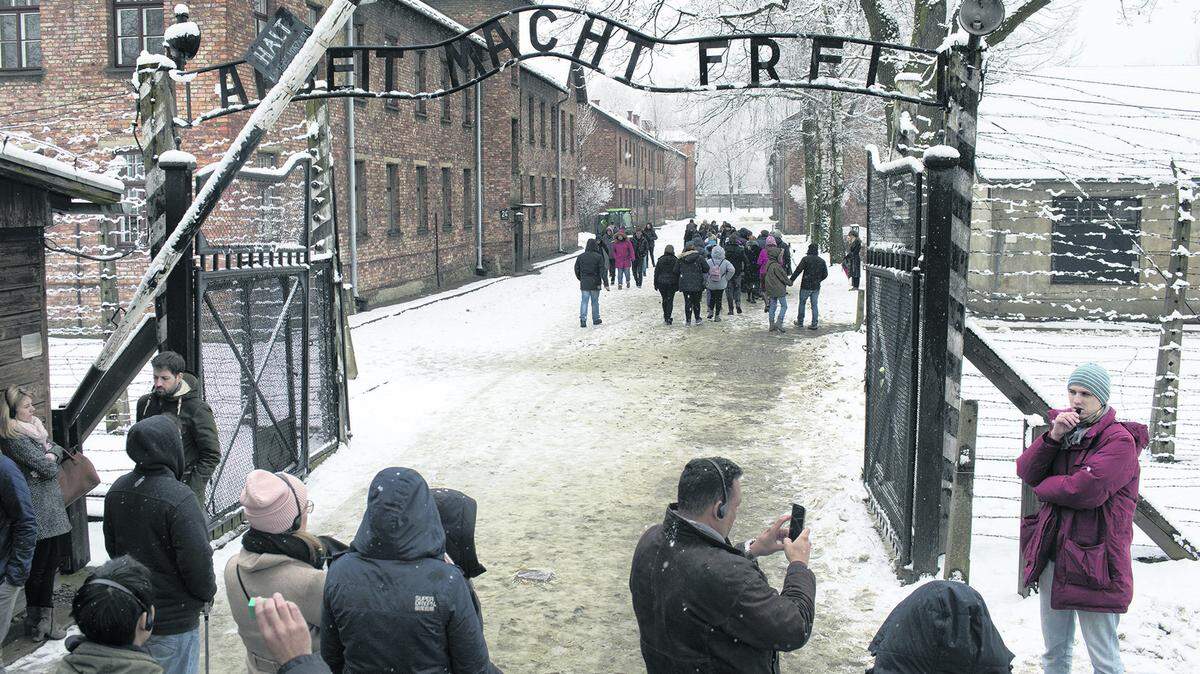
Birds sing in the treetops of hell. It is a discovery you keep making, one that keeps taking you by surprise as you walk in Auschwitz-Birkenau, Belzec, Treblinka, Tykocin and other sad and solemn places where six million Jews were murdered in a bacchanal of cruelty that ended 60 years ago. Birdsong. You keep looking up, noticing it here as you never would elsewhere. You might call it a hope song, proof that life’s circle will always, eventually, round the corner toward healing.
But the hope song feels out of place. Like the neat lawns covering what once were fields of mud and excrement. Like the hotdog stand that sits near the front gate of Auschwitz. There is something jarring about birds singing in the trees that overlook these places, something incongruous about melodies of God in workshops of the devil. About life going on, stubbornly, regardless.
This “interfaith pilgrimage” to Polish Holocaust sites has been organized by the Remember Committee, a project of the Charleston Jewish Federation of South Carolina — one of several Holocaust-memorial European trips for Americans each year. The 25 sojourners include teachers, a dentist, a lawyer, an insurance agent, and this Herald reporter, an African American drawn here by a belief that this is our story too, “our” in the largest possible sense. That it belongs to, applies to, is instructive to not just Jews, but any people who have known, or simply care about, the maddening eagerness of human tribes to subjugate one another.
The central figure on the tour, though, is not the reporter, the dentist or the lawyer. It is the survivor. His name is Joe Engel, he is 77, and he spent two years on the verge of death.
You wonder: Did birds sing in the trees when the train delivered him to Auschwitz in 1942? Did they sit warbling in the high branches as Josef Mengele, the infamous Nazi “doctor,” flicked his thumb right or left, life or death, for the benumbed Jews who stood lined up for judgment? Did they fill the air with song as bigger, stronger boys were sent to die while Engel was sent to “live” in a charnel house where skeletons staggered about the business of dying and human remains drifted down in flakes from the crematorium chimneys like some evil snow? Or did even nature fall silent with awe?
“Mengele was there,” says Engel as the group enters Auschwitz. He is pointing to a spot near a metal archway with a sign that reads Arbeit Macht Frei. A lie no less cynical in German than in English. “Work Makes One Free.”
Of 2,000 new arrivals who came to Auschwitz that day, says Engel, the Nazis selected 200 to be housed at the camp. “The rest of them, they send them to the gas chambers. But in 1942, they didn’t have no gas chambers then. So what they done, they dig ditches and they force the people to go into the ditches, with kids and everything else. They spread gasoline and they threw in some firebombs and that’s the way they went to their deaths. You could smell the flesh.”
WALL OF DEATH
Walk on. Auschwitz is crowded today. Students on school trips, mostly. Then Engel stops and points to a black cinder-block wall in a courtyard between two of the two-story brick structures that housed the Jews. Flowers and candles hug its base.
“Over here, this was the death wall,” he says. Meaning the spot where Jews were summarily executed. “This was a high point of the day for the SS,” adds Lara LeRoy, director of the Remember Project, referring to Nazi’s elite paramilitary corps. Engel nods. “This was fun for them,” he says.
Joe Engel is the kind of old man who routinely turns up in newspaper profiles as spry, meaning that he gets around well and doesn’t fatigue easily. His English remains a work in progress, even after 50 years in the United States. “German” is pronounced “JOY-man,” “gas” comes out “guess.” “You should know,” he warns apologetically, “mine English a little....” Pause, rephrase. “Broken English, I was a professor,” he says.
He is an irrepressible man. Which makes it easy to forget that, even though it’s been 60 years and this is his fifth return, it is hard for him to be in these places. Then you ask too probing a question and he looks away, toward the tower where the guards once stood. He says, “It’s no picnic talking about it, you know?” But he talks anyway.
“It’s all right,” he reassures. “I don’t mind. I want the people to know, especially the young people, to prevent another Holocaust. I don’t care who, whatever you are, things like that should never happen. “We survivors thought, after the war, there’s no more wars. That’s the end of everything. But you can see now what’s going on. People still killing people and everything. Things didn’t change.”
Across a gravel path from him, school children on a field trip are crowding into one of the buildings. “Some of them don’t believe,” says Engel. The memory of one in particular rankles him. “I was in a school and we talked about it and she rised up and she said, ‘I don’t believe you, what you said. How could one human do it to another one like this?’ I said, ‘You don’t believe me? I take you to the place, so you can find out, you can see for your own eyes.’ You couldn’t convince her. You got people now said the Jews made it up.”
TWO CAMPS
Auschwitz, where 1.2 million human beings were killed, is not just one place. There were dozens of sub-camps and three main camps . The first, called simply Auschwitz, could, if one were willing to overlook the guard towers and the barbed wire, pass for an Ivy League college campus, with its weathered brick buildings and lanes shaded by trees that were not there 60 years ago.
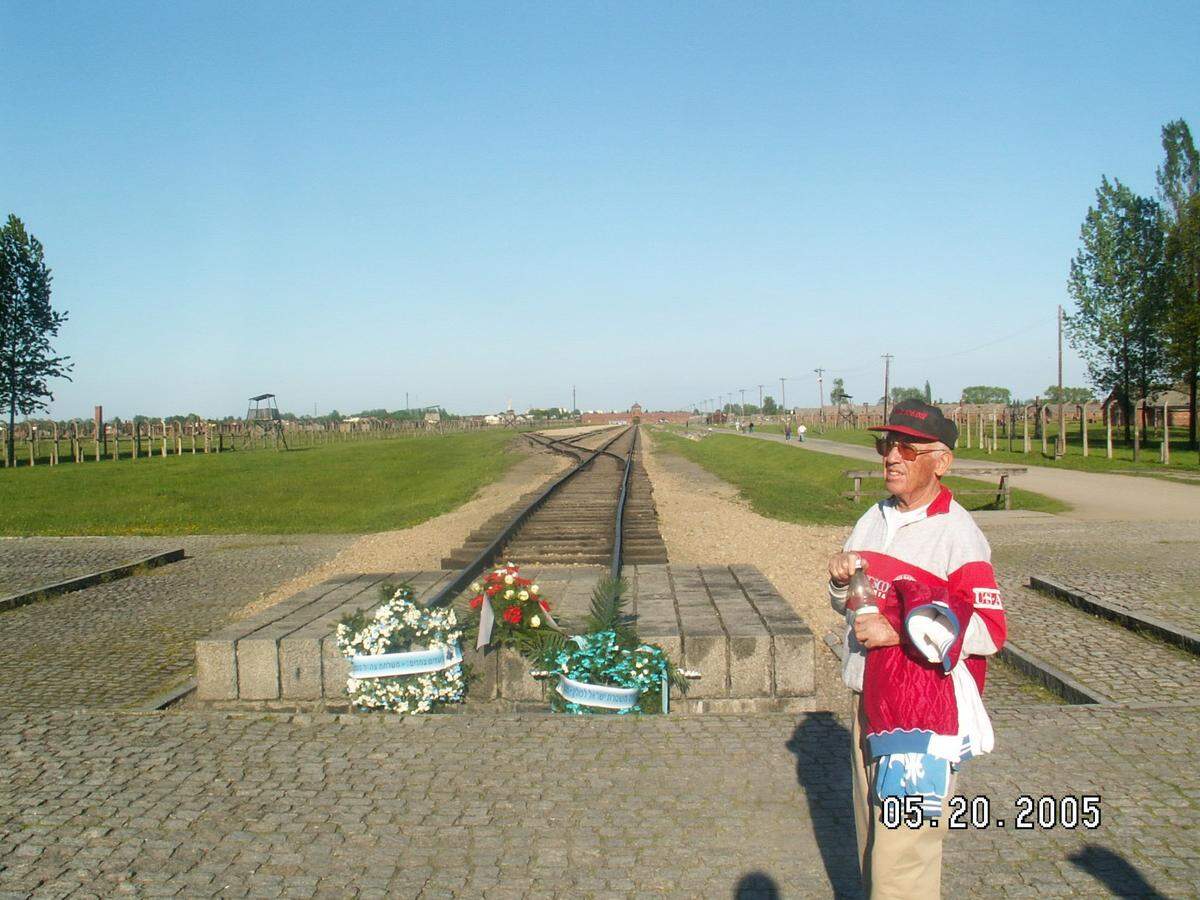
The second main camp, a short bus ride away, is Auschwitz-Birkenau. It was the intake camp through which prisoners first passed. There is a shock of the familiar when you see it, because you’ve seen it before in movies — Schindler’s List and others. The barracks are long and low-slung and there’s that iconic archway beneath the brick guard tower where train tracks enter the compound. Sixty years ago, they carried boxcars full of the doomed.
You will not mistake this for a college campus. Where Auschwitz is a museum, its barracks plastered with historical pictures and artifacts on display, Auschwitz-Birkenau is history largely unadorned, unprettied, unfussed with. The Germans might have left just an hour ago. The barracks are dank and shadowed, the stone floors rough and uneven. The rubble of two crematoriums sits as it has for six decades, one destroyed by the Jews in an act of rebellion, another by the Nazis in an act of cover-up.

At the edge of the forest on the far end of the camp, a memorial plaza has been constructed of cut stones. Engel gathers the group, several of them his cousins two and three decades younger, and begins to talk about this place where he once thought he would die.
“Anybody who wasn’t here can’t believe what we went through inside,” he says. “You know a lot of books been written about it, a lot of movies been made about it, but nothing came close to what’s been going on here in the death camp, Auschwitz-Birkenau. Maybe if I wouldn’t be here, I wouldn’t believe it myself. ‘Ah, what human being can do it to another one for no reason?’ The only guilt they had, because they were born Jews. This was the only guilt.”
A woman who is not with the pilgrimage group stands listening. There is horror on her face. “Every morning,” says Engel, “you could see hundreds of skeletons. Not human beings, just skeletons. Bones. The only thing you saw was bones and a big nose. We used to pick ‘em up and they used to take ‘em to the gas chambers over there.”
At this camp, as at almost every stop of the tour, LeRoy asks some member of the group do a reading — a poem, an essay relating to the atrocity that happened on this spot. Then the Jews in the group say Kaddish, the Jewish prayer for the dead. In English, it says, in part: “Glorified and sanctified be God’s great name throughout the world which He has created according to His will. May He establish His kingdom in your lifetime and during your days, and within the life of the entire House of Israel, speedily and soon; and say, Amen. “
You are struck that there is no lamentation in the ancient words. There is no woe or why. There is only praise.
ACT OF FAITH
Praise in places like these is an act of almost incomprehensible faith. Six million people died in the Holocaust for being Jewish. Five million more for being homosexuals, Jehovah’s Witnesses, communists, or simply opponents of the Nazi regime. There is - the word is unavoidably ironic - something bloodless about the numbers, repeated now for six decades. There is something in them too large for minds and hearts to comprehend, too abstract to truly grasp.
Roughly 3,000 people died in the attacks of Sept. 11, 2001 and it is remembered as one of the most traumatic days in American history. Eleven million people dead is a Sept. 11 attack every single day for 10 years. It is New York City dead. And Washington, D.C., dead. And Atlanta dead. And Dallas dead. And Pittsburgh dead. And Miami dead. And not just dead. Nor even just murdered. Slaughtered. Butchered.
That’s what it was. A boy at Belzec who had sand pushed down his throat with sticks. Babies thrown from hospital windows in Lodz, and a young SS man making a game of how many “little Jews” he could catch on his bayonet. Women in Auschwitz subjected to an “experiment” in which a cement-like fluid was pumped into their uteruses. A woman in Przemysl whose baby was snatched from her arms by an SS man who, according to a witness, “took the baby into his hands and tore him as one would tear a rag.” And nameless thousands suffocated standing up in train cars too crowded to allow corpses to fall, shot in the brain, tumbling into graves they themselves had dug, inhaling poison gas in dark stone rooms.
This is how they died. Butchered. Slaughtered. Why? Someone once asked this of Mengele. “Here there is no why,” he said.
A DANCE OF JOY
A klezmer band is playing in a restaurant in the Jewish Quarter in Krakow, where members of the interfaith pilgrimage have just finished dinner. Several members of the group are engaged in a spirited debate over how the world should respond to genocide. Then the band goes into Havah Nagilah, the celebration song that has become a Jewish folk standard and Joe is up dancing with a woman from the group and even the debaters have to silence the debate and clap in time, because you can’t not clap when Havah Nagilah plays. The old man dances as if his bones were made of joy.
No member of the band playing the Jewish song is Jewish. That’s because there are virtually no Jews left in Krakow. Even here, in the Jewish Quarter. The synagogues are maintained, but nobody worships in them. The ancient cemetery is open, but tourists far outnumber mourners. Before the war, there were 60,000 Jews here out of a population of 250,000. There are less than 200 now.
So the old man is dancing to Jewish music in a place where there are no Jews. Where there is no rabbi. Where the last bar mitzvah was before the war. And you wonder: What is it that gets into human beings that makes them feel they have the right to deny or annihilate other human beings for the sin of difference? Slaughter the Jews because they’re Jewish, enslave the Africans because they’re African, murder the Armenians because they’re Armenian, the Tutsis because they’re Tutsis, the Kurds because they’re Kurds, the Sudanese blacks because they’re Sudanese blacks. Where does that come from? Why is the lesson never learned, even at the most ruinous cost?
Graffito spotted on a wall in the Jewish Quarter: Juden Raus. Jews Get Out.
As Chris Huszczanowski, the group’s guide, puts it, “The anti-Semitism in Poland is a very special one. The anti-Semitism without Jews.” You question him, thinking something has gotten lost in his imperfect English. He repeats himself with emphasis. “Without Jews,” he says. “Show me, visiting, traveling through Poland, small village, medium-size city, a city without any synagogue, any shul there. They never seen Jew. But you have grafittis on the walls. Like Mogen David, the David Star, (intertwined with) the gallows.”
Two days later at Majdanek, a death camp on the outskirts of the city of Lublin, 15-year-old Jan Rydzha, a high school student, pauses in his morning’s labors to talk with a reporter. He and a group of his fellow students are engaged in a class project, using hoes and hands to clear the foundation of a barracks. Old wash basins and receptacles for human waste are taking shape, hacked out of the tall grass.
The reporter has asked Rydzha whether young people here are really taught about the Holocaust. “In Poland, we have quite a full education about the Holocaust,” he replies in flawless English. “Not only about the numbers and the statistics, but about generally the human tragedy that went with it.” But Rydzha says he wonders sometimes if the message gets through to all those who visit Majdanek. “For example,” he says, “in the barracks, you can actually find some graffiti and some text written in black marker on the bunk beds. To me, that’s total disrespect and I just can’t believe who would do that.”
Kasia Zych, who is 18, finds it hard to believe what happened in her hometown 60 years ago. “It’s huge and enormous and it scares me.” And to the people who say it didn’t happen? The teenager with death camp soil on her hands says, “I think they should read more books and maybe even come here and see it with their own eyes. It happened. Happened. I think people who say Holocaust never happened are stupid. They have small intelligence.”
There is a display at Majdanek you would show such people if you could. It is not the gas chamber where live canisters of poison gas are still in storage. It is not the glass display case filled by toys stolen from dead children of long ago.
No, it is the shoes. They fill Barracks 52, row upon row of them in cages made of chicken wire and wood. Close. Touchable. How far back does this barracks go? Fifty feet? Sixty? More? The shoes stretch virtually the entire distance.
You start walking between rows of footwear piled taller than you are, passing by sandals and slippers and work shoes, black leather dusted gray by age and time. You move through a forest of things once worn by children and old men, women and girls, long ago, when they were living.
The air is stale. There is no light beyond that from the sun which enters through the door in front. The shadows eat it greedily. It is silent in here, still but for the sound your feet make against the floorboards as you move further down the row, deeper into places where sunlight does not follow. Soon you cannot see. But you can feel. The weight of shoes piled high all around you. The accusation of their emptiness. A chill rises through you. You keep walking. It is like walking into death.
‘A MIRACLE’
“Before the war, was very bad for Jews,” Joe Engel tells you. He is sitting in his bus seat, a few rows from the front. “The anti-Semite was very bad. Before the war, had the market, Tuesday and Fridays. Had people with signs, and they’d sit by the Jewish stores and they told them not to go into Jewish stores. I still remember they said in Polish, ‘Don’t buy from the Jew.’ “
“Listen, was very bad. Exactly like the Americans treated the colored people. Especially in Easter,” he adds. “A Jew was scared to go out.”
He was 11 when the Nazis smashed across the Polish border. “When they came in, they destroyed the city, they made us wear a Star of David. You couldn’t walk out on the sidewalk. You had to walk in middle of street. We had no place to live, so we decided to go to Warsaw.”
They walked for two days. Ended up spending a year in the Polish capital, living with family. “One room,” says Joe. “At nighttime, the floor was not big enough for everybody to lie down in the same time. So we had to take turns lying down on the floor to sleep.”
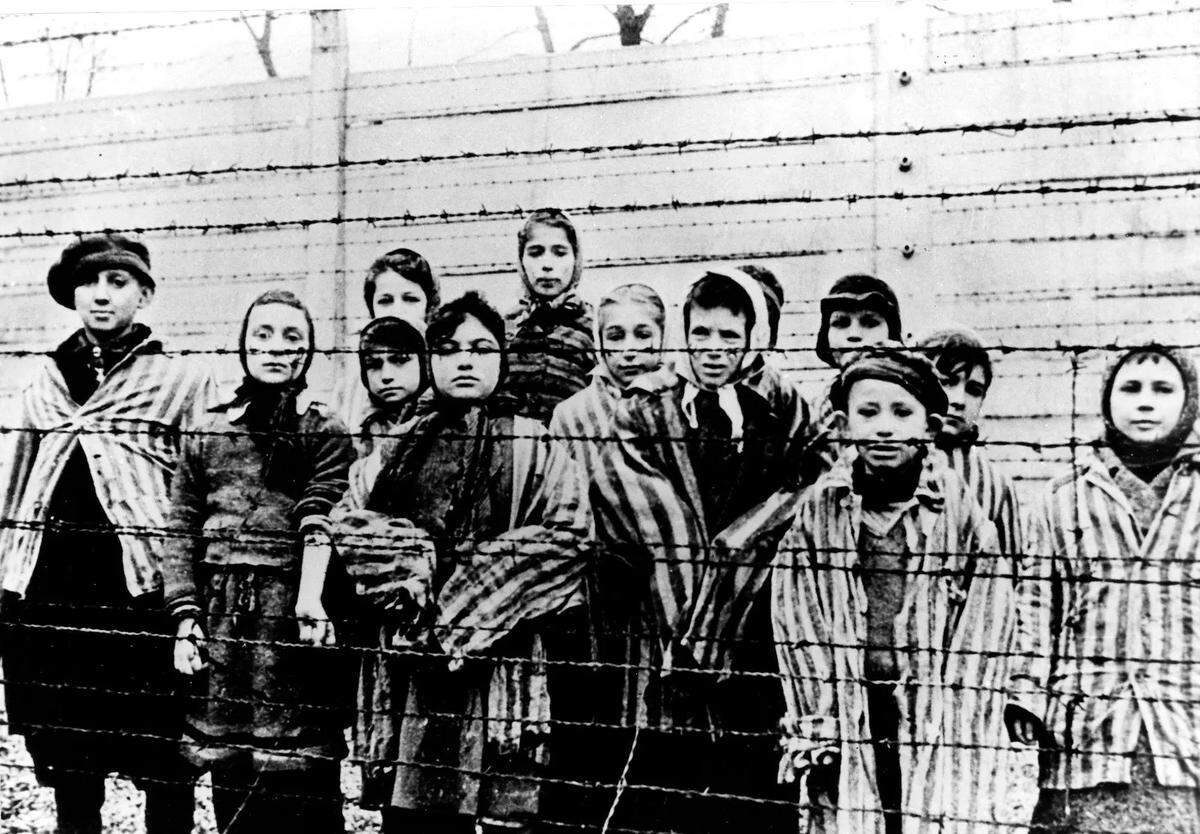
By 1942, Joe had been deported to Auschwitz. He remembers it as a series of beatings. Beatings for not moving fast enough. Beatings for trading food. Beatings for entertainment. And that was hardly the worst of it.
“When I came home from the day’s work and they saw my bed, for some reason, wasn’t made up like should be, and it was in the winter time, cold, they make me undress, naked, and they put me outside and they make me kneel and they took some ice water, cold water and pour all over you, till you got stiff, almost frozen to death. They took you inside again.” Nor was that the worst of it. The worst of it, he will not speak.
To this day, he is not sure why or how he was chosen to live. Nor why or how he did. “I’ve been asking a lot of people,” he says. “I would ask the rabbis, all kinds of people, how come I survived and my parents didn’t survive. How come you had people there, very religious, they never sinned in their life, even in the camp, they prayed and prayed, and after awhile, they sent them to the gas chambers for no reason. And everybody was expecting a miracle, a miracle from God, but the miracle never come.
“For me, was a miracle. But for the rest of the 6 million Jews, was no miracle whatsoever.”
A DARING ESCAPE
Joe Engel lived in Auschwitz for two years and four months. In January of 1945, with the Russian army closing in, the Nazis ran, sweeping before them 58,000 prisoners — Engel among them — in one last march. Most of the Jews were murdered en route. Engel survived to be herded onto a train. Destination: Germany.
“Was cold,” he says, “was open, no food, no water, nothing. And you could see peoples dying like flies from the cold weather, freezing to death. So I told myself, You know, when it’s going to get dark, I’m going to take my life in my own hands. If I survive, it’s OK. And if I don’t survive, I don’t have to suffer, you know what I mean? ‘Cause suffering is more than anything else. The punishments they give you, it’s worse than death.
“So I said, the hell with it. As soon as it’s going to get dark, I’m going to jump the train. So, was high snow. And soon as it got dark, I jumped. They stopped the train, they was looking, and I was under the snow. They had eight, 10 foot of snow. Luckily, they couldn’t find me. I was under the snow till the train moved.”
You ask a few more questions, but you can sense he is tired of talking about it now, maybe tired of remembering. You thank him for his time. He falls silent and doesn’t speak much for the rest of the drive.
The miles grind away. But a few nights later, standing before the group at a restaurant in Warsaw, he returns to the story. It finds him on the run, hiding in a barn under a pile of hay.
“The Germans came in with the bayonets. And they were lookin’ for people. They sticked all over to find anyone. How many lives a cat got? Nine? I must’ve had eleven. Luckily, they didn’t find me. A couple hours later, I was still in the barn. The one side was the Russian army and the other side was the German army. And I was between. And I was laying in the barn. And the bullets fly in the barn. How lucky can a man be?”
Indeed. He survived to reach the United States. Survived, even though 140 members of his family, including five of his eight siblings, did not. Survived to open a dry cleaners in Charleston, called Glamor Cleaners “because I was glamorous.” Survived to retire, survived to reach 77, survived to dance, survived to stand in a restaurant surrounded by family and new friends.
He lifts his glass, a toast. “So I hope, if we all get home, we going to spread the Holocaust, to make people know what the survivors went through, so their kids can live in freedom. They wouldn’t have to worry for Holocaust. ‘Cause we all one. If we cannot be one and looking out for one another, the world going to come to an end.”
He is looking at you. You try to tell yourself it’s only your imagination. But the glance holds too long to be called fleeting.
“So let’s remember all the people,” he says. “They sacrifice themselves so other people can live and tell the stories. So don’t forget ‘em. Like we was in Auschwitz, you don’t think they were happy to see us there? I mean the dead ones. ‘Cause anyplace you step, you find dead ones. You find blood underneath. The eyes are still on you. The gaze is steady and direct.
“That’s what it says: Don’t you ever forget me, so long you gon’ live. You tell this story for us, because we not here to tell this story.”
You nod and promise that you will. But in truth, it’s a promise already made. You made it on the uneven stone floors of a gas chamber, in a dark place filled with empty shoes. And in a quiet clearing in the woods.
A VILLAGE SLAUGHTERED
There is in the region of Bialystok a village called Tykocin, a place to which Jews first came in 1522. By the end of the 19th century, three quarters of the population was Jewish.
There are no Jews there now, but there remains an ancient synagogue. On its walls are words in Hebrew partially painted over by the Nazis six decades ago. An attempt to murder memory.
You drive a couple miles out of town, down a narrow road. The bus stops and you climb off and walk down a trail into the Lupachowa forest. After a couple of minutes, you reach a clearing. There you find several monuments, clustered about with candles.
Ahead of you and to the left and right, are three areas marked off by green fencing, waist high. These are the graves. On August 24th and 25th of 1941, 1,400 people — all the Jews of Tykocin — were marched to this place, lined up before open pits, and shot. Kaddish is said.
Then Lara LeRoy asks if anyone in the group has words to offer from the Christian tradition. You struggle for something to say. But the mind quails, the moment passes, the people move on, each to their own thoughts.
And then the song comes. It is an ancient melody that might be called the African-American kaddish, a song one often hears black people sing when pain is present and loss gouges the heart. You are not a singer, but you sing anyway.
Precious Lord, take my hand,
Lead me on, let me stand
I am tired, I am weak, I am worn
Through the storm, though the night
Lead me on, to the light
Take my hand, precious Lord Lead me home
You walk about this killing place feeling them, the old men, the boys, the mothers with babies in arm. Look back down the path along which they walked to their deaths. Stand under this cathedral of trees where they stood, waiting for the gunshots.
What did they say? What did they think? Was it here that a little girl pleaded for her life promising, “I won’t be Jewish anymore?” Does it matter?
You sing the African-American kaddish over and over. You can’t stop yourself; the song won’t leave you alone. But you don’t mind. Because when you sing it, there is no woe or why. There is only that immense peace that comes from knowing God is nigh. The words lift from you like weight.
When my way grows drear
Precious Lord, linger near
When my life is almost gone
Hear my cry, hear my call
Hold my hand, lest I fall
Take my hand, precious Lord
Lead me home
A young woman from your group sits on the ground near one of the killing places, weeping in agony. You’ve never talked to her, don’t know her name. You sit next to her, put an arm around her shoulder, say nothing. After a moment she leans against you, sobbing inconsolably. You hum Precious Lord. The woods are still. Birdsong drifts down from the trees.