
Nov. 7, 2004: Journey yields glimpse of the missing past
“This is the story of how we begin to remember.” - Paul Simon, Under African Skies
Seventeen hours later, you land in Niamey, Niger.
Unbending gratefully from your seat, you gather your things and make your way out to the top of the steps. Then you stop, halted by the need to press this moment in your mind like roses in the family Bible.
The sky is a postcard blue. The sun hammers down. The airfield is little more than a few strips of concrete on a plain of burnt orange sand.
Standing there at the top of the stairs, you sift through the knowable generations of your family: the farmer, the poet, the factory worker, the soldiers and domestics who came before you. Almost certainly, none of them ever made this journey. Which means you are probably the first member of your family to stand under African skies since the day its unknown progenitors were taken away centuries ago.
It is a realization that presses in on you as you step down.
Africa. Finally, Africa.
***
My name is Leonard Pitts Jr. I am the oldest child of Leonard and Agnes, the grandson of John and Annie on my father’s side and of Rachel, and a man named Pearl, on my mother’s. Beyond that, I don’t know.
Well, that’s not quite true. I have a few names, fragments and tantalizing scraps of information either passed down to me or ferreted out by me. But as far as what I know and can recite with certainty, that goes back two generations only.
It’s a limitation you find a lot among black people. We have no Ellis Island stories, no passed-down tales of the old people in the old country. Slavery, still looming as mountains do all these years later, makes that impossible.
After all, our sojourn here began with a mass kidnapping, a voyage of no return for 20 million mothers, brothers, sisters, sons. They went into a New World where women were regarded as breeders, where impregnation by rape was commonplace, where marriage was not sacrosanct, where families were often sundered by sale.
The past is hard to know for all of us. But for African Americans, it is worse than mystery. It is a broken bridge, a missing piece. It is that untethered feeling that comes when your history is only two generations long.
Which is why I was intrigued several years ago when I heard about Dr. Rick Kittles and his work with the National Human Genome Center at Howard University in Washington, D.C.
Kittles was building what is now a database of 22,000 DNA samples representing 135 African population groups. And last year, when he began to commercially exploit that research, offering DNA tests to help American blacks determine what part of Africa and what peoples of Africa their ancestry traced to, I was among the first in line.
I went to www.african ancestry.com and ordered two of the company’s tests, one each for maternal and paternal lineage. The company says that 1,500 other people have done the same, including former Atlanta Mayor Andrew Young, actor LeVar Burton and director Spike Lee.
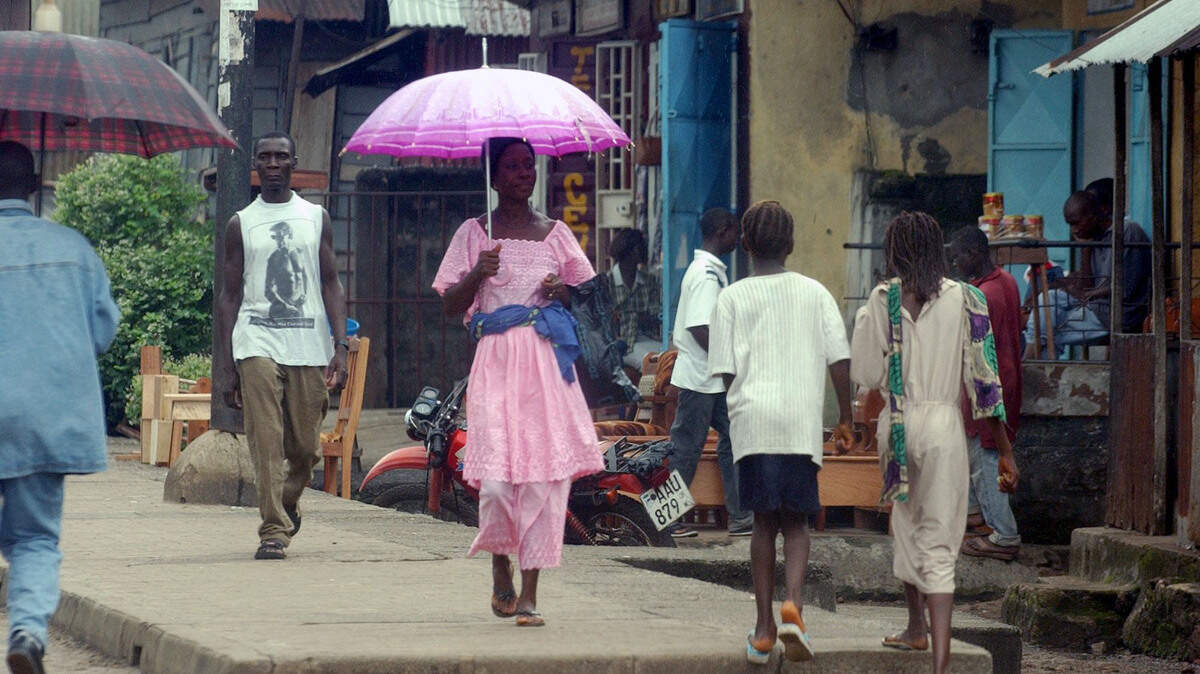
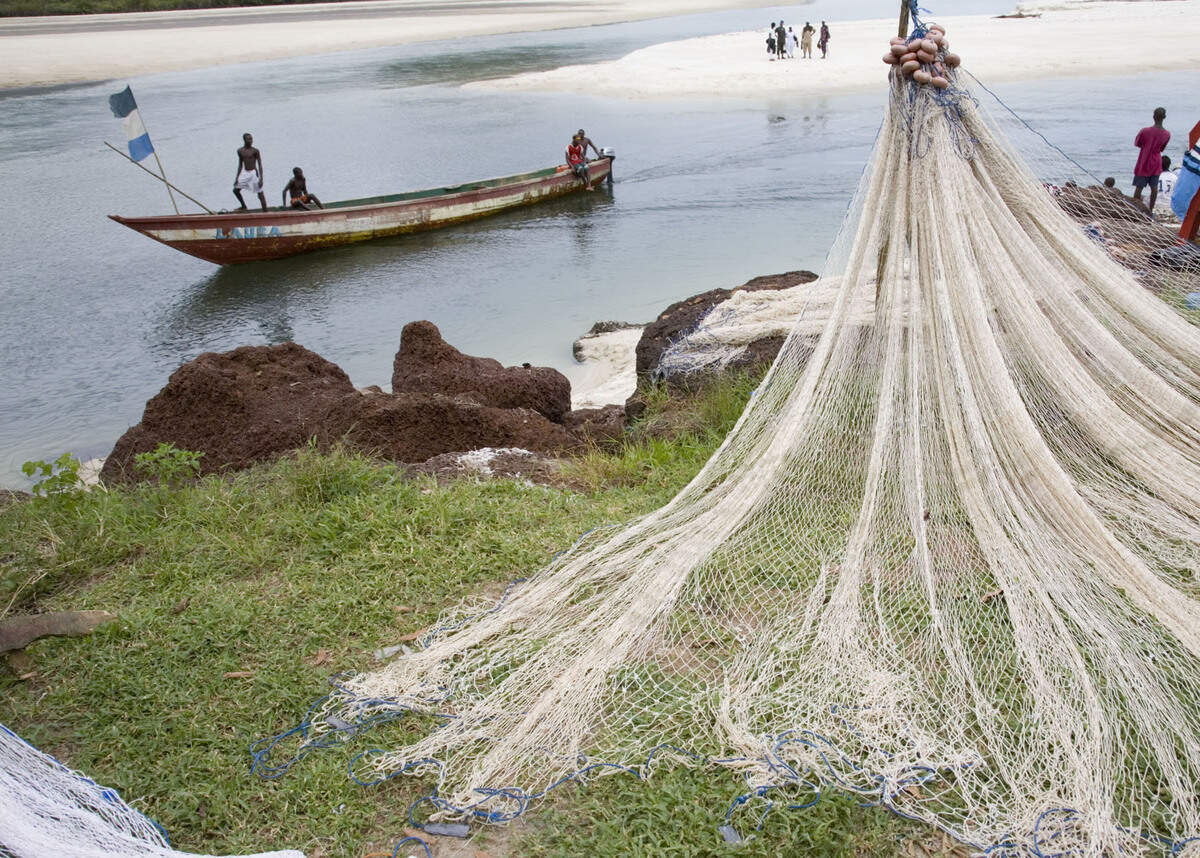
Six weeks later, I received the results. My paternal line traces to the Mende people of Sierra Leone. My maternal link is here, among the Songhay people of Niger.
I have come to Africa to find out what that means.
NIGER
Niger is Africa’s second-largest country, about twice the size of Texas. Much of it lies in the Sahara Desert, north of Nigeria. It’s a difficult location which, combined with the fact that the nation is landlocked, helps explain why its population is a relatively-small 11.3 million. Indeed, this former French colony is one of the least-densely populated places in all of Africa.
Not that you’d know this from stepping into the streets of Niamey, the capital city. They, positively writhe with activity. Cars rush headlong. Scooters with men riding double weave dangerously among them. People drive with a recklessness that would make a New York cabbie flinch.
The curbs are crowded with mud huts and lean-tos from which sellers step into the street to hawk candy, Coca-Cola and cellphone calling cards. The air is cross woven with sounds of French, Hausa, Djerma, more. Some people wear traditional African robes. Others opt for T-shirts advertising Adidas, Phat Farm and Jesus. The sand is everywhere, covering everything. Indeed, there are places where the pavement just ends, as if in surrender, and the sand takes over, vast avenues of it, ferrying cars and people and the occasional camel to their destinations.
My guide is Kedidia Mossi, a 40-year-old single mother who runs a public relations firm. A Nigerien born in France, she spent a dozen years studying and working in the United States. For the last five years, she has moved back and forth between France and Niger.
Kedidia is Songhay, the tribe to which my maternal DNA links me. She says her family is after her to stop her wanderings and settle in her ancestral home.
She wants to. And she does not.
France has infrastructure, medical care, opportunity. But Niger is home. She is torn.
On this first morning, she takes me to do some sightseeing and to run some errands within walking distance of my hotel. It’s an educational experience. We visit a zoo where sickly looking animals lie prostrate in the shade. We tour a small museum of Songhay artifacts — musical instruments, cloth and gourds.
Then Kedidia leads me through a crowded marketplace. People reach toward us, advertising either the trinkets they have for sale or just their own misery and need. Kedidia passes them as if they are not there. Which seems cold until you count the hands and realize that if you stop, if you even make eye contact, you will be subsumed. The need — for food, for clothes, for everything — is greater than your resources.
So I keep moving, stepping gingerly across a sidewalk where a vendor is selling guinea fowl. The birds lay still, as if plastered to the concrete by the heat. The street itself is also obstructed, so crowded with vendors that cars are forced to creep through single file. At the end of the block, a white woman stands looking sheepish, having driven her 4X4 head first into one of the craters — calling them potholes really doesn’t do them justice — that pockmark the streets.
Kedidia and I pass by just as a crowd of two dozen African men seizes the front bumper of the car and with a manly shout, lifts it from the hole. The sheepish woman drives quickly away.
We cross to a supermarket. Sitting on the curb outside, a man in a dirty Chicago Bulls T-shirt reaches an empty hand up to me. I ignore him as I have seen Kedidia do. He swivels after me on his hands and I see that he is wearing sandals on them. His legs are shriveled and useless. Polio, I will later learn.
I pass him a couple times and each time he follows me, swiveling as if on a hinge, then lifting his empty hand.
We go around the corner where we finally find what we were looking for: a vendor selling an adaptor that will enable me to plug in the expensive electrical devices I have brought with me from home.
AFRICA’S “SHAME”
“I hope you don’t take our pictures and go away and put shame on us.”
A woman I don’t see yells this after photographer Sarah Glover and me the next morning as we walk through the rural Songhay village of Boubon, a parade of children stringing out behind us. It strikes me as a perceptive thing to say.
It has always been easy, after all, to “put shame” on Africa, easy to heap pity upon a continent that seems like the world’s eternal basket case. Consider Niger itself. Only 15 percent of the population is literate. One in four babies born here dies. Its people have a life expectancy of 46 years.
But you are not here long before you realize there is more to the picture. That poverty is not the end of life.
“Even if you’re poor here, dignity is very important to you,” Kedidia counsels.
Indeed, for all its undeniable suffering, Africa is also a reminder that you don’t miss what you’ve never had, that contrary to what the American advertising community would have you believe, one is not incomplete because one does not own a microwave and a Cadillac. And that, regardless of circumstances, life has this way of being lived.
So in Boubon, about 15 miles northwest of Niamey, where there are no cars and narrow dirt paths cut between the huts and every building is made of mud, you don’t find people sitting on their hands bemoaning circumstance. What you do find is a girl pumping water out of the ground and a lively marketplace where vendors are selling peanuts, plastic bowls, tobacco and millet, a grass that is a staple of the Nigerien diet. And you find, too, a small group of men and boys on the porch of a thatched-roof hut, eating from communal bowls, taking a break from studies of the Koran.
When they learn why I am there, someone makes a wry offer to give me a “chita,” the facial marking that distinguishes Songhay men. The tradition began centuries ago, when people started disappearing and no one had any idea what had happened to them, no knowledge of the Middle Passage or the slave trade. All they knew was that their children were gone. So they began to mark them in the hope that if they ever saw them again, they would know them.
“That’s your identity card,” the man says, “so wherever you go, they know that you are Songhay.”
A HISTORY LESSON
We travel between the villages on narrow, but serviceable roads that cut across vast flatlands and fields of millet. Occasionally, we pass old Toyota vans, crammed with bodies, ferrying people between the villages. At ferry crossings and entering villages, you see welcome signs bearing a familiar red and white logo. Bon voyage from Coke. American enterprise at work.
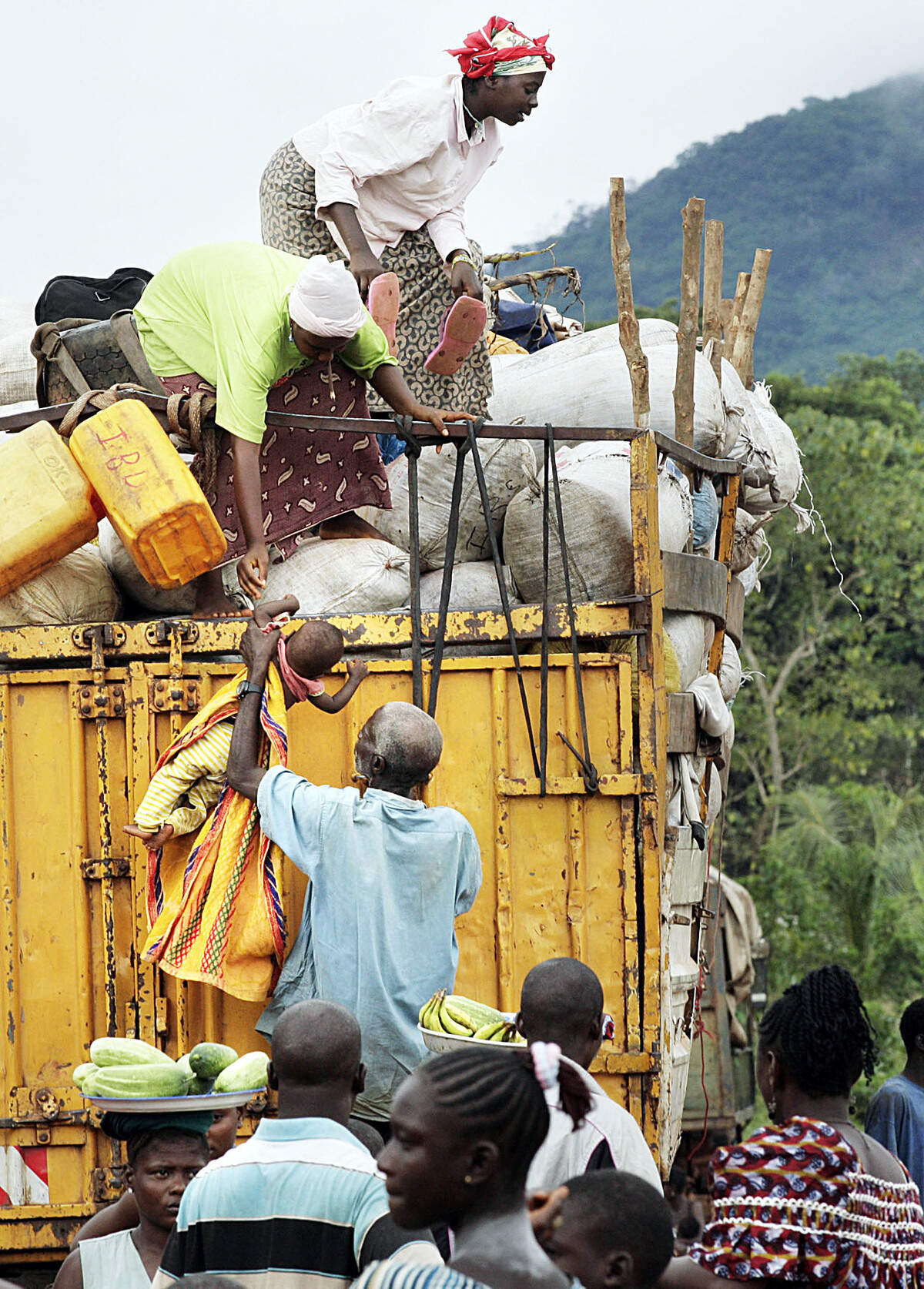
By the side of the road, girls walk with produce and jugs balanced on their heads and boys drive donkey carts. Goats cross the road gingerly, scurrying out of the way at the sound of an approaching vehicle.
This is smart. Our driver, Nasser, has a lead foot. The landscape flies past.
When we pass through villages, people always turn to watch us going by. In the village of Karma, a boy named Rashid even runs alongside our vehicle, pointing us to the river, where the women are washing clothes and selling green pumpkins. He grins with the sheer joy of exertion. We give him a few CFA, the local currency, for his trouble.
It is near sunset that we find ourselves in Namaro, a Songhay village about 18 miles north of Boubon, where we are granted an audience with the chief, Amirou Namaro. He receives us sitting on his cot wearing an elaborate blue robe. Besides the cot, the room is furnished with a clock, a rug, a radio and a few chairs. Outside in the compound, his wives are tending to children and preparing the evening meal.
I ask what being chief entails. Through Kedidia, Namaro launches into a long recitation of his lineage, at least 14 generations of chiefs. Given that I can only recount two generations with any confidence, I am impressed and tell him so. Namaro laughs and says something to Kedidia.
“He says they have to know it,” she translates. “They know their lineage all the way to the Askia.”
That would be Askia Mohammed, who took the throne of the Songhay nation in 1493. In his 19-year reign, he built one of the largest, wealthiest and most fearsome empires of that day.
“Before the white people came to Africa,” says Namaro, “the Songhay used to be stronger, used to have more power in this region. They’d go to other lands and fight and make war. That was their job, to make war and win. . . . And then the white people came and they destroyed all the traditions, the structure and the power for them.”
A NIGHTMARE
We leave the village the way we came — meaning, at high speed on a road that rides like one long rumble strip. Nasser, gifted with more enthusiasm than actual skill, accelerates through craters that bounce us against the ceiling, the vehicle fishtailing as it lands.
Somehow, we reach the ferry crossing the Niger River without injury. The boat’s ramp is lowered into the muddy water, so that the line of cars and trucks must drive down into the river and then up a steep and slippery incline to the deck. This challenges the skills of even the most experienced driver. And then there is Nasser.
When our turn comes, he stomps the accelerator and we hit the ramp with a jarring thump. Our wheels whine and spin, seeking purchase on the wet metal, but to no avail. We slide back into the water. Nasser backs up to take a longer run at the ramp, but we just end up in the water again.
At this point, Kedidia’s had enough. She bails. Sarah decides to stay in the car because she is a professional photographer with thousands of dollars worth of equipment at stake. I decide to stay because I am an idiot.
One more time, Nasser gives it the gas. The car bolts forward and slams the ramp, wheels squealing. We begin to slide but then, without warning, the tires catch and the vehicle leaps onto the deck.
Straight toward a row of parked cars.
Nasser spins the wheel and the car skids left, now sliding toward where the passengers are seated. Miraculously and — thank you, Jesus — we stop short of tragedy. Nasser backs triumphantly into place.
Other vehicles follow, some with livestock tied on top. One van has a bunch of birds — chickens, or guinea fowl, I can’t be sure — tied by their feet, hanging upside down. All seem resigned to their fate in someone’s cooking pot except one feisty rebel who keeps cawing, flapping his wings and lifting above the van until the restraints on his feet are stretched taut.
The three of us cross the river in gathering darkness, the ferry engine chugging loudly. The sun is an orange disk in a sky the color of dust. The river is placid and brown.
Half an hour later, we are speeding toward Niamey, when I chance to glance at the gas gauge. The needle is poking E.
I point this out to Kedidia and she asks Nasser if we have enough gas to make it back to Niamey.
“Maybe,” he says.
The sun goes down. Blackness settles, featureless and impenetrable. I slump into my seat, mentally calculating what it might be like to spend the night stranded in one of the more remote places on earth. No cellphone signal. No gas station. No auto club.
And little in the way of food or water.
Eternity passes twice before Niamey appears.
When we pull up at the hotel, I blow kisses to the building. In the darkness beside me, Nasser chuckles softly.
AFRICANS IN AMERICA
It is morning and we are on the road again. We have a full tank of gas and are provisioned with tall bottles of water and sandwiches from the hotel. We have a new driver.
We also have a passenger, Kedidia’s 51-year-old cousin, Oumaarou Souleymane, a farmer and Koranic scholar. He is a tall man with a gentle, gracious air. I have been asking him questions about his life. Then, through his cousin, he says something that stops me cold.
“They’ve heard that in America there are a lot of black people and that the black people originated from this continent,” says Kedidia, translating, “but how they got into America, they don’t know. Whether they went there by themselves or somebody took them, they don’t know.”
He doesn’t know how Africans got to America?!
Sarah and I trade a look and then speak simultaneously. “Can we tell him?”
But how are we supposed to do that? How do you convey it in 25 words or less to someone who has no conception? How to make him understand buying human beings on credit and building a pit so that a pregnant woman can lie her belly there as her back is whipped to tatters? How to explain black children in cages swinging above the fancy dinner table to fan flies from the white diners below?
We try, but I can see from his face that he does not understand. Kedidia adds some thoughts of her own, explaining to him that when Europeans went to America, they discovered native peoples living there and subjected them, too, to brutal mistreatment.
The natives’ ordeal doesn’t register either. “They were human beings?” he asks.
Yes, we say. They were.
Souleymane is not unique. It turns out that the fate of the Africans stolen away from these shores remains something of a mystery to many of those who have spent their lives in rural villages. Two hours later, Koulbeye Ousseini, Kedidia’s aunt, wants to know about “our black people in America. What are they doing? What kind of work are they doing? What’s the kind of life?”
So Sarah and I try to tell her, to capture in a few words that delicate dance between progress and pain that characterizes black life in America. Many African Americans are succeeding beyond the wildest dreams of their forebears, we say. Many others are mired in poverty and prison.
“They should continue to do the good jobs,” she says. “That way they won’t have problems.”
Sitting in his open market, her husband, 84-year-old Ali Mossi, also has questions about America. “He has heard your ancestors were here and taken to America,” says Kedidia, translating. “He says that unfortunately in this culture there is no written history, so they don’t know what happened exactly.”
So yet again I find myself trying to condense 400 years of African-American history. Finally, I tell Mossi that I am here because I am trying to understand my heritage — because I took a test which said that I am Songhay like him.
The old man’s eyes flicker, but he doesn’t respond to this. Instead, he launches into a speech extolling the fierceness of the Songhay warriors, the fact that they were unbeatable in warfare until their arrows and spears came up against guns. He even sends for some of his war weapons and poses with them for Sarah’s camera.
Afterward, I turn to Sarah and ask if she is ready to leave. But suddenly, the old man is speaking energetically to his niece. I wait for him to finish, then look to her for the translation.
“You’ve told him your ancestors came from here and he has heard also from his own grandparents that some people were taken from here to America. And because you took the time to come here to see him, he is very grateful that he has seen people who were lost. He says he is very, very thankful because you recognize that your ancestors came from here, that you honor him and he’s very grateful to God for that.”
People who were lost, he says. And the first thing that comes to mind is a lyric from an old hymn that is often sung in the African-American church.
“I once was lost,” it says, “but now I’m found.”
I glance at Sarah, but I can see that she, too, is struggling for words.
I ask Kedidia to tell her uncle that the honor is entirely mine.
AMERICAN DREAM
We spend a lot of time here trying to explain America. It is the lighthouse in the storm in this part of the world, an exemplar looked to with hope and expectation. People speak of America as they speak of dreams. Every bright young man, every beaming young woman, tells you confidently that they are going there.
You ask an old person if they’d like to go to America and their eyes go out of focus as if fixed for a moment on yesterday’s ambitions, now yellow and brittle with disappointment and age.
“I’m too old now,” they’ll say. “But maybe my son or daughter. If my child can get there, get an education, make some money . . .” The thought makes them smile. It’s always a sad smile.
“America is a country that helps other countries a lot,” says Kedidia’s cousin Souleymane, “and that cares about humanity and about the well-being of the rest of the world. A lot of young people and even some adults’ life dream is to visit America.”
“You are from America?” asks Hassan, a 28-year-old shopkeeper, excitedly. I am in his store buying a soda.
I tell him yes. He points to the floor. “First time?”
Yes, I say. This is my first time here. Hassan, who says his command of English is “small, small,” makes me understand that he desperately wants to go to America someday. “In Africa is difficult to succeed.”
Having spent so many years in the United States, Kedidia’s view is a bit more jaded.
“I went to a black school in Alabama,” she says. “After that, they took me to Nebraska to study agriculture. And it was so hard. First of all, we have the culture shock of being there, people you don’t know, a culture you don’t know. I lived in this little off [campus] house with a lot of white people who came from rural Nebraska. I was longing to get closer to the African Americans, but there was no connection until later on.
“It was very, very difficult,” she adds. “Sometimes, some white people played a game of dividing the African Americans and the Africans. ‘Oh yeah, Africans are different from African Americans.’ They have this stereotype of the African Americans and they try to make you feel [like you are better than an African American]. I’d tell them, ‘The only difference between me and an African American is my ancestors were not brought here. If my ancestors were brought here by force, you would say the same thing about me.’ “
But Kedidia would like to return to the United States someday. Or barring that, to France. Still, there’s the matter of her family, pressing her to stay in Niger.
I ask if she ever feels herself torn between cultures. She hesitates before admitting that she does.
SONGHAY SOPHISTICATE
Lunch is served. I am wondering how I can get out of it.
Drink only bottled water, eat only food prepared hot in restaurants that cater to tourists. This is the stern warning the doctor gave me when I told her I was going to Africa. She ran down a list of nasty diseases to which Africa visitors are susceptible and cautioned me to be careful about what I put in my body.
Yet here I am, about to disregard that sensible advice. Problem is, I can’t see any way around it. We are in the courtyard of Oumaarou Souleymane’s home. Goats are milling about, one of his children is pounding millet in a gourd. Souleymane is off praying and without our knowing, one of his wives has prepared us a meal.
Is there a way to turn that down? To politely say, “Thank you, no?”
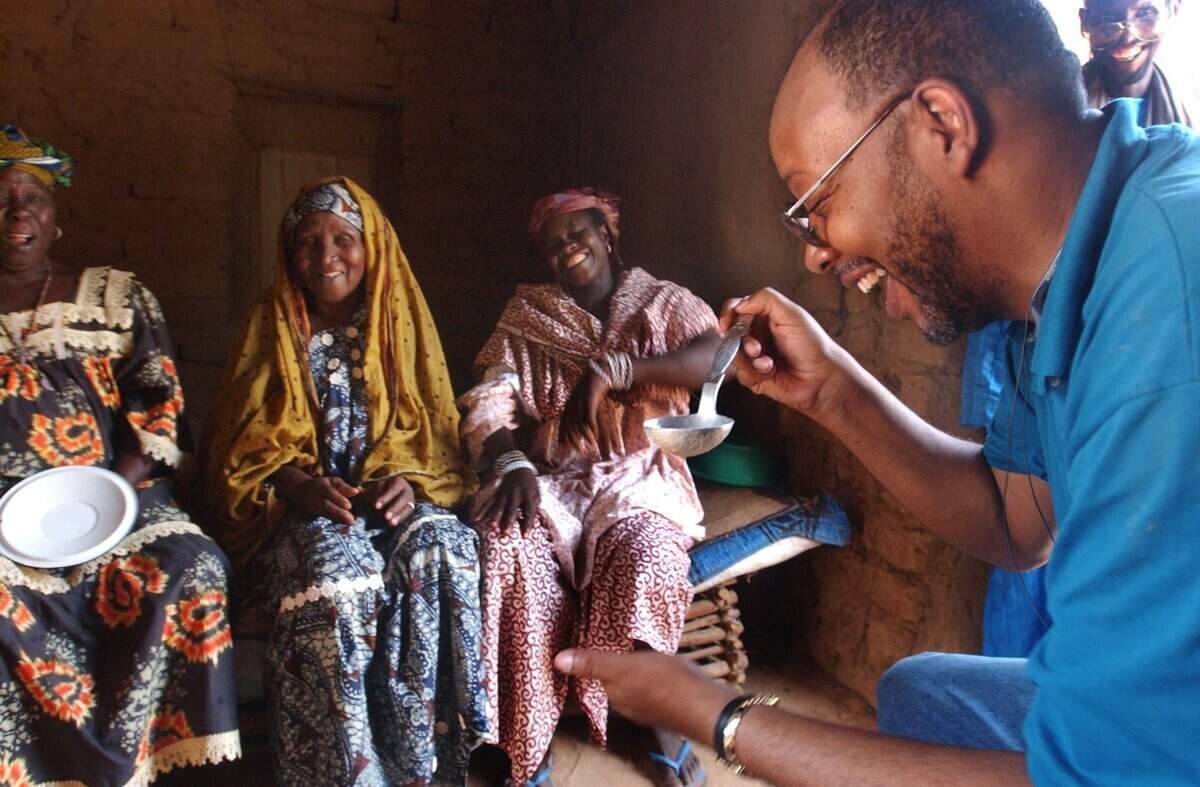
If there is, I can’t think of it. So we remove our shoes and file into the hut where the food is waiting. There are three pots, one with scrambled egg, the other with chicken legs, the third with a soupy porridge called donou. Fanning at the flies that are a constant torment, I eat a piece of chicken. With my fingers, I scoop out a few bits of egg. But I draw the line at donou.
Three times in the last hour, I have been served this stuff. The first was when Koulbeye Ousseini offered me some. The second was after I’d made a face like Frankenstein’s monster taking NyQuil and Sarah asked me to take another sip so she could get a picture. The third was when we went to say goodbye to Ali Mossi and he bade us drink our fill.
Donou is made from millet and yogurt. It is pasty white with green flecks, tastes gritty, sour and sickly warm.
Souleymane’s wives are not around to be offended, so Sarah and I pass on the donou. Having eaten enough to be polite, we step out of the hut into the sun. Then I realize Kedidia is not with us.
She is still inside, sitting cross-legged on the floor, hungrily spooning up donou. It is an image that stops me. Kedidia, you have to understand, is a sophisticated woman. Dresses with a flourish, speaks at least three languages, travels internationally, holds advanced degrees.
She is also a Songhay woman. Somewhere along the way, I think I forgot this. Maybe once in awhile, she forgets it, too.
But just when you think you’ve moved beyond reach of its tethers, culture has this way of sneaking up on you, this way of reining you by small gestures, rooting you by little things. Suddenly you are reminded who you are. And that who you are is about more than blood. It is also about where you come from and the things you saw when you were there.
Kedidia catches me looking. She smiles. “Sometimes,” she says, lifting the spoon coated white, “I have such a craving for this.”
Sarah and I wander away. Our guide lingers behind us sipping donou, sitting cross-legged in the dirt.
HOW THIS STORY HAPPENED
In August 2003, Herald columnist Leonard Pitts wrote a moving essay about using the African Ancestry DNA-testing service to determine his ancestors’ origins. His mother, he found, was from the Songhay people in Niger. His father, from the Mende of Sierra Leone.
“Knowing that gave me a gladness that’s hard to articulate. Like finding the jigsaw’s missing piece. I felt a quiet joy. It made me want to know more. Made me want to go there,” Pitts wrote.
Last July, the Pulitzer Prize winner did so. Joining him was Sarah J. Glover, photographer from The Philadelphia Inquirer, The Herald’s sister newspaper, who was already in Africa thanks to winning the National Association of Black Journalists Ethel Payne Fellowship.