
Classic '97: Ice fishing for a 1917 Zamboni oui will go
This Dave Barry column was originally published Tuesday, September 30, 1997.
Ice hockey got its start in Canada, which stands to reason, because Canada has an abundant supply of the element that is most essential for the sport: Canadians. As soon as they learn to walk, Canadians strap on ice skates and get out on the nearest lake or pond. They do this even if it's the middle of summer; thousands of them drown every year. But the survivors quickly develop the toughness, the stamina, the resilience and -- above all -- the buoyancy that your top hockey players must have.
The first known ice-hockey games were played on frozen lakes near mining towns. There were no nets, no blue lines, no face-off circles, no grandstands, no referees, no helmets and no organ music. There were Zamboni machines, but they were huge, horse-drawn, steam-powered contraptions that crashed through the ice and sank without a trace, so the games always had to be canceled after the first period, not to mention the fact that there was a bad horse shortage.
But the big difference between modern hockey and those early games was that back then there were no goals. Instead of trying to score, the players would just skate around and try to whack each other with sticks, the object being to get sent to the penalty box, which in those days was an actual enclosed box with a lid on it, which meant it was the only place you could get warm. Often by the end of the game there would be as many as 30 guys in there.
So in many ways, the early game was very different from the one we know today. But the names of some of those early hockey stars -- names like Edouard ``The Little Gallstone'' LaPoing, Scotty ``Frenchy'' MacHootmon and Pierre ``The Acute Angle Between the Wings of Certain Airplanes Designed To Improve Lateral Stability'' Dihedral -- are still spoken of fondly in Canada whenever Canadians get together to speak fondly of names.
In the late 19th Century, two technical breakthroughs brought a major change to the game of ice hockey. The first was the invention of goalposts, which gave the players something to aim for. However, the goalposts were not really used to their fullest potential until several years later, with the invention of the puck (which gets its name from the ancient French word ``puque,'' meaning ``a small black object that you cannot see on television'').
With the puck, it was finally possible to have scoring, a development that led to the founding, in 1917, of the National Hockey League. At first there were only two teams, the Toronto Fromages and the Toronto Fighting Pinafores, both of which made the playoffs that year. It was a hard-fought series, but Toronto, led by 52-year-old Bobby Hull, prevailed and was awarded the Stanley Cup, named for the league's first commissioner, Pete Rozelle.
Professional ice hockey quickly grew in popularity, and it was only a matter of time before the United States got involved, which led to World War II. By the time the smoke had cleared, there were six teams in the National Hockey League: The Montreal French Persons, the Chicago Dental Assistants, the New York Nicknames, the St. Louis Prongs, the Boston Office Supplies and the Orlando Magic, all of which made the playoffs that year. These would remain as the only six teams in the league until 1978, when 125 new teams (all of which made the playoffs that year) were added to accommodate Wayne Gretzky, who is contractually obligated to change teams every two weeks.
Another big improvement was that goalies started wearing protective masks. At first they wore them in their pants, but then, when they found out about protective cups, they realized they could wear the masks on their faces, and the modern era of hockey had begun.
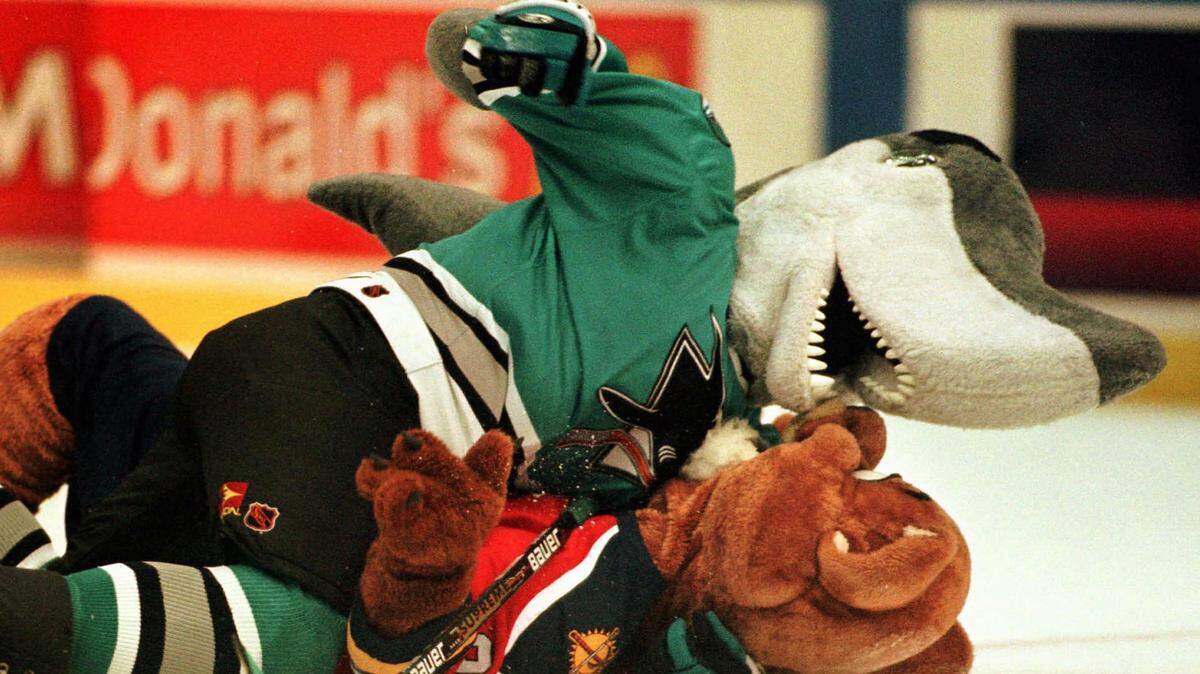
Today professional ice hockey is a fast-paced and exciting sport featuring end-to-end action that never stops except for about every 30 seconds, when there is either ``icing'' or a fight. The National Hockey League has been making an honest and sincere effort to stop the fighting for several decades now, but it has had no luck. One possible solution would be to make a rule stating that players who fight will be thrown out of the game, but this apparently has not occurred to the NHL. Instead, the league has elected to prevent fighting via the following strict procedure:
1. When two players start punching each other, the referees immediately skate over and stand around doing nothing.
2. When the players start to get tired of punching each other, the referees move toward them, as a signal that if they plan to punch each other some more, this would be a good time to do so.
3. When the players are unable to punch each other anymore, the referees send them to the penalty box to rest their arms for a few minutes, after which they may return to the ice and resume punching each other.
For some baffling reason, this strict procedure has failed to stop fighting. Nevertheless, NHL hockey continues to be very popular with the millions of loyal fans who will fill the arenas this year, which happens to be the 80th anniversary of the founding of the NHL. It's an occasion that will be marked by many festivities, as well as a historic effort by salvage divers to locate and resurface an early Zamboni machine believed to be lying on the bottom of Lake Huron. It's going to be a great season. Your team will make the playoffs.
This story was originally published September 30, 1997 at 12:00 AM with the headline "Classic '97: Ice fishing for a 1917 Zamboni oui will go."