
Gardeners should also take care of trees’ roots. Here are the do’s and don’ts
To a shade tree, the first part of that supply chain is its roThere’s not one of us who hasn’t been impacted by supply chain issues these past 12 or 18 months. When the supplies don’t get where they’re needed, progress comes to a screeching halt.
ot system. Water passes into the roots and from there it’s transported through the xylem cells (the bulk of a tree’s trunk — the “wood” of that trunk) up to the leaf canopy.
Along with the water, carried in water solution, will be the essential nutrients the plant uses in the manufacturing of sugars that are critical to life on our planet. Those nutrients, whether they are from organic sources or inorganic ones, must be broken down into simple elemental form so they can pass through the roots’ cell walls by osmosis and carried up to the leaves along with the water.
So, that is the front end of a tree’s supply chain. Its importance cannot be overstated. But it’s amazing how often we overlook it as we choose, plant and care for our trees. Mid-fall is a good time to address root problems with shade trees. I thought I might point out some that you’ll see.
Critical Note: As long as you plan to grow trees, you must remember that 90% of any tree’s roots are going to be in the top foot of the soil. Sure, it’s going to have a tap root to anchor it. But the critical “feeder” roots are going to fan out just beneath the soil’s surface where they can efficiently capture rainfall and nutrients. Don’t ever forget that. You’re about to learn why.
Keep the root flare at the original grade
It’s imperative that a new tree be planted at the same depth at which it was growing in its prior home. That’s why you measure the height of its root ball carefully as you dig the hole for planting. And that’s why you do not put loose soil beneath the soil ball when you plant it. Loose soil will compact and settle until the tree is no longer at the original grade. That puts its feeder roots too deep into the ground where they no longer can function properly.
Never add fill soil over more than a small percentage of a tree’s root system
Soil compacts over time. Roots can be suffocated by that compacting soil if you add more than 1 inch of topsoil over more than 20 or 30 percent of a tree’s root system. If you’re building a berm to provide privacy, shield noise or direct rainfall runoff, just be sure it doesn’t impact the soil beneath the tree’s drip line. That’s where you can assume the bulk of the feeder roots will be. As strange as it may seem, you can actually remove 2 or 3 inches of soil from the root zones of most trees and do less damage to most trees than if you add the same amounts over their roots.
Construct a well to maintain the original grade
Sometimes it means putting a retaining wall 6 or 8 feet away from the trunk of a tree and then building a deck across it for safety. Sometimes you can do something on a much broader scale for a large, spreading tree. If you’re trying to save a native tree during construction, you’ll want to have a certified arborist on site with you from the outset. He or she will insist that no construction trucks drive across the root zone and no utility lines be cut through it.
Watch for girdling roots
When you see a root encircling the tree’s trunk or even crowding across another root, nothing good is going to come of that. You need to remove the offending root, and fall is the best time to do so. The demand for moisture is at its low ebb now. If you’re using a chain saw to cut a root, a quick warning: don’t let the saw blade come in contact with soil. It will instantly dull it. Use a long-handled axe or a hand saw for that part of the task.
Root sprouts need to be removed
Some tree species have the bad habit of sending up sprouts from their shallow roots. Silver poplars certainly do it, and a small percentage of live oaks will do it. When challenged, so will ornamental pears. They have short life expectancies anyway, often splitting in wind or ice storms, and when they do, sprouts start appearing all over the yard.
Let me concentrate on the live oaks, since the sprouts that small percentage will produce will be growing while the trees are still healthy and vigorous. You are going to have to dig them out by hand, because they are still tethered to the mother tree, and anything you apply to them directly will be carried back to “mama” immediately. Use a sharpshooter spade after a heavy rain to sever them several inches below grade. Hopefully each one that you cut will be gone for good.
Some roots need to stay in place near the surface
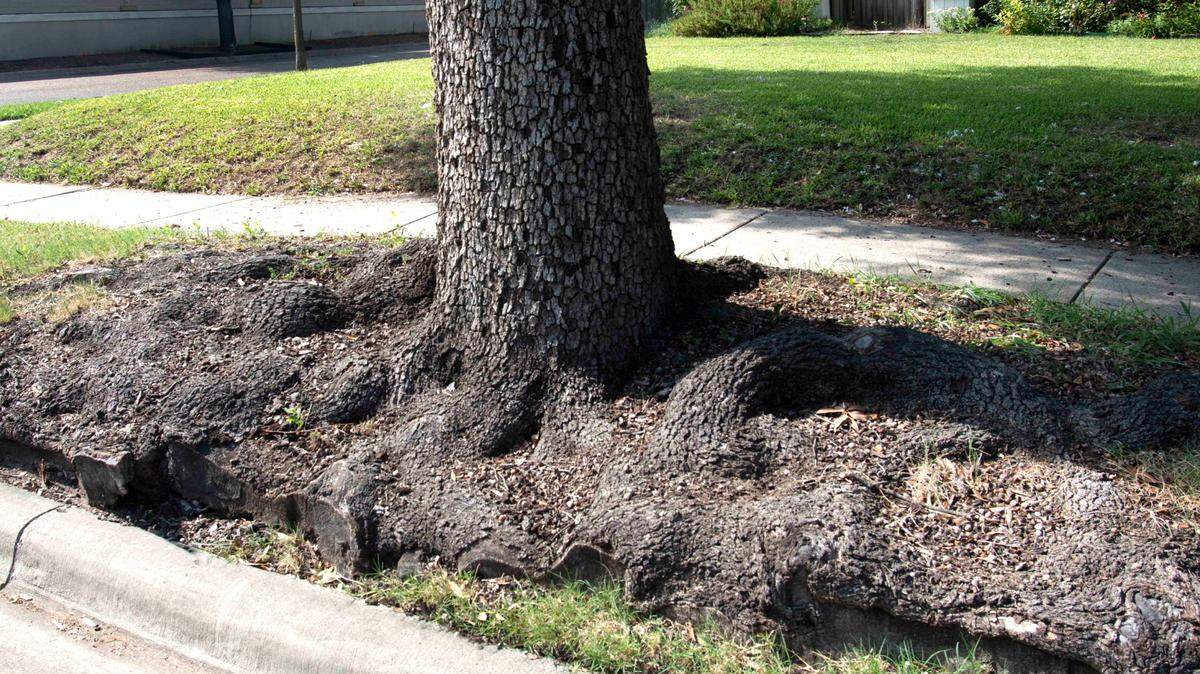
While it’s true that you can remove an occasional surface root or two each year (as long as it’s not too large), if the grass is thinning and the sight of exposed roots is bothering you, make the switch to a shade-tolerant groundcover that can conceal them. Mondograss and liriope are two good choices. So are Asian jasmine and purple wintercreeper euonymus, although falling leaves may get caught up in their vines. The critical thing is that you not try to pile fresh soil to conceal the exposed roots. You won’t do that, however, because you now know how damaging that can be.
Neil Sperry is a Texas-based horticulture expert. Join him at www.neilsperry.com and follow him on Facebook.
This story was originally published November 5, 2022 at 1:00 PM with the headline "Gardeners should also take care of trees’ roots. Here are the do’s and don’ts."