
UM opens ‘clean room’ for nanotech research
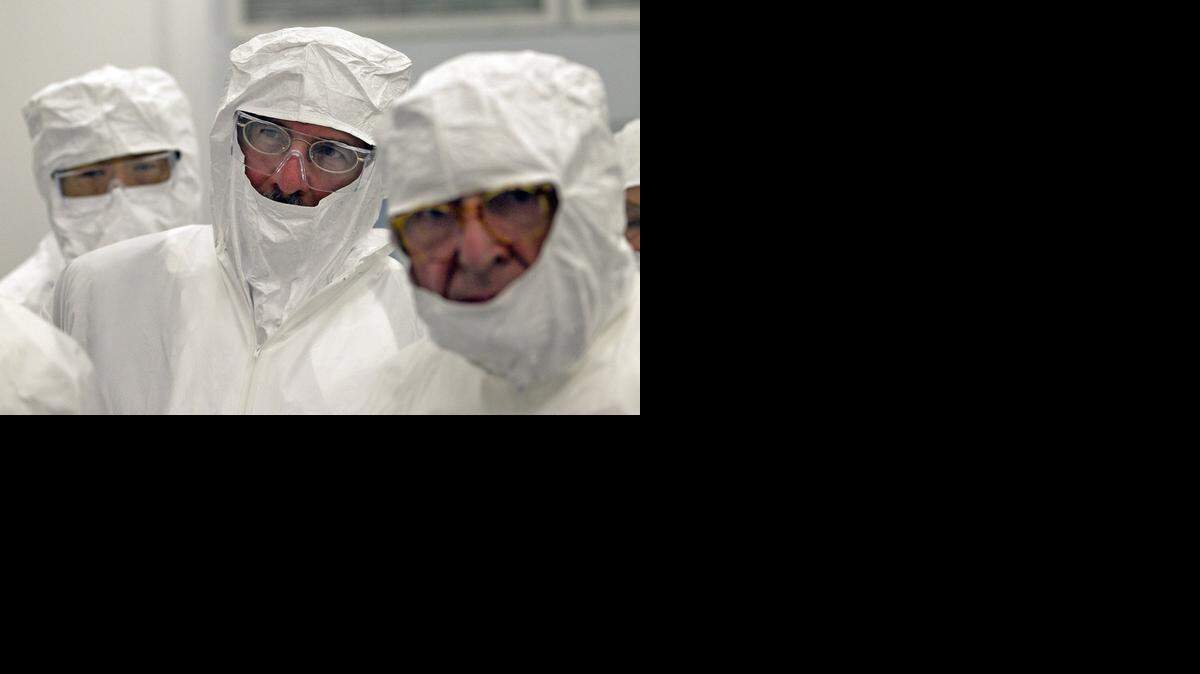
Wearing a white haz-mat suit, a head-covering mask and goggles, University of Miami provost Thomas LeBlanc took a tour Wednesday of what is believed to be one of the cleanest rooms in South Florida — literally.
With a high-powered air filtration system and a strict dress code, virtually every particle of dust is filtered out of the new 2,800 square-foot “clean room,” one of the first nanofabrication facilities built in South Florida dedicated to biomedical research.
“It’s not easy to put this on over a suit,” said the provost after the opening of the Dr. John T. MacDonald Foundation Biomedical Nanotechnology Institute’s nanofabrication facility, located at UM’s Miller School of Medicine. LeBlanc joined nine other white-suited executives in a tour led by Onur Tigli, UM assistant professor of electrical and computer engineering.
“We dress like this to protect the devices we are making,” Tigli said.
By substantially reducing the dust particles that naturally fill the air researchers will be able to work with everyday materials but on a nano-scale — about 100,000 nanoparticles fit into one piece of human hair. In nanotechnology — creating and manipulating materials down to the atomic level — researchers build devices that can capture cancerous cells or replace insulin-making cells in the pancreas.
The hope: Nanotechnology — a nanometer is one-billionth of a meter — will lead to cures for cancer and diabetes, among other conditions. Nanotech devices, for example, would carry medicine directly inside cancer cells, sparing the patient from chemotherapy’s nausea and hair loss.
“This facility puts us on the cutting edge of some of the most scientific and technological research in the world,” said UM President Donna Shalala. “It’s transformative.”
Dr. Richard Cote, director of the John T. MacDonald Foundation Biomedical Nanotechnology Institute, said the room needs to be clean because “even a dust particle is enormous compared to what we are working with.” UM recruited Cote from the University of Southern California.
A typical office building contains 500,000 to 1 million particles per cubic foot of air. The clean room is designed to never allow more than 100 particles per cubic foot.
Cote said that by using nanotechnology, researchers will be able to detect diseases early, deliver treatment to the right place at the right time and restore tissue and organ function. They’ve been developing a nano-scale blood test that will identify tumor cells in the bloodstream, before they can metastasize to other organs in the body.
In 2012, the Dr. John T. Macdonald Foundation gave the nanotechnology department a $7.5 million grant to increase its efforts in the field. UM used the grant to build the clean room and to recruit researchers. The researchers are developing nanotech devices to be used in medicine, engineering, chemistry and physics. In science, nanotechnology is creating smaller and faster computer chips.
Meanwhile, Florida International University has had a smaller clean room for the past 10 years, focusing on broad-based research, including engineering and biomedical. The university has worked with UM over the years.
“We have collaborated in the past,’’ said Neal Ricks, manager of FIU’s Advanced Materials Engineering Research Institute.
By combining biomedical with the sciences, researchers can do more to devise cures and treatments for prevalent diseases, Cote said.
“Having this facility is fundamental to the success of our program,” he said.
An earlier version of this article had incorrect information provided by UM. Florida International University has had a smaller clean room in operation for 10 years.
This story was originally published January 28, 2015 at 9:44 PM with the headline "UM opens ‘clean room’ for nanotech research."