
Work-out studio can help those with spinal injuries
When Alfredo Iglesias dove along the coast of Playa de Carmen resort in Mexico where he and his wife, Michelle, were spending their honeymoon in 2008, he didn’t realize that the water was only thigh-high. His neck snapped. He was paralyzed from the neck down and airlifted to Jackson Memorial Hospital from Cozumel.
Iglesias, 34, was frustrated and hopeless during therapy, which involved traditional in-chair exercises, which he says were “limiting” and “too light.” He felt that he wouldn't be able to make any progress unless his body was seriously challenged.
After visiting and participating in Project Walk: Paralysis Recovery Center in California, Iglesias made plans to open a workout studio in Miami designed to help people with paralysis and spinal cord injuries through out-of-the-wheelchair exercises, led by specialized trainers, including a kinesiologist, who studies the body’s movement.
In February of this year, he and his wife opened i Am Able Fitness, a nonprofit in West Kendall. “We've been thrust into something that no one knows how to deal with. I want to help ease the transitions and help people,” he said.
The project has caught the eye of the Miami Project to Cure Paralysis, a spinal cord injury research center affiliated with the University of Miami Miller School of Medicine.
“Anyone could focus on themselves and even with what he’s going through, he wants to help everyone,” says Deena Cilien, a senior research associate at the center.
She met Iglesias three years ago when he was participating in a hand study to see if electrical stimulation would help improve his movement. She and her staff regularly refer individuals to i Am Able Fitness and the studio is listed on the Miami Project’s website as a resource for “Living with Paralysis.”
“It's important to keep your body active because one day if we are able to find a cure, then people who have been conditioning and learning how to bear weight through rigorous exercises at i Am Able will fare better in recovery,” Cilien said.
Most of the equipment in the one-room studio is designed for able-bodied people, with only a few exceptions.
“It feels like you're pushing an immovable object — constantly, but you've got to keep doing it until it moves a little,” Iglesias says of the intense workouts and the equipment. “Working out in a chair isn’t ideal for our bodies.”
He believes that by conditioning all the parts of the body, especially the parts that have little to no feeling, that some form of recovery can be possible over time through re-establishing neural connections. He points out that traditional therapy just works the parts of the body that still have feeling.
“I know the difference because I live it and I understand it,” he says.
“They see beyond the chair,” Michelle says of her husband and their clients.
Julio Gutierrez, 53, of West Tamiami became paralyzed from a reaction to a flu vaccine on July 19, 2012. Approximately 300 people get Guillain-Barre Syndrome annually from flu shots, a disorder in which the body's immune system attacks the nervous system.
“People used to call me Sponge Bob because my legs were so skinny. My wife would even dress me in a yellow shirt,” says Gutierrez, who says he’s built strength in his quads, glutes and hamstrings in the three months that he’s been a client there.
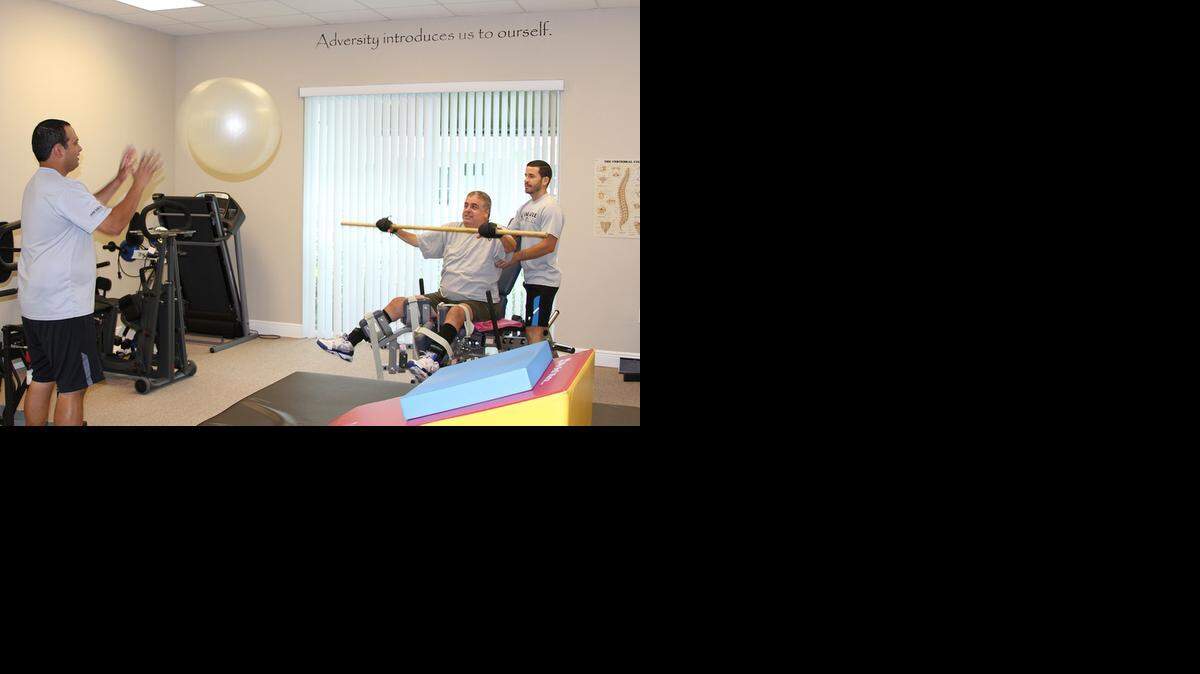
He goes one to two times weekly for a 90-minute session and can now push himself out of his wheelchair, stand and even walk a few steps while holding onto the trainer, something he says he couldn't do while undergoing traditional therapy.
On a recent day, the former criminal defense and immigration lawyer is on the Power Plate machine, which vibrates at the base so that it's more challenging to maintain balance while providing electrical stimulation throughout the body. Two specialized trainers, Sachi Gundrania, 28, a kinesiologist, and Osvaldo Reyes, 25, are working with him.
“If we stop working out, how are we ever going to recover?” Iglesias says as he watches Gutierrez from his wheelchair. His aide dog, a black Labrador, is by his side.
The couple’s dream is to eventually make fitness therapy at i Am Able free.
“I can't find enough philanthropic donors to make it free for everybody. Monetary resources shouldn’t have to be the reason why people can't come,” says Iglesias, who has to allocate costs for special equipment and specialized staff.
The out-of-chair sessions are $90 an hour. They welcome people with all forms of paralysis: quadriplegics, tetraplegics and paraplegics.
“It’s the clients’ hard work that really makes it work. If we stop working out, we’re going to wither away in our chairs,” Iglesias says. “We’re designed to stand, not sit.”
Guiterrez says it’s the little victories that people need to focus on to stay motivated.
“I can’t give up. When I fall they catch me,” he says, nodding at trainers Reyes and Gundrania.
“You never fall,” Gundrania says.
“You always catch me,” Gutierrez replies.
If You Go
What: i Am Able fitness studio for people with spinal cord injuries and paralysis
Where: 14221 SW 120 St., Suite 101, Miami,
Cost: $90 per hour session
Call: 305-283-9717 or email: info@iamablefitness.org
This story was originally published October 20, 2014 at 7:36 PM with the headline "Work-out studio can help those with spinal injuries."