
Parents of premature infants get lifeline with nurses when baby leaves the hospital
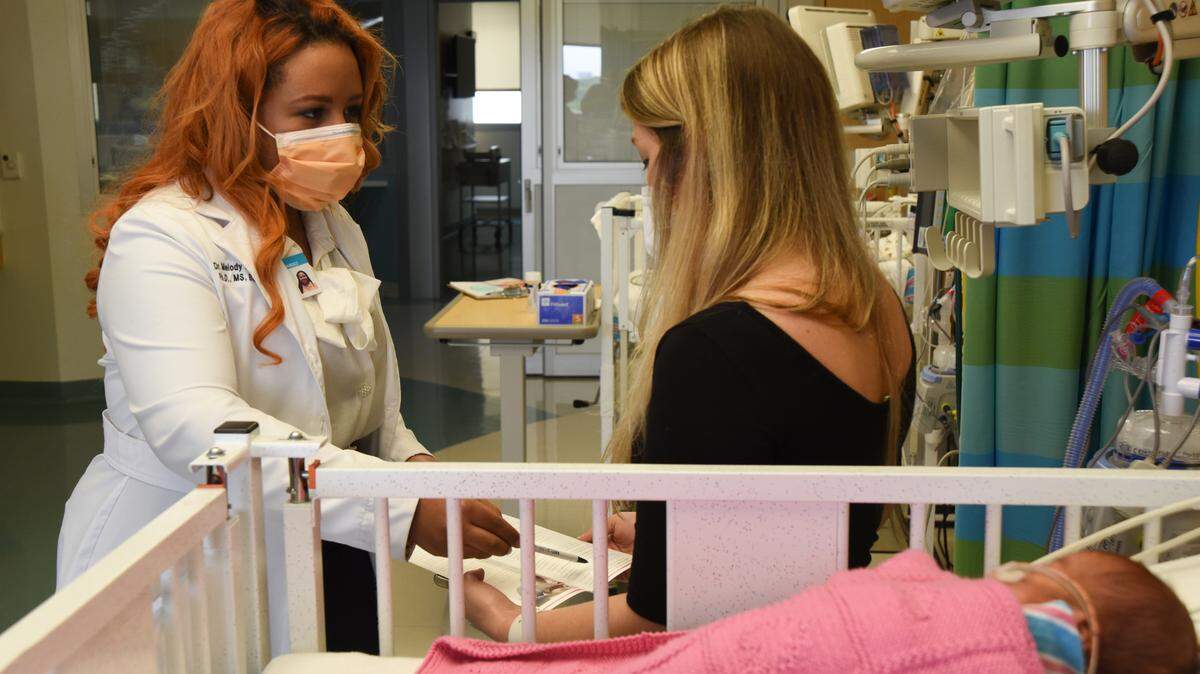
When Sarah Priestley-Akhtar gave birth to twins — a boy, Zayn Priestley Akhtar, and a girl, Sophie Priestley Akhtar — she experienced the outpouring of love from neonatal intensive care unit (NICU) nurses.
“I had a perfect due date for twins,” said Priestly-Akhtar, 36, of Palmetto Bay. “It was 2/22/22.”
Her babies, however, were born three months prematurely, on Nov. 24, 2021.
Sophie, who weighed just 2 pounds, 1 ounce, had to be airlifted by helicopter to Nicklaus Children’s Hospital about an hour after she was born. Her brother, Zayn, was airlifted to Nicklaus the same day. He weighed 2 pounds, 10 ounces.
Though Priestley-Akhtar gave birth to them at Mercy Hospital in Coconut Grove, they needed Level 3 care in the neo-natal intensive care unit (NICU), which Nicklaus offers.
“The NICU nurses really cared for them as if they were their own children,” said Priestley-Akhtar. “They went above and beyond. The specialists and the doctors and the lactation consultants there were phenomenal. We’ll always be forever grateful for the nurses and the care that they gave them.”
Sophie stayed in the NICU at Nicklaus for four months and Zayn for three and a half months. Now nearly 5 months old, Sophie weighs nearly 11 pounds and Zayn weighs nearly 12 pounds.
“Their team was very expansive,” said Priestley-Akhtar. “They had cardiology, neurology. … Every specialist they needed they saw in the NICU.”
Support from hospital to home
Two years ago, Nicklaus Children’s Hospital launched the Baby Steps Program to provide assistance from hospital to home for infants who received NICU services at Nicklaus. Premature infants are at higher risk of developing health complications that can lead them back to the hospital.
“The program offers a nurse-led telehealth transition of care intervention for infants cared for in the NICU and their caregivers,” said Danielle Altares Sarik, Ph.D., a pediatric nurse scientist and a pediatric nurse practitioner at Nicklaus.
From April 2020, when it started, to March 2021, there were 158 telehealth visits and 90 phone calls among the 229 families enrolled in Baby Steps. During that period, only three babies had to be readmitted to the NICU.
So far, around 300 mothers have used the program, funded by a $300,000 grant from Florida Blue Foundation and available to all infants who receive care in the Nicklaus NICU and are discharged to a home setting. Caregivers must reside in Florida. A telehealth visit is scheduled within 24-48 hours after discharge.
“The work grew from the clinical gaps that were noticed by team members,” said Altares Sarik, who also serves as principal investigator of the program.
“The transition of care period represents a critical time during which caregivers need support,” said Altares Sarik. “While discharge planning begins long in advance and parents learn from the clinical team how to provide care, inevitably there are questions and concerns once the family is home. The Baby Steps Program was created to fill this need.”
In the United States, close to 1 in every 10 infants receives care in the NICU within the first month of life.
Getting answers from a trusted source
Verquisha Blige of Miami worked with Baby Steps after her son Johnny’s nine-month stay in the Nicklaus neonatal unit following his birth.
“The ability to speak to someone by telehealth after going home was extremely helpful,” said Blige, who had three consults via telehealth in the weeks after Johnny was discharged from the hospital in March. “It saved me going to Google for answers. Instead, I could get them from a caregiver I trusted.”
On-demand calls to a NICU nurse can also be made for urgent issues that arise within the first two weeks of discharge.
“During the telehealth encounters, the NICU nurse has the ability to see the infant and the caregiver, and to visually assess the home environment,” says Altares Sarik.
She adds that if the infant has been discharged with any technology needs, such as supplemental oxygen, feeding tubes or other devices, the telehealth platform also facilitates visual inspection of these systems.
The grant is provided through an academic-clinical partnership between Nicklaus and the University of Miami School of Nursing and Health Studies. Altares Sarik serves as the principal investigator and Yui Matsuda, Ph.D., a nurse scientist specialized in public health nursing at the University of Miami School of Nursing and Health Studies, serves as the co-principal investigator.
Lactation help for new moms
Carey Acosta has been an RN at Baptist Health Homestead Hospital for 12 years. For the past nine years, she has been the hospital’s lactation coordinator.
She helps new mothers breastfeed, facilitates baby care preparation for new moms before discharge and gives free lactation follow-up consultations at the hospital for moms who gave birth there and need breastfeeding help after being discharged.
“If they need help breastfeeding, they can come back to me for free,” she said.
Acosta said there are many benefits of babies who drink breast milk, especially with the threat of COVID-19 infections.
“If you had COVID or if you’re vaccinated, you’re going to pass the antibodies to your newborn, especially since there isn’t a vaccine available for babies,” she said.
Acosta also often leads donation drives for new mothers who lack financial resources. Her drives provide baby clothes, diapers, bassinets and other essentials.
Safe sleep practices for infants
One of Acosta’s biggest efforts is teaching parents and caregivers about the importance of safe sleeping to reduce the risk of sudden infant death syndrome (SIDS).
Each year in the United States, 3,400 infants under the age of 1 die from SIDS, according to the CDC. Nearly 30% of those deaths were due to accidental suffocation and strangulation in the infant’s bed/crib.
“The best thing for a caregiver to use on their baby is a swaddle blanket or long-sleeve pajamas,” says Acosta, who heads the hospital’s Safe Sleep Task Force.
Among her tips:
▪ Always place an infant on their back to sleep, never their stomach.
▪ Do not put blankets, pillows or bunkers in the crib, as a baby could easily suffocate from these.
▪ Do not wrap babies in too many blankets, causing them to overheat.
Since 2019, Homestead Hospital has given out 2,000 sleep-sacks, free of charge, for mothers who gave birth there.
“We started the task force because we noticed that we had an increase of babies in our community that were dying from SIDS,” said Acosta.
In 2018, eight unresponsive babies were rushed to the emergency room at Baptist Health Homestead Hospital. All eight died from sleep-related deaths.
In 2019, the year the Safe Sleep Task Force was established, four unresponsive babies were rushed to the emergency room at Homestead Hospital. All four died from sleep issues.
In 2020, there were no SIDS cases at Homestead Hospital.
“That really became our big passion — to teach moms how to safely put their newborns to sleep.”
Help for postpartum depression
Acosta said that it’s normal for moms to have the baby blues after giving birth. Feelings of anxiety, depression and being upset can last a few days or a few weeks after childbirth before subsiding.
“It’s concerning when you’re crying all day, when you don’t want to get out of bed, when you’re not interested in eating,” she says of indicators of postpartum depression.
The American College of Obstetricians and Gynecologists (ACOG) defines postpartum depression as intense feelings of sadness, anxiety, or despair that prevent women from being able to do their daily tasks.
“Postpartum depression can turn into postpartum psychosis,” said Acosta, “when you think of harming yourself or hurting your baby. That’s when it turns really dangerous. We always try and catch that early on.”
Nurses at Homestead Hospital call all mothers one week after discharge and again at 14 days, which is when postpartum depression usually peaks.
“We’ve actually had several moms that we’ve identified,” Acosta said.
“We usually refer them to Healthy Start Coalition of Miami-Dade, which has a program called Moving Beyond Depression.”
In that program, licensed mental health clinicians provide 15 weekly treatment sessions to mothers using In-Home Cognitive Behavioral Therapy (IH-CBT), which focuses on the mother’s mental health. They also are referred to their doctor if medication was needed.
Acosta and one of her co-workers led a PBS health segment on postpartum depression and were surprised by how many people called in saying they’d experienced it.
“I think that so many people are afraid to talk about it, so we definitely need to normalize it and not have that stigma that’s attached to it, because it is hormone-driven,” she said.
CDC research shows that nationally, about 1 in 8 women experiences symptoms of postpartum depression. And since postpartum depression estimates vary by state, the rate can be as high as 1 in 5 women.
This story was originally published April 25, 2022 at 1:02 PM.