How art and music are helping cancer patients cope with stress from chemo, treatments
In 2017, Leilany Uscinski was diagnosed with stage one anal cancer and began a six-week process of chemotherapy and radiation.
“Don’t move too much, Don’t get you wet
A stranger in my temple demanding my care
In return you fed me poison, to kill me, to cure me
Salt water to flush me, its taste on my tongue to anger me.”
This is a verse from the first poem she wrote after a poetry workshop at Sylvester Comprehensive Cancer Center at the University of Miami medical school.
“It was so fresh. The emotions and the feelings that I had were still very raw,” said Uscinski, 54, who is in remission and on Sept. 17 will celebrate her four-year anniversary of finishing her radiation and chemo treatments.
“I felt I really needed somewhere where I could go and talk to,” she added. “As much as I could talk to my husband and my family, it’s different being able to share things with other survivors who understand.”
Arts in cancer therapy programs
Sylvester’s poetry program is just one way that Sylvester, like cancer centers across South Florida, are tapping into the arts to help patients get through the arduous journey of chemo, radiation, hair loss and other difficult cancer treatments. Survivorship choirs. Art therapy. Meditation. Journaling workshops. Even professional musicians roaming the hospital with guitars, violins and keyboards.
“People cope differently,” said Cristina Pozo-Kaderman, Ph.D, director of clinical operations at Sylvester’s Cancer Support Services. “One of the things that Cancer Support Services provide is this opportunity for patients to explore what is their best way to deal with the stress that’s associated with a cancer diagnosis and its treatments.”
Pozo-Kaderman’s mother was diagnosed with cancer at the age of 27.
“She said to me, ‘What really helped me was my faith, my prayer and speaking to the priest.’”
Pozo-Kaderman said she didn’t understand at the time, but in her early 30s, she got it.
“She didn’t need to speak to a psychologist because she had the priest and went to her spiritual retreats. That’s what did it,’’ she said. “That helped me to sort of understand and be able to develop these programs, where it’s the multiple disciplines that best help the patient.”
Musicians play at MCI
At the Miami Cancer Institute of Baptist Health South Florida, seven professional artists, including five musicians and two artists, roam the lobbies and waiting areas to play music and create art. Their goal: Reduce stress for patients and their loved ones.
MCI launched the program in April.
“The objectives of this program were first and foremost to engage patients and the staff in the arts. It was the idea to create a healing environment to transform the whole cancer journey for these patients, and also to develop a therapeutic platform so that patients could develop coping skills and reduce anxiety, pain and stress,” said Beatriz Currier, M.D., medical director and chief of psychosocial oncology at MCI.
Prior to joining MCI, Currier had worked at Sylvester, where she had been part of a study involving the arts. The study found that the amount of pain medications requested by patients 48 hours after they were exposed to a musical performance was significantly lower than for those who were not.
“That’s a powerful finding. But I wanted to do it on a much broader spectrum. Not just looking at singers, but I wanted to look at musicians. I wanted to look at visual artists. I wanted to bring in the art therapists and music therapists to make sure that we had the entire spectrum of needs covered,” said Currier.
To find the right artists, MCI created a committee of 14 Miami artists, who selected seven out of 100 applicants.
“You need someone with really good communication skills, someone who can read the behavioral cues from the patients and their caregivers, and be able to respond to that. So we’re looking for artistic excellence and people who are compassionate,” Currier said.
Tony Seepersad is a violinist who’s played at Florida Grand Opera, Miami City Ballet and the South Beach Chamber Ensemble, but because of COVID, he was not playing at the time he read the ad for the job at Miami Cancer Institute.
“The difference between an artist in residence and a music therapist is that a music therapist goes in with specific goals, trying to heal this part of you through the music, whereas when we go in there, it’s patient led,” said Seepersad. “So we ask them what they would want and provide this kind of artistic engagement that they choose, as opposed to us trying to choose something to heal them. But in the process, it does kind of work in tandem.”
Seepersad also plays for patients while they are going through chemotherapy or other treatments. He said he’s been in the room when the patient’s blood pressure spiked or they were having a reaction to chemo, but music helped them relax.
Seepersad said sometimes the nurse brings him into the room of a patient who may need a distraction. He is usually not aware of the medical details of the patients.
“I know I haven’t got much time left,” said Robert Tascione, as he was listening to Seepersad play classical music along with a pianist in the waiting area at MCI. “If there is anything I miss in the world, I’m going to miss the music. Music is everything.”
MCI staff enjoys the music and art
The patients aren’t the only ones benefiting from the music and art.
“We created this initially with the patient and their caregiver in mind, but very quickly realized that the staff needed to be pulled into this,” said Currier.
“It has been eye-opening for us the impact it has on the staff who have also participated with many of these activities,’’ she added. “No one’s immune from the stress of daily life, neither the staff, nor the physicians. Having this ability to engage in the arts has been very beneficial for all of us.”
On a recent day, a nurse listened to the music.
“Just to stop for a few minutes to listen, you’re being shoved back to your sense of Zen,” said MCI nurse Mary Jane Alamar. “It gives you a few minutes for you to get your balance again.”
Besides music, patients can also do art projects.
Elizabeth Escobar was about to head home after finishing her chemotherapy treatment when she spotted the art instructor along with her cart full of materials standing in the waiting area near the musicians.
“I stopped to look to see what they were doing so [the art instructor] asked me if I wanted to make a flower and I said, ‘Sure!”’ said Escobar, who made a flower from tissue paper.
“When you finish a treatment, you’re coming out in your mind of what you just went through, and to do something like this, it takes your mind totally off,” she said.
Art therapy at Cleveland Clinic
Cleveland Clinic in Weston uses art therapy to work with patients.
While the art studio closed during the pandemic, Rachel Upton-Rice, the Cleveland Clinic therapist, continued her in-person art therapy with her art cart, which she often takes into the patients’ rooms.
She fills the cart with coloring pages and material that she challenges patients to create objects from.
“It is affording the patients with an opportunity to engage in creative activities and cognitive challenges,” said Upton-Rice. “It also gives me an opportunity to provide supportive counseling in each individual interaction and to assess their anxiety levels, their distress levels, their mood.”
She emphasized that art therapy is a mental health profession. When patients finish their art product, Upton-Rice helps them assess the meaning of what they have created.
“You want patients to have an understanding of their own truth, of what’s going on inside them,’’ she said. “You want that to empower them as well to take positive action steps and solution steps toward wellness in their treatment orientation. And then, of course, for their overall well-being.”
Survivorship choir at Sylvester
At Sylvester, one of the big hits has been the survivorship choir, whose members have been practicing over Zoom amid the pandemic.
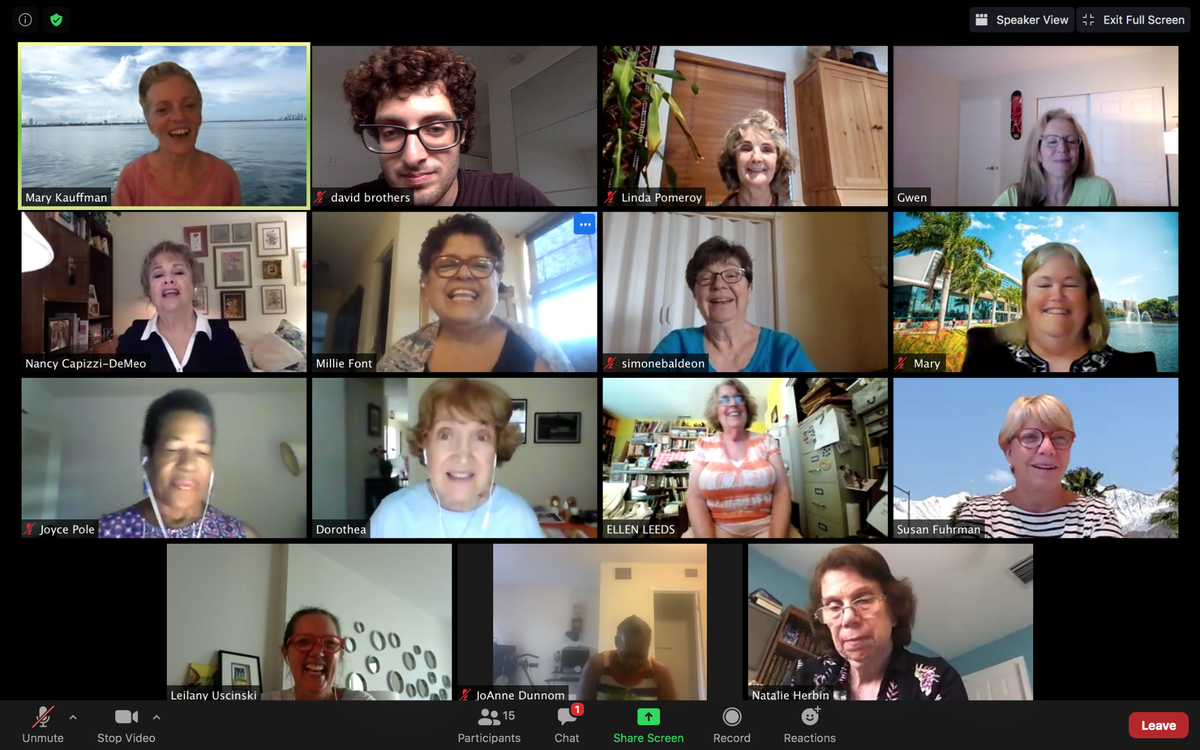
Gwen Carter joined the choir recently after she heard about it from a friend. While the choir’s Zoom session sometimes messes up in the middle of a song, it didn’t affect the choristers’ spirit.
“I had real crippling anxiety, and I thought I was not going to get along with this group,” said Carter. “I’ve got to say, I have laughed the hardest during the pandemic with the faces you see on the screen. We just go wicked silly.”