
Should I trust my Apple Watch to monitor my heart?
Is it smart to trust your heart to your Apple Watch?
Apple has built fitness trackers into its devices for years but entered into a new realm of healthcare monitoring when it began adding an electrocardiogram (what it calls ECG also known as EKG) app to its Smart Watch about a year ago.
An ECG is a graph of the electrical activity of your heart and can determine heart rate and rhythm. The recently released results of a Stanford University study funded by Apple on more than 400,000 people showed that the app could detect atrial fibrillation, an irregular heart rhythm that can go undetected by the patient and affects about 6 million Americans. The risks are real: Left untreated, patients with atrial fibrillation, commonly known as AFib, could face a high risk of stroke.
Initially, many in the medical community were wary of the Apple Watch’s heart-monitoring features. Doctors worried that their offices would be overloaded with calls from stressed-out Apple Watch-wearing millennials with their blurry ECG pdfs that would mostly come out to be negative because they are not in AFib’s high-risk older population, leading to more costs for patients. Some even feared patients might ignore physical symptoms if their watch says they are OK.
That skepticism was tempered somewhat by media reports of the Apple Watch signaling a serious health problem for some people who had no idea they had one.
Now that the watch’s ECG features have been in the wild for a year, with millions of potential users, do doctors see value in it or is this just a lot of Apple hype?
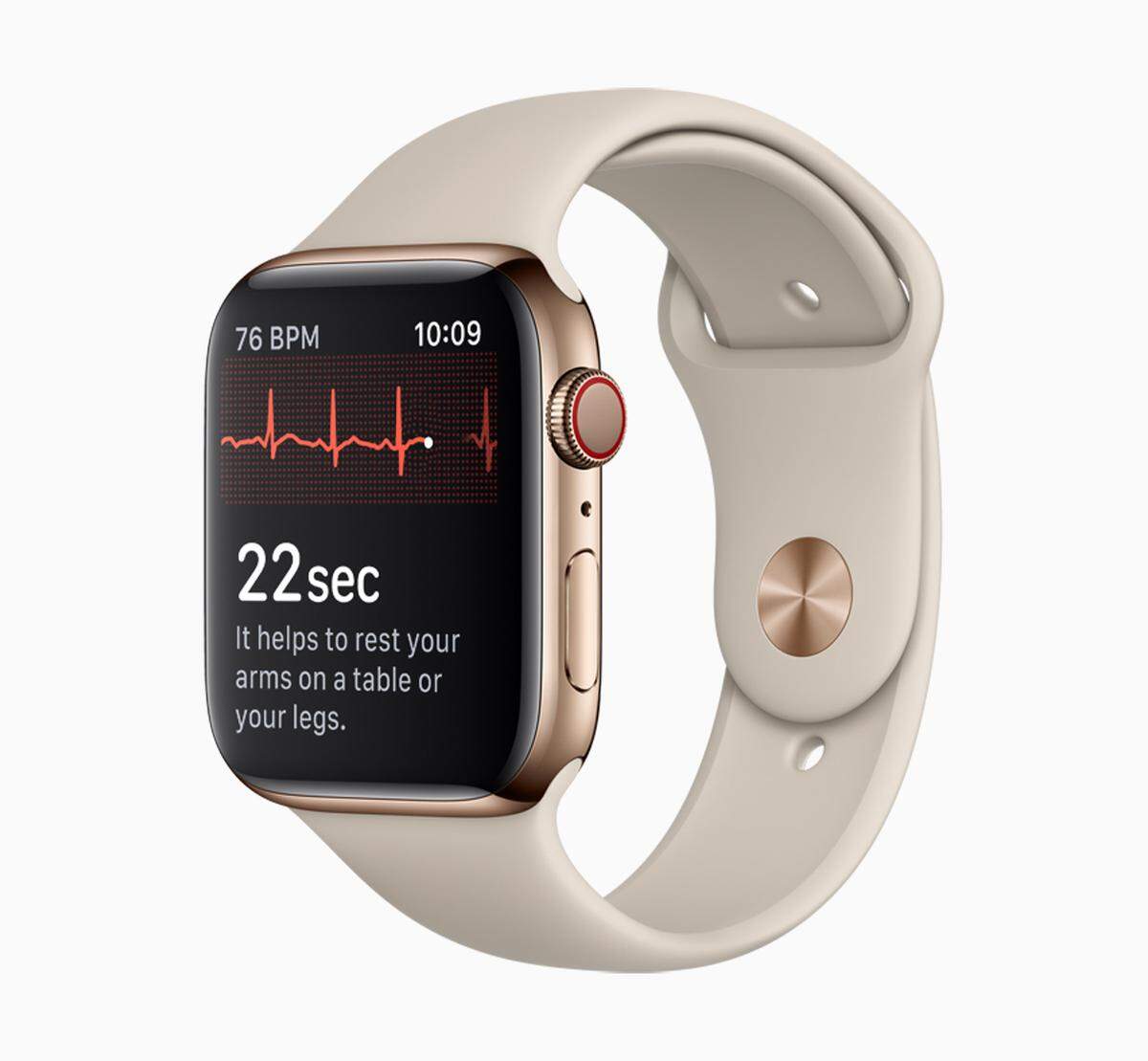
Cardiologists in South Florida interviewed for this report have seen an increase in patient referrals because of Apple Watch readings but not the deluge some thought there would be. More importantly, they say, the technology is useful for building awareness among people and it has signaled medical issues. Though the doctors say the technology is not perfect, it’s getting better with every update, and they generally recommend it to most patients.
”The trend in tech is to have these wearable sensors that purport to provide some health information — I think it is great. It makes people more conscious about their health. Sometimes it will detect health issues the patient doesn’t even know about,” said Dr. Gervasio Lamas, chairman of medicine and chief of the Columbia University Division of Cardiology at Mount Sinai Medical Center.
A patient in her 50s who was being treated for AFib believed her treatment wasn’t working and began recording several episodes on her watch that she thought were AFib. “Much to my astonishment, they were,” said Lamas. “That led to a change in therapy, which is great.”
Complicating the picture is that with atrial fibrillation, people can’t always feel their symptoms, yet it causes about 20 percent of strokes in the U.S. every year, said Dr. Ahmed Osman, director of electrophysiology for Broward Health. In the United States, AFib results in 130,000 deaths and 750,000 hospitalizations annually, according to the Centers for Disease Control and Prevention
While there have been other consumer applications that tried to monitor heart rhythms, “the revolution came about with the Apple Watch, which uses optical heart sensors to detect an irregular rhythm,” he said.
Still, the Apple Watch has not been heavily tested on the most at-risk population, he said. The Apple Heart Study of more than 400,000 were overwhelmingly younger Apple Watch users without any prior heart conditions. The study found just 0.52% of the participants, or about 2,000, had irregular heart rhythms. They were recommended to get further evaluation by doctors in the study and of those that wore ECG patches for two weeks as directed, 34% were found to have AFib.
Osman and other doctors say right now the jury is still out on how useful these will be in the high-risk population for AFib, those in their 60s and older, and more studies are needed. Irregular readings from the app would require further evaluation by a doctor before determining if it is AFib and, if so, what the treatment plan will be.
“We have many patients who use these,” said Osman. “It is a useful additional tool together with others to monitor these patients long-term. The consumer applications are really going to evolve in the next few years, and I think in the future everyone will have one of these for screening and for rough detections of abnormalities.”
Indeed, wearable technology is one of the fastest-growing sectors of the technology industry and is expected to surpass $10 billion in shipment revenues in 2020, according to the Consumer Technology Association. Consumers are looking to wearables to do more than count steps; they want to also track their cardiovascular health. And these innovations might just be the extra set of eyes a doctor, and the patient, need.
A Broward Health cardiologist recommended that Ronald Plumeri, 66, get an Apple Watch after he had initially treated him for AFib. Plumeri did buy the $500 Series 4 watch, even though his other doctors were lukewarm about the technology.
Months later, Plumeri thought he was cured, but he checked his watch and it showed him AFib had returned. “I had no clue. Now I can check it whenever I want and I know what to do — I can call the doctor.”
Plumeri then underwent an ablation, a more advanced procedure than his earlier AFib treatment. He continues to use his Apple Watch to help monitor his health.
“I can check an EKG anytime I want and it is telling me to stay in and breathe, it tells me a lot of things to do,” Plumeri said. And there is so much more it can do. “I can do everything with my watch and my phone. I can connect to 911. If something happens and I fall, it asks me if I fell because it knows. It’s crazy. Something new. It’s worth every penny.”
Another aspect of atrial fibrillation is that it can be very intermittent.
“We are very limited in cardiology on how we monitor patients. The monitors you stick on your skin you can use for a couple of weeks. They are accurate but what’s two weeks in a course of a year? There are patients who say my heart races out of control every other month – well, two weeks doesn’t help you,”’ said Lamas of Mount Sinai. Implantables are accurate, but more invasive, he said.
Some of the images patients bring to him “look like a Burmese python dipped in mud,” he said. “But you can surmise in a year or two it will be a crystal clear picture. … We are just in the beginning of this.”
Lamas hopes that Apple Watches will be adopted by his significantly older, heavier and less active patients. “You have something you are wearing that is telling you if you are succeeding or failing at your fitness goals that your cardiologist prescribed,” he added.
Could the Apple Watch help noticeably lower cardiovascular deaths from strokes and heart attacks?
Lamas thinks the chances are good. He points out it’s at no cost to the medical system, and Apple is doing all the marketing, producing millions of users.
“You could then start doing the math and you have to monitor thousands of people before you can prevent a stroke. You know what? They wanted a watch anyway, they are having fun with their watch, the healthcare system didn’t pay for it, and you prevented a couple of strokes,” Lamas said. “Some physicians are negative about it because patients come in with nothing. Well, that’s a short visit – congratulations you don’t need a heart doctor.”
For patients with a history of palpitations or irregular heartbeats, monitoring it with an Apple Watch would be a good thing to do, said Dr. Romualdo J. Segurola Jr., chief of cardiac surgery for Jackson Health System.
“This all falls into the chapter of preventive medicine. Similar to if you have heart disease or coronary artery disease, you have to stay away from carbohydrates, you have to stay away from fats, preventing a complication before it happens can make all the different in the world,” said Segurola.
“All of this supplements good care. But this does not void you from using medications. For people with a history of AFib, you should not stop taking the medications just because you have the Apple Watch.”
This watch is smart, but it can’t replace your doctor.
Email the writer at ndahlbergbiz@gmail.com and follow her on Twitter @ndahlberg