
Two pioneered heart surgeries, another two share a medical practice and a marriage

Cardiologists care for your heart in more ways than one, whether its performing innovative treatments or teaching you habits to help you stay healthy. Here are three South Florida cardiologists who provide care in unique ways:
Less-invasive surgery
Dr. Joseph Lamelas felt so connected to South Florida that when he invented a minimally invasive way to do heart surgery he named it the “Miami Method.”
Lamelas, chief of cardiac surgery at the University of Miami Health System, has performed more than 16,000 cardiac operations since 1990 — more than 7,000 of which have used a minimally invasive approach.
He offers patients every cardiac surgical procedure except heart transplant, and began refining techniques for less invasive procedures in 2004. By 2012 he had invented a way to repair aneurisms in the ascending aorta and treat valve disease through a 2-inch incision on the right side of the chest, rather than by splitting the chest open. Lamelas dubbed his procedure the Miami Method.
It is one of his many contributions to the field.
In 2004, when Lamelas began working with less invasive surgical techniques, the instruments he needed didn’t exist — so he invented them, along with a patient who happened to be an engineer. Miami Instruments, Inc., the resulting collaboration, develops cardiac surgical tools to facilitate less-invasive procedures.
Minimally invasive methods result in less trauma to the tissue during the surgery, so recovery and time in the ICU is shortened, he said. Bleeding and the need for transfusions are minimal.
Lamelas has strong ties to South Florida. He worked in Miami for 26 years, most recently at Mount Sinai Medical Center, before leaving for two years for Houston. He returned to South Florida in January 2019 to join the University of Miami.
In the past nine months at the University of Miami, Lamelas has averaged four surgeries a day and completed 600 heart surgeries.
“About 85 percent of those were minimally invasive cases, and I’ve had patients that come from all over the world,” he said. He also conducts training courses several times a month with surgeons from across the globe, including groups from China and Japan this year.
“While I’m operating, my mind is constantly thinking about how to make the techniques better,” Lamelas said. “There is always room to grow, and technology and techniques continue to advance…you have to take calculated risks and be up for the challenge.”
Sharing a medical practice, and a marriage
They’ve been married more than 46 years, sharing a life, a home and a family. But doctors Mammen and Molly Zachariah also share a deep faith and a calling to cardiology that has led them to work together their entire careers.
At Broward Health since 2016, Dr. Mammen Zachariah is an interventional cardiologist, handling cardiac catheterizations, coronary angioplasty and stents. Dr. Molly Zachariah is a noninvasive cardiologist responsible for echocardiograms and imaging to diagnose heart disease.
They share an office, with a partition down the middle. Though they examine patients separately in dedicated exam rooms, the Zachariahs are known to collaborate and consult on difficult cases.
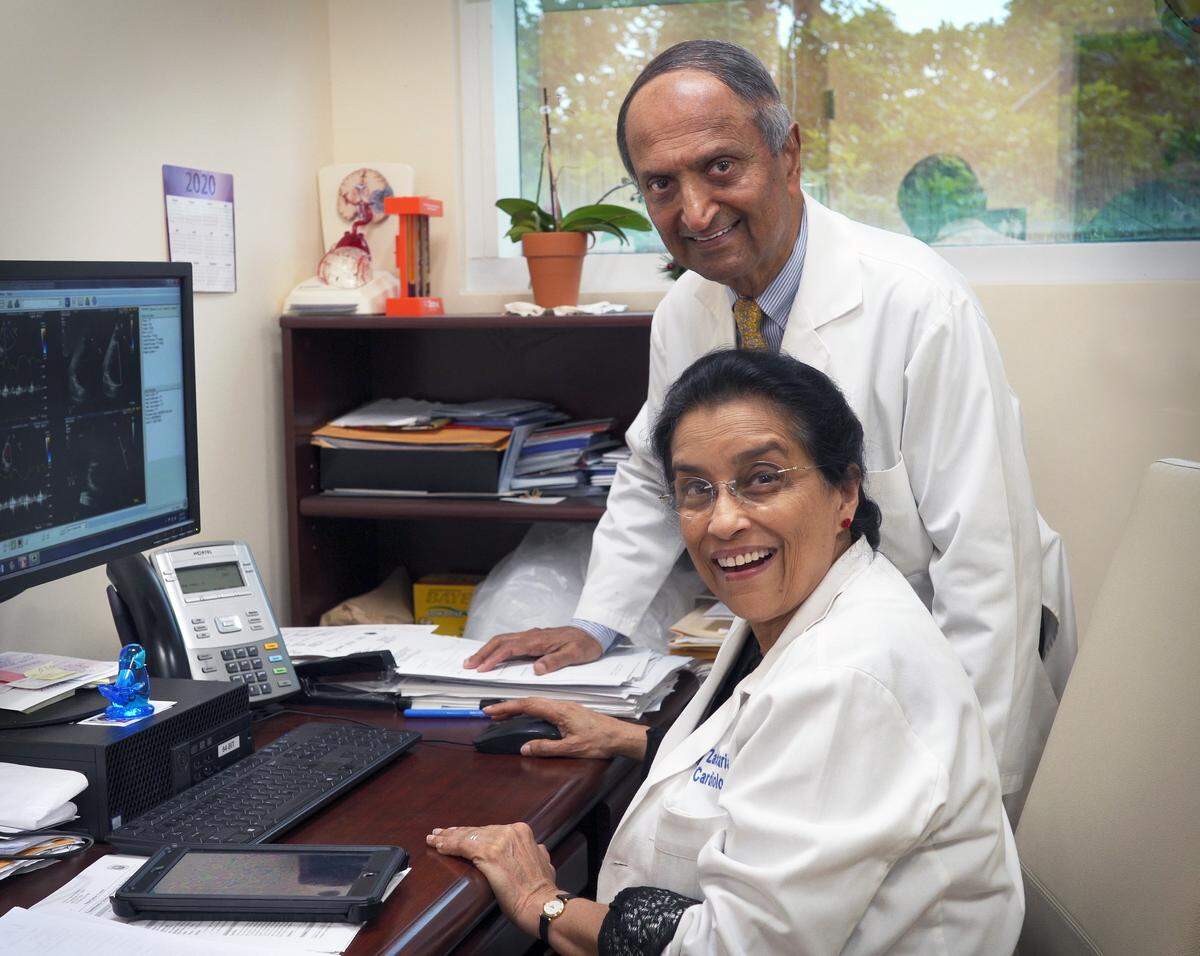
“It has been so wonderful all these years to work together,” Molly Zachariah said. “It has been so easy. We help each other if there is a tough problem” and pitch in when the other is busy, she said.
The two met in India when they were both in medical school. She was a first-year student. He was in his final year. A relative of Mammen’s introduced them and the rest is history.
“Through God’s blessing and divine interference, she was the chosen one. That’s how it worked,” Mammen Zachariah said.
The couple eventually moved to the United States, both completing a residency in internal medicine and a fellowship in cardiology at St. Joseph’s Hospital and Medical Center in New Jersey.
In 1986, they were drawn to South Florida, lured by the weather, which was similar to India, and because Mammen’s two brothers were in the area. The Zachariahs joined Mammen’s brother, Dr. Zachariah P. Zachariah, at Holy Cross Hospital, where they helped found its heart institute.
In 2014, Mammen and Molly Zachariah were both named Top Doctors by U.S. News and World Report. Now at Broward Health, they spend their days caring for patients, and sometimes their evenings too, talking about tough cases even at home. The couple have an adult son and a new granddaughter, born in January.
“It is our mission to care for patients in the best possible fashion,” Mammen Zachariah said. “That’s been our goal, and so far it has been very successful.”
Molly Zachariah said they never tire of each other’s company. “I think it is wonderful that we work together,” she said. “We are together all the time. I actually cannot think of not being together — it’s like part of the body.”
Pioneering a heart surgery
It’s a rare complication, affecting only 1 percent of heart patients, and in November 2019 Dr. Miguel Diaz performed one of the first 100 procedures of a pioneering new treatment to fix it.
Dr. Diaz, an interventional cardiologist and medical director of the structural heart program at Palmetto General Hospital, performed the BASILICA procedure developed in 2018 by the National Institutes of Health. BASILICA stands for Bioprosthetic Aortic Scallop Intentional Laceration to prevent Iatrogenic Coronary Artery obstruction. It was developed to increase treatment options for high-risk patients who need heart valve procedures.
BASILICA is used just before a procedure called TAVR, transcatheter aortic valve replacement. In TAVR, a catheter is threaded through an artery to replace a blocked valve with a new valve. In very rare cases, the coronary artery becomes obstructed.
“When you displace the old valve up against the wall of the aorta, sometimes it can act like a trap door, closing shut the coronary artery,” Diaz said. “That’s a catastrophic complication. Patients usually die.”
.JPG "2017 004 (17).JPG")
With BASILICA, an electrified guide wire is threaded through a catheter to slice through the leaflet of the old valve so that it cannot block the coronary artery before the TAVR procedure.
“When you electrify the wire it can basically slice through the leaflet, kind of like a knife through butter,” Diaz said.
The National Institutes of Health had gone around the country teaching the procedure through live cases at conferences, Diaz said. In 2019 he and his team came across a patient that was a perfect fit and in September, after additional training and dry runs, Diaz, Dr. Marquand Patton, an interventional cardiologist, and their team successfully performed the procedure.
The BASILICA procedure was first used by the National Institutes of Health to treat seven gravely ill patients who qualified for compassionate use of the technique — then untested in humans — because no other care options were available.
“All patients had a successful TAVR with no coronary obstruction, stroke or any major complication,” said Dr. Robert Lederman, one of the leaders of the study, in a press release from the NIH.
Researchers hope the technique will help reduce the number of deaths from heart valve disease. Every year, about 5 million people in the United States are diagnosed with heart valve disease, and more than 20,000 die, according to the American Heart Association.
“Necessity is the mother of invention. The procedure itself is not difficult. It’s ingenious in its design, and all credit there goes to the NIH,” Diaz said. “There is another way to protect the coronary arteries during TAVR, which is to place a stent. Our hope is that the BASILICA procedure in the future would be a better way to do it.”