
So, you want to be the next girls’ soccer star. First, learn about overuse injuries
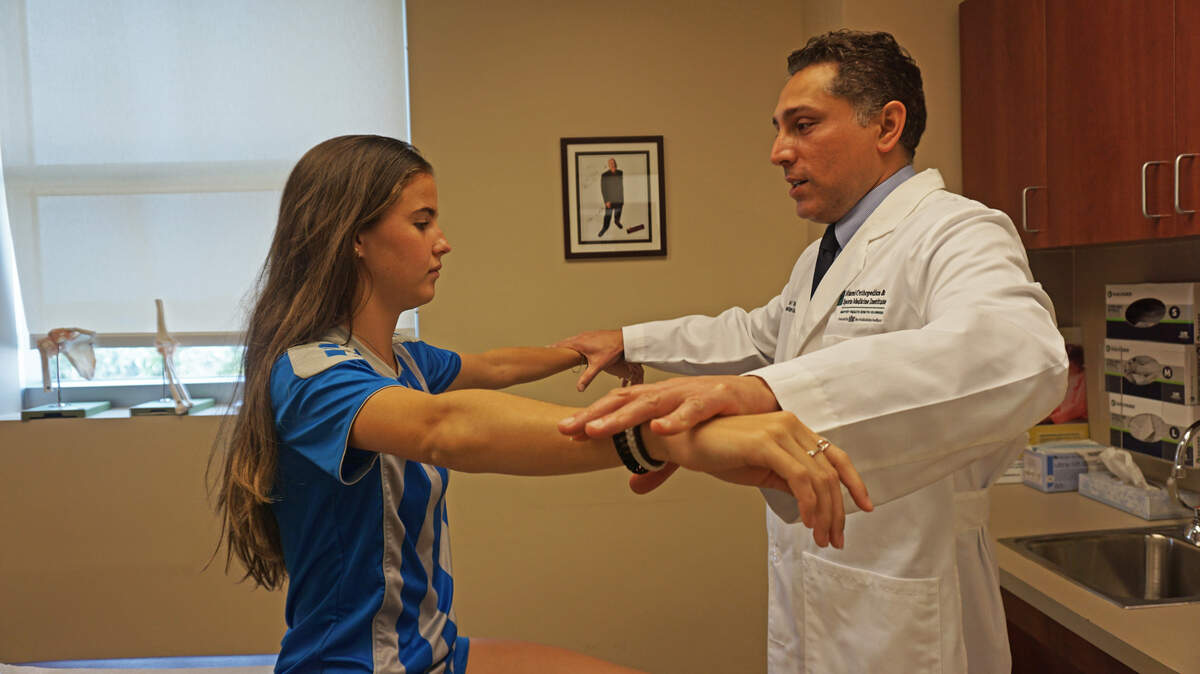
When the U.S. Women’s soccer team won the World Cup, scores of young women athletes sat up and took notice.
Some athletes may even have pledged to train harder and longer with the same goal in mind. But extra training can come at a price, particularly in South Florida, where sunny days mean teen athletes can train year-round. Young female athletes involved in sports such as soccer, swimming and softball often experience overuse injuries from overtraining.
“In South Florida, we’re seeing a lot of early sports specialization where a child gets involved in one sport at an early age and plays it 12 months out of the year,” said Dr. Gautam Yagnik, orthopedic surgeon at Miami Orthopedics and Sports Medicine Institute, part of Baptist Health South Florida. “That can contribute to overuse injuries.”
Knees, shoulders and feet
The most common overuse injuries in females are sports specific, but tend to be tendinitis around the knee and shoulder, shin splints and stress fractures around the feet, Yagnik said.
With overhead sports, like volleyball or swimming, you see more shoulder tendonitis, he said. Lower extremity athletes like basketball or soccer players that are doing a lot of running and jumping have more issues with the knee, ankle and foot, Yagnik said.
Dr. Farah Tejpar, a sports medicine specialist with Cleveland Clinic Florida, said she sees knee ACL injuries more frequently in girls, as well as more stress fractures and low back pain and injuries.
.jpg "Tejpar_Farah_2015_B (1).jpg")
“With the ACL injury we know that there’s about a three to nine times higher risk for those injuries in women, and it really has a lot to do with the shape of our bodies,” she said. “The angle of our hips and the way our thigh bone is shaped puts us at a little bit of increase of risk to injure that ligament that’s in the knee.”
When women jump, they tend to land with knees more extended, not as bent or flexed. That also puts stress on that knee joint and increases risk for that type of injury, Tejpar said.
Women athletes also are 50 percent more likely than male athletes to have a sports-related concussion, according to a study by the American Academy of Neurology. “The reason for it is a little bit unknown,” Tejpar said. One reason may be is that neck girth and neck strength in young teenage women is less than in males. That neck girth and strength helps to prevent the motion in the head and the brain, which prevents concussion, she said.
How to prevent injuries
Overuse injury prevention depends on the sport.
“It’s managing the amount of training and game time and utilizing rest periods and cross training so that you don’t hit that maximum exertion that creates injuries,” said Dr. Lee Kaplan, director of the University of Miami Sports Medicine Institute. “For a teen, the best things are a good planning process and listening to your body. When you start to get worn out from multiple competitions and training sessions you learn how to back off — that’s what the professionals do.”

Screenings that can help
Pre-participation screenings can help look for areas of weakness in a young athlete’s body that are prone to injury.
Memorial Healthcare System, for example, offers a pointe readiness evaluation for ballet dancers ages 11-12 that includes functional movement testing. The dancer is asked to do specific moves and the body’s reactions are observed to see if the dancer is ready for pointe shoes, said Dr. Matthew Fazekas, a pediatrician and sports medicine specialist with Joe DiMaggio Children’s Hospital and Memorial.
“The functional screening is crucial in preventing overuse injuries because ballet instructors used to say, ‘You’re 11 years old, you’re ready to get on pointe.’ But not all 11-year-olds have the same biology and skeletal and muscle maturity,” he said.
“Doing a functional screening gives you reassurance and confidence that that particular athlete is ready.”
Functional exercise
Sometimes the right exercises can help prevent injury.
Female soccer athletes, for example, have the highest rates of concussion incidents, Fazekas said.
A 2017 study by the American Academy of Orthopedic Surgeons found that high school girl athletes have a significantly higher concussion rate than high school boy athletes. Female soccer players suffer the highest concussion rates among high school athletes, even more than male football players.
“We look for the biomechanical issues that predispose an athlete to concussion, then we can give an ‘exercise prescription’ to improve biomechanics and reduce the risk of getting these types of injuries,” he said. “You can do it with concussion in that acute setting, but you can often do it to help prevent certain overuse injuries.”
.jpg "Dr. Matthew Fazekas 070919 (1).jpg")
Another way to prevent overuse injury is to look for common injury patterns in a particular sport. Injury prevention research has indicated that with some injuries, like ACL tears, a specific exercise protocol can help reduce injury risk, Fazekas said.
“Medical literature has identified an imbalance between acquired muscle and hamstring muscle as one of the factors that predispose you to an ACL tear,” he said. In soccer “FIFA came out with an ACL-prevention protocol that includes exercises that healthy athletes can do to help balance that musculature. Studies showed that the program helped reduce the injury risk rate for an ACL tear.”
Tejpar said there are functional exercise programs that can be done with a physical therapist where they focus on specific strength training, stretching, pliometric exercises and how to jump and land correctly to not put so much force on the knees.
Diversify sports
“The advice that I give to a lot of my patients and their families is to diversify sports,” Yagnik said.
“Back in the old days, we all used to play three sports a year and they were at different parts of the year. It allowed you to develop different skill sets and work different muscles, and it allowed your body to rest and recover the right way.”
Cross train, and take time off
Carve up training and designate certain periods of time where you’re building up to competition-ready levels, Kaplan said. Monitor how you feel and make sure you’re keeping up with recovery time, proper sleep and nutrition. Utilize good training techniques and coaching so you know when your body can sustain the training load.
Yagnik said adequate rest doesn’t only mean taking one or two days a week off from training, but taking a couple of months each year — which can be broken up — off from the sport. This time can be used to cross-train.“
If you’re a swimmer, take some time off and do strength training and dry land running, where you’re not just swimming seven days a week, 365 days a year,” he said.
Fazekas said one study by Boston Children’s Hospital researched how many hours per week is too much before you start seeing certain injury patterns. The article suggested matching your age to the number of hours you participate in a sport per week to reduce overuse injuries.
But it’s not a “one size fits all” strategy, he said.
“If you look at dance, a 10-year-old dancer could spend 10 hours in one day at a summer intensive. It is essentially not feasible at that age” because some female-dominant sports peak at an early age, Fazekas said.
“Many of the women who just won the World Cup are in their 20s. When you look at U.S. gymnasts and U.S. national figure skating champions they are teenagers,” he said. “You have to individualize recommendations by sport, because what works for one may not work for another. So the suggestion to match age to weekly hours of training may work in injury rehabilitation, but not prevention.”
The importance of recovery
If you do sustain an injury, you need more than rest, depending on the sport, Kaplan said.
“It can be as easy as somebody who has tennis elbow from hitting too many tennis balls needs to rest, but rarely is it just rest,” he said. “Usually it’s rest combined with not only stopping the process, but building back up again to prevent it from happening, rather than just jumping in and seeing those stresses again.”
The most important thing is to get evaluated by someone trained in the area so that you make sure it’s nothing more significant, he said.
“If you have shin pain from playing a lot of soccer, maybe rest will help, but if the history and the physical diagnosis tell you it could be more significant, it could be a fracture,” Kaplan said. “You really need to know that at the beginning, then you can set what the return of sport and recovery are based on how significant the injury.”
This story was originally published July 24, 2019 at 7:30 AM.