It’s known as the ‘Silent Killer.’ How high blood pressure is impacting the black community
Four years ago, Luther Core Jr. went to the doctor and learned he had a shellfish allergy.
He also learned something else: He had high blood pressure.
“I was surprised because most of my life my blood pressure was low,” said Core, a 47-year-old African-American engineer who lives in Coral Gables. “I didn’t go to the doctor regularly so there was no gradual progression. It just went from very low to high.”
Coronary heart disease is the No. 1 killer for all Americans, according to the American Heart Association. Hypertension, or high blood pressure, contributes to heart disease and often has no symptoms, giving it the moniker “the silent killer.”
And African Americans have a higher prevalence of hypertension than other racial and ethnic groups. More than 40 percent of non-Hispanic African-American men and women have high blood pressure, which is often more severe and develops earlier in life for African Americans. Some blood pressure medications, too, are less effective in treating African Americans.
Higher rates of obesity and diabetes in the African-American community contribute to the higher rates of hypertension. Researchers also believe genetics play a role.
Studies suggest that African Americans are more sensitive to salt, causing as little as half a teaspoon of salt to raise blood pressure, the AHA said. High blood pressure can also run in a family, and one’s risk can increase based on age, race or ethnicity, according to the Centers for Disease Control and Prevention (CDC).
Having one or more close family members under 60 who have high blood pressure doubles the risk of a person developing the condition. Normal blood pressure levels for adults are less than 120/80; high blood pressure levels are 140/90 or higher, according to the CDC. Levels in between are considered at risk.
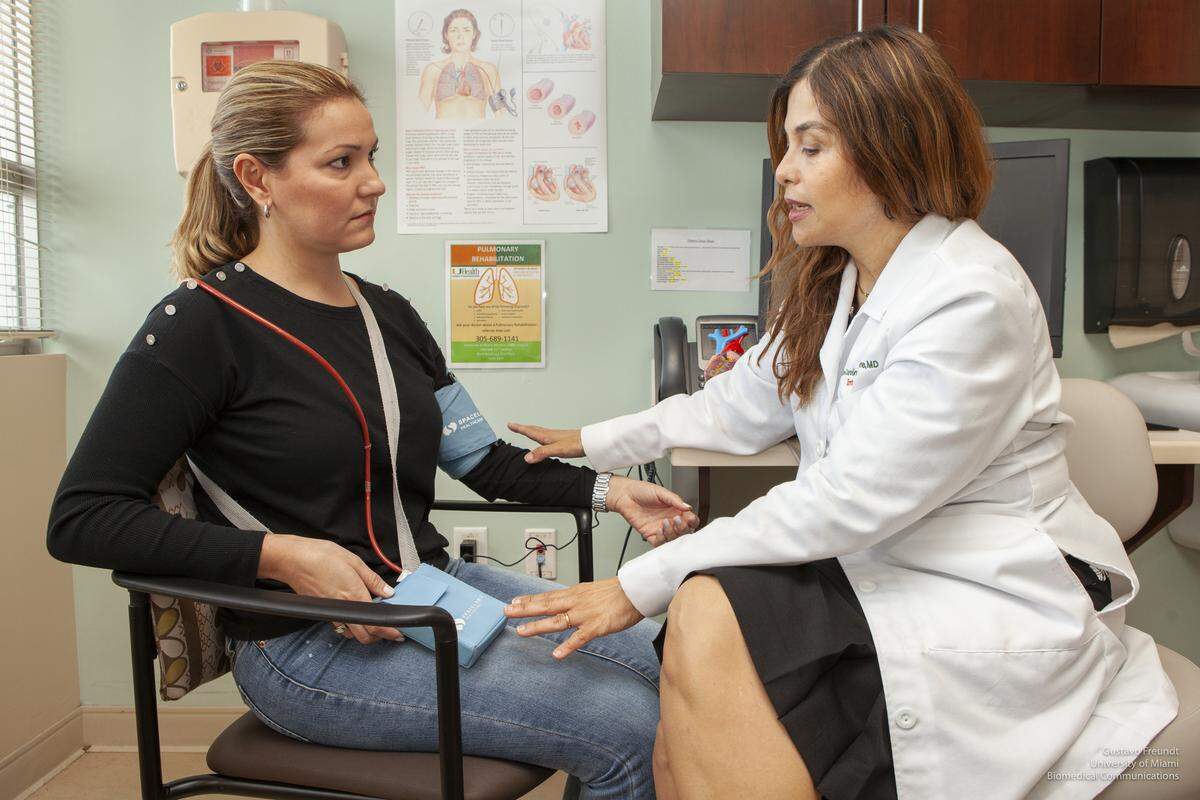
Education is the key to curbing risks for hypertension in the African-American community, said Dr. Maria Carolina Delgado-Lelievre, hypertension specialist and assistant professor of medicine at the University of Miami Miller School of Medicine. She launched the Hypertension Clinic in April as part of her Hypertension and Cardiovascular Prevention Program, a collaborative effort with UHealth’s new Preventive Cardiovascular Medicine Program.
The clinic offers in-depth screenings and personalized treatment for high blood pressure.
“Once the population is educated about hypertension, they can understand what it is and how it can lead to death,” she said. “Sadly, with no symptoms, hypertension is affecting our young population because their blood pressure is going up and they are not aware. If you know what you are facing, there is a greater likelihood of controlling your blood pressure. Knowledge is power.”
External factors such as diet, exercise, alcohol, drugs and stress all increase your risk of hypertension. But in the African-American community, lack of access to healthcare and mistrust of doctors can also play a role, said Dr. Arnoux Blanchard, program director for the cardiology fellowship program at Broward Health.
People who are not insured or can’t afford high co-payments for treatment rely on the emergency room. When they arrive at the ER, they often have a more advanced stage of hypertension and damage to organs.
“It is still a headache to see people in such a rich country without access to healthcare,” Blanchard said. “It is more cost effective for a person to have healthcare before the condition worsens and treatment becomes more costly.”
Mistrust of doctors
The mistrust of doctors by many in the community stems, in large part, from the 1932 “Tuskegee Study of Untreated Syphilis in the Negro Male.”
Researchers with the U.S. government conducted the study, which initially involved 600 black men in Alabama — of which 399 had syphilis, according to the CDC. The researchers did not get the patients’ informed consent, and they told the men they would get treated for free in exchange for being studied for “bad blood,’’ a catch-all term.
In fact, the researchers allowed the men with syphilis to go untreated so they could study the effects of the disease. This went on for 40 years, until The Associated Press broke the story in 1972, which led to an investigation.
Blanchard, an African-American physician, said he still sees the mistrust in African-American patients.
“People still see doctors as hostile to their well-being based on their past experiences,” Blanchard said. “It is important to treat a patient like a person and not a number. Patients are more compliant with recommendations of doctors if a relationship established.”
Today, researchers are working to rebuild that trust, particularly when it comes to treating hypertension.
Barbershop study
A study published in December in the New England Journal of Medicine tested whether pharmacist-led programs in barbershops in the black community could significantly lower high blood pressure in black men in the United States. After 12 months, the black barbershops in Los Angeles County, where the study was conducted, showed that when guidance was coupled with medication, a blood pressure measurement of less than 130/80 was achieved by 68 percent of men who participated in the study, compared with 11 percent of those who didn’t participate.
Core, the Coral Gables engineer, has a family history of hypertension. His paternal grandfather died of a ruptured aorta.
“You can’t outrun genetics, but I’m doing my best to minimize my chances,” Core said.
He admits he initially ignored his hypertension diagnosis, but now takes an active role in his health. In the past year, he lost 25 pounds by changing his diet and exercising. He enjoys walking, cycling and interval training. His goals are to lose an additional 25 pounds and to no longer take Losartan, a hypertension medication.
“Sometimes, life gets in the way,” Core said. “So, it can be hard to exercise and change your diet. But, I’m doing what I can to be in better shape and improve my overall health. “
Tips to fight hypertension
▪ Talk with family members to find out if there is a family history of hypertension. Talk to grandparents, someone in their 60s or 70s. Find out if they take medication for their blood pressure or heart.
▪ Obtain a blood pressure screening. Go to your primary care doctor or use a blood pressure machine at a drugstore. If your blood pressure is equal or higher than 120/80, there is hypertensive risk and you need to see a doctor.
▪ Watch out for protein shakes, energy drinks, pre-workout drinks, and over-the-counter supplements that keep you awake. High amounts of stimulants can increase the risk of stroke and heart attack.
▪ Start a diet and exercise program.
▪ Quit smoking, which increases the likelihood of having another heart attack or stroke.
Hypertension Clinic
UHealth Tower West Building, 1321 NW 14th St., Suite 510. Open Thursday and Friday, 12-6 p.m. by appointment; 305-243-5544.
This story was originally published February 20, 2019 at 4:35 PM.