
Praise the braise: Michael Ruhlman’s cookbook gives a new look to an old technique
The morning after I made Beef Brisket Carbonnade, my house smelled wonderful. The lingering fragrance of slow-cooked beef and sautéed onions reminded me of the midday Sunday dinners of my childhood, with main dishes that simmered while my family was at church.
The brisket was the first of four meals I made from Michael Ruhlman’s new cookbook, Ruhlman’s How to Braise: Foolproof Techniques and Recipes for the Home Cook (Little, Brown and Co., $25). It revived for me a way of cooking that I had nearly forgotten.
What was it about braising that drew me? Initially it was reading Ruhlman’s descriptions of the aroma of seared meat and sautéed onions, the layered flavors in the sauce, the tenderness of the meat. After I made Ruhlman’s Lamb Shanks and served them over risotto, I realized that braising is the key to some favorite comfort foods: beef stew, lamb shanks, coq au vin.
Braising goes back to the days when we were home long enough to tend to a dish that requires hours of cooking. It’s old-fashioned also because it involves dredging meat in flour and searing it in generous quantities of fat.
Over the years, many of us have traded braising for grilling — little time, little work and little or no added fat required. There’s a lot to be said for that trade, but as Ruhlman reminds us, that doesn’t mean we can’t make the occasional pot roast or osso buco.
And although the cookbook doesn’t make this point, most of his recipes translate nicely to crockpot meals, a cooking trend that is back for a second round.
Ruhlman is a journalist who went to culinary school and worked in restaurants before he began writing cookbooks and other food-related books. Braising is from his series of cookbooks that go into depth on a single technique; the last one was on roasting. This cookbook has only 20 recipes, but they cover a nice range of main ingredients — turkey, duck, lamb, veal, corned beef, fennel and onions — in addition to the usual beef, pork and chicken.
The recipes come with lengthy, detailed instructions that helped me understand how braising works rather than leading me blindly through the steps. When I added an ingredient or took some action, I understood why and how I was doing it. That’s especially helpful if, like me, you like to change recipes to suit your own tastes.
I made four dishes from the cookbook. In addition to the lamb shanks and the beef carbonnade, I made Chicken Thighs braised coq au vin style and Posole, a Mexican stew of pork, chiles and hominy (the whole kernels, not grits). Some I made in a single day on the weekend. Others I spread out over several nights after work — prep work and searing on the first day; the long braise on the second; the sauce or gravy, noodles or rice, and add-at-the-end ingredients on the third.
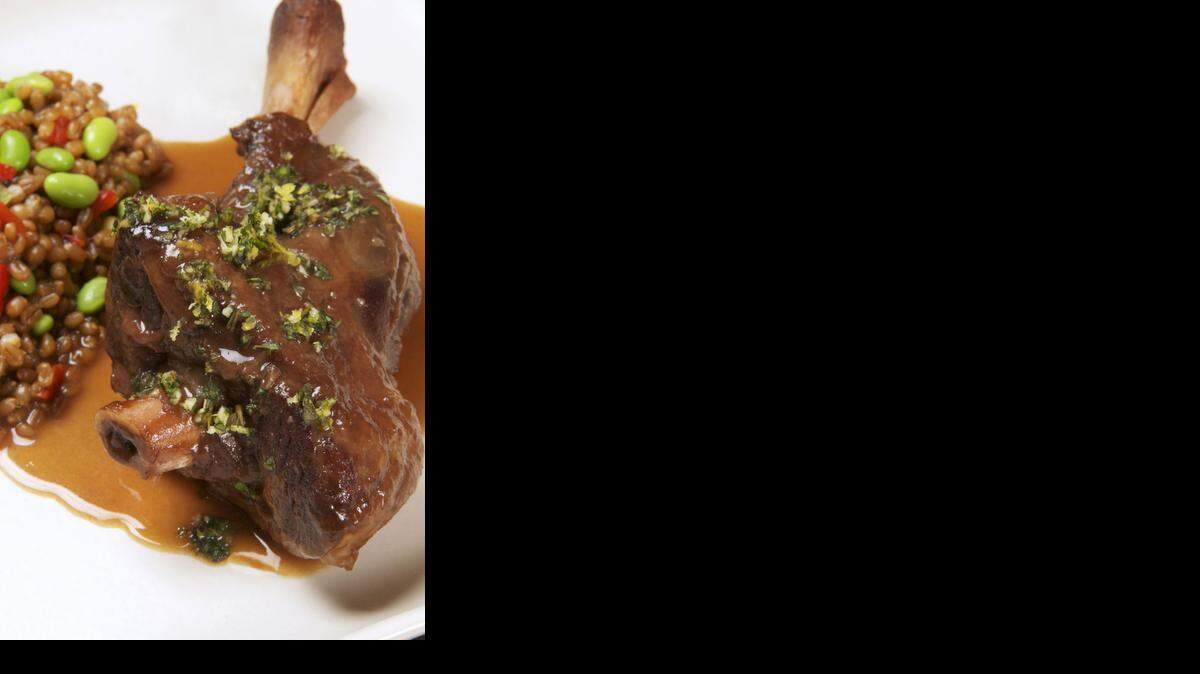
My favorite of the four was the lamb shanks, partly because I love anything over risotto, but also because the shanks are cheap compared to rack of lamb. That’s one of the advantages of braising — it makes tough, cheap cuts fork-tender.
As I pulled the lamb off the bone, I wondered whether it might make a good crockpot dinner. In fact, I thought, most of the main courses in the book would probably do well in a crockpot as long as the cook made sure to transfer the juices and brown bits from searing the meat into the crockpot.
Ruhlman said he hadn’t used a crockpot in a long time, but agreed that pork, lamb or beef — not poultry — could do the long, slow part of the cooking in a crockpot. He warned against overcooking though.
“If something is braised too long, it loses all flavor,” he said. “Taste braised meat without the sauce and you’ll see it has very little flavor. All flavor is in sauce. Also, vegetables do fragment and meat can become mealy if cooked too long.”
I had the most fun making posole. Technically it’s more stewed than braised because it has a lot of liquid, but the recipe calls for searing the meat on a grill, followed by long, slow cooking in the oven, so we’ll let it slide as keeping in the spirit of braising.
Ruhlman’s recipe calls for a can of whole tomatoes, each held in the fist over the pot and squeezed into bits that cook down into sauce. It’s messy business, and as the stew simmered, I grumbled on Facebook that next time I’d just buy a can of diced tomatoes. To my surprise, my comments raised a ruckus among posole (or pozole) purists. “As a native New Mexican I must tell you tomatoes have no place in posole,” said one friend. “MAYBE a pinch of oregano or a little onion, never ever cumin.”
Not only does Ruhlman’s recipe include tomatoes and cumin, it commits even more serious sacrilege by also calling for honey and Asian fish sauce.
Facebook fell silent with that news. I wondered if my friend’s head had exploded.
A couple hours of oven simmering later, I tasted the posole. The sauce was rich and moderately spicy with ancho chiles, its complexity nicely rounded out by the honey and fish sauce, although their individual flavors were not discernible.
A number of recipes in the braising cookbook, including the lamb shanks, call for fish sauce, which Ruhlman calls his secret ingredient. It seemed an odd choice, and I asked Ruhlman about it.
“The fish sauce revelation came from my first chef instructor at the [Culinary Institute of America], Michael Pardus, who said he even puts it in his mac and cheese. And it’s true,” Ruhlman responded in an email. “It’s simply a great all-purpose flavoring device, deepening flavors without calling attention to itself, like salt. I use it in everything from salad dressings to sauces to a bechamel sauce.”
At the end, the rich braising liquid is made into a sauce. One of the things I like about these recipes is that Ruhlman doesn’t always fall back on the conventional method of thickening the sauce with cornstarch or flour. The carbonnade is thickened with puréed onions, the posole with diced tomatoes.
His fallback position is to use beurre manié, a paste made of equal parts butter and flour, that mixes easily with the liquid and thickens it without making lumps.
By the Book is an occasional feature that checks out recipes from new cookbooks. Marjie Lambert is travel editor of the Miami Herald and author of eight cookbooks. She recently tested ice cream and pimento cheese recipes for By the Book.
About the book
“Ruhlman’s How to Braise: Foolproof Techniques and Recipes for the Home Cook,” by Michael Ruhlman; Little, Brown and Co., $25.
Braised Lamb Shanks with Mint Gremolata
Ruhlman says the shanks will go well with any starch — mashed potatoes, brown rice, couscous, spaetzle, egg noodles or risotto. He also suggests serving them over a salad of cooked wheat berries with a lemon vinaigrette. Makes 4 servings.
4 lamb shanks
Kosher salt
Freshly ground black pepper
Flour
Vegetable oil
1 Spanish onion, sliced
2 carrots, chopped
10 garlic cloves, roughly chopped
4 cups veal or chicken stock
2 cups dry red wine
2 tablespoons honey
1 tablespoon Asian fish sauce
2 bay leaves
Beurre manié (see note)
1/4 cup chopped fresh mint
1 tablespoon finely minced garlic
Grated zest of 1 lemon
Heat oven to 300 degrees. Season the lamb shanks with salt and pepper at least 10 minutes and up to 3 days before cooking them. Dredge them in flour just before cooking; shake off the excess. Add plenty of vegetable oil to a Dutch oven that will comfortably contain the shanks. Sear the shanks over medium-high heat (in batches if necessary). Remove them, wipe out the Dutch oven and return it to the stovetop.
Add 1 tablespoon oil to your braising vessel and cook the onion, carrots and garlic over medium-high heat until softened, 5 to 10 minutes. Return the shanks to the pot and add the stock, wine, honey, fish sauce and bay leaves. The shanks should be about two-thirds submerged (add more water, stock or wine if necessary). Bring the liquid to a full simmer and cover the pot. Place the pot in the oven and cook until the lamb shanks are fork-tender, 2 to 3 hours.
Remove the shanks from the pot. Strain the braising liquid through a fine-mesh sieve and remove the fat that rises to the top. Return the defatted braising liquid to the pan, bring it to a simmer and thicken it as you wish with the beurre manié. Return the shanks to the pot.
As close as possible before serving, combine the mint, garlic, and lemon zest to make the mint gremolata. Serve the shanks on top of the noodles, rice or other starch, spooning the sauce over the shanks and finishing with the mint gremolata.
Note: Beurre manié is a mixture of butter and flour that is used to thicken sauce. Combine equal volumes of flour and butter (preferably at room temperature) and mash together with a fork until you have a uniform paste. You can refrigerate or freeze any leftovers for future use. Add gradually until sauce is at desired thickness. Generally figure on using about 2 tablespoons of beurre manié to thicken 1 cup of liquid, but start with less than that so you don’t overthicken.
Source: “Ruhlman’s How to Braise,” by Michael Ruhlman (Little, Brown and Co., $25).
This story was originally published April 14, 2015 at 9:48 AM with the headline "Praise the braise: Michael Ruhlman’s cookbook gives a new look to an old technique."