
Archive: A look back at the Miami Grand Prix, the first city street races in the 1980s
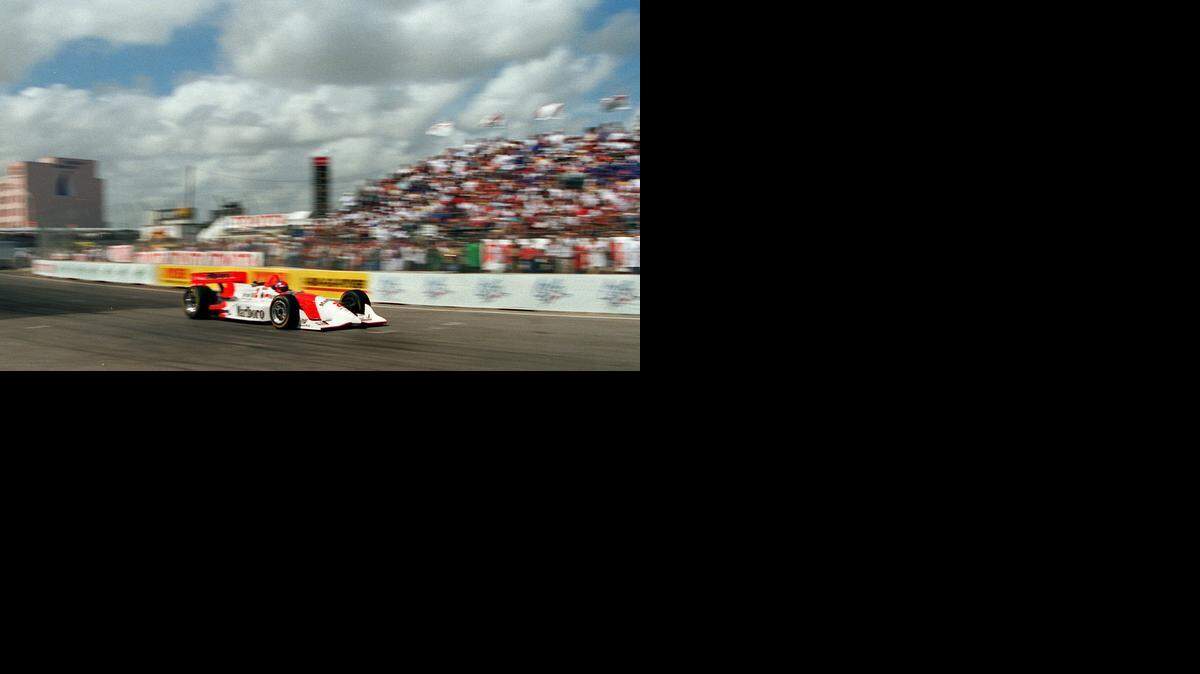
This article was originally published Feb. 27, 1984.
Ralph Sanchez watched his car, "The Spirit of Miami, " putter out of Sunday's Grand Prix after 90 laps, but not even that could steal the gleam from the race promoter's eye.
After nearly four years of planning and 12 months after a blinding rain washed out his first race, Sanchez was watching his Grand Prix fantasy crystallize on the streets of his city, between the palm trees and under a sunny, blue sky.
"I couldn't have asked for a better ending, for a better day, " he said, just as the $4-million weekend's main race, the Budweiser Grand Prix of Miami, roared to life on Biscayne Boulevard.
"If we didn't sell out, we were very, very close. I would say we were a couple thousand tickets short of selling out, " said Sanchez, the Miami real estate investor and president of Miami Motorsports -- the race organizer.
After the Grand Prix, he stood elegant in a navy blue jacket and gray slacks, grinning beside the winning teams, as if it didn't matter that his own Chevrolet March, the top qualifier in Saturday's practice runs, had given out.
In the background, streamers, cast by spirited racing enthusiasts, sailed from the hotel balconies along Biscayne Boulevard and landed on the street like a first snow.
Those who emerged triumphant beneath the confetti were the driving teams of twin Jaguar XJR-5s: Brian Redman of Jacksonville and Doc Bundy of Virginia -- who split the $50,000 first-place prize -- and Bob Tullius of Virginia and Pat Bedard of New York.
Around the racing pit, there was a bustle of spectators who had paid anywhere from the $15 general admission price to $55 for some of the grandstand seats. Sanchez estimated the crowd at 60,000 to 70,000, though no official tally had been reached Sunday night.
But even with the apparent success of Miami's second Grand Prix, Sanchez said he can, at best, "pay some bills" and put a dent in the $1.2-million deficit left by last year's wet attempt at a major international street race.
"It'll be a good couple of years before we can break even, " he said.
His wife, Lourdes, moving elegantly about the VIP club at Miamarina, put the matter more poetically.
"It's going to take time, " she said. "Last year, we planted the seed. This year, a little plant blossomed, but it's not yet a tree."
Sunday's Camel GTO and Grand Prix races capped a fast-paced week that brought auto racing figures from all over the world to downtown Miami and transformed the very heart of the city into a concrete-banked speed circuit.
As workers labored on the track, parties and press conferences were held in hotel suites. The Pavillon Hotel, headquarters of the Grand Prix, witnessed a midweek parade of star drivers, gritty racing crewmen and mini-skirted groupies shuffling through its lobby. There was many a mechanic with a bottle of beer in hand, roaming about halls more accustomed to champagne.
On Sunday, thousands of spectators -- many of whom peeled off their shirts by noon -- lined the Biscayne Boulevard track while a fleet of turbo-charged Porsches and sleek Jaguars raced around hairpin turns, sometimes shifting to speeds up to 160 miles per hour, some spinning off the course into a cloud of smoke.
"The rumble creeps inside of you. I feel like I'm about to take off. I'm fascinated by the speed, " said Miriam Garcia, 25, clutching the fence at the starting line just before the Grand Prix began.
For the second year, the Miami races drew David Berthel, auto racing fan from Boston. "We got rained out last year, but Miami put so much professional planning into this race that I had to come back and give it another chance, " he said. "I'm glad I did."
From a farther corner of the world, from Rio de Janeiro, Brazil, traveled 24-year-old Bernardo Oiticica.
"I came to see the best driver in the world, " he said of his idol, Emerson Fittipaldi, who copiloted car 84, "Spirit of Miami."
While many well-tanned race enthusiasts swigged beer aboard yachts at Miamarina, a beleaguered Gayle Samfilippo stood in the mobbed lobby of the Marina Park Hotel, elbow-to-elbow with about 200 others all trying to squeeze into two elevators.
"I'll have a great view, " Samfilippo said, "if I ever get up there."
Despite the crowd, Miami police and paramedics reported a pleasantly slow day.
Near the entrance gate, a thin man wearing a T-shirt and dark sunglasses who appeared to be lost, walked up to a hot dog vendor and asked: "Excuse me, where the hell am I?"
"Miami, sir, " the vendor responded, handing him a hot dog.
Inside the Grand Prix VIP Club at Reflections on the Bay -- called Regine's Grand Bay Grand Prix Club -- was a fashionable assortment of high rollers who paid $250 a ticket to get a close-up view of the hairpin turn and to weave past well- arranged tables laden with gourmet dishes.
There was one fellow clad in black leather pants, his jet black hair dyed fuscia-purple on top. He was Carmen Appice, a famous rock drummer. As he passed a stylish cluster, one woman remarked: "Obviously he must be famous. Nobody would dare come here dressed like that if they weren't famous."
Also milling about the VIP club was the Grand Prix grand marshal, better known for coaching the University of Miami Hurricanes to national glory.
Howard Schnellenberger, lunching with his wife, Beverlee, stared out through the window to Biscayne Bay, which sparkled in the sunshine.
"I got ahold of my resident meteorologist and I arranged this weather, " he said.
"I'm here as a novice, to rest and relax and, for once, to watch other people work, " said the coach.
Meanwhile, back at the racing pit, mechanic Martin Raffauf, his hands covered with grease, was hard at work, checking the oil and replacing tires on a turbo-powered 935 Porsche. Raffauf is part of a four-man pit crew that changes tires and pumps gas in about 30 seconds.
He talked about the Biscayne Boulevard track.
"It's unique, " said Raffauf, who has been a race car mechanic for six years and who got up at 5 a.m. Sunday to prepare for the big race. "It's kind of rinky-dink and kind of short, but they did one hell of a job putting this course together."
Herald Staff Writer Lourdes Meluza also contributed to this story.
This story was originally published October 21, 2014 at 9:19 AM.