
25 years ago, the FIU men’s team went from unknown to ‘rock stars.’ This is their story
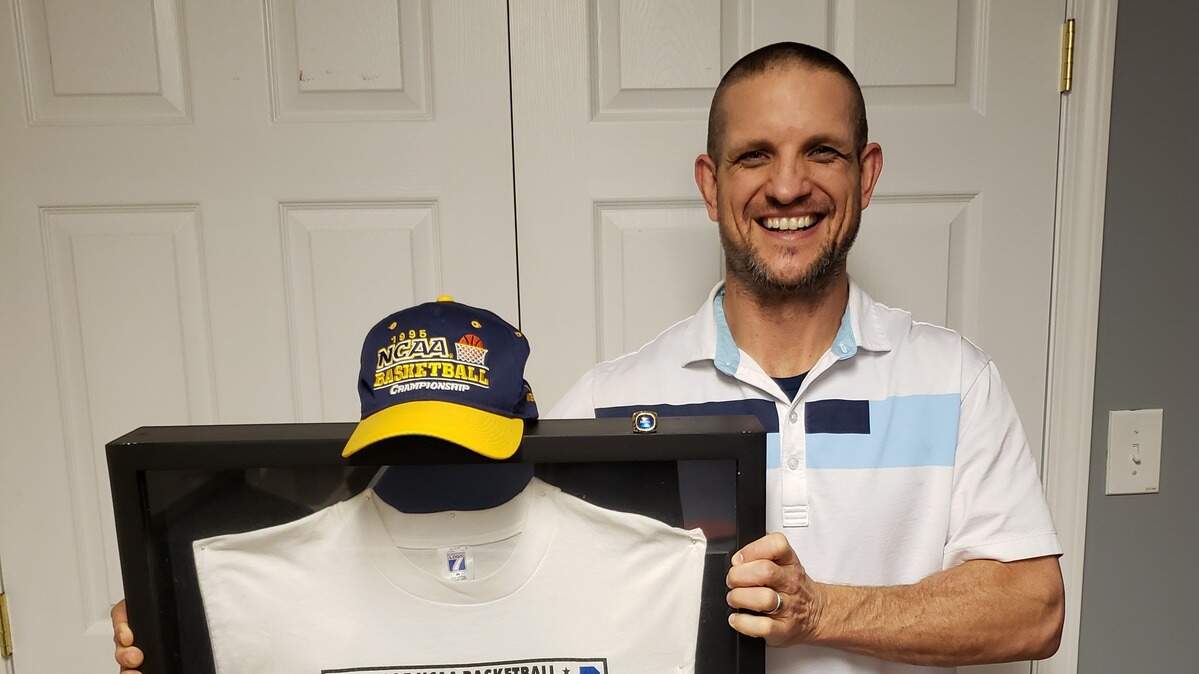
A quarter-century ago, FIU’s men’s basketball team stepped out of its team bus in Idaho only to find hordes of fans wanting their autographs and photos.
FIU was known as the Golden Panthers back then — now they’re just the Panthers — and that 1994-95 team had made the NCAA Tournament despite an ugly 11-18 record. They were the only team with a losing record in the tournament, and they were sent all the way out to Boise to face the top-ranked UCLA Bruins.
Prior to FIU, it had been 34 years since any school had made the tournament with a record that bad or worse.
“We were the Cinderella team,” said Vince Cautero, who was an FIU assistant under head coach Bob Weltlich at the time. “When our kids stepped off the bus for a one-hour practice in Boise [that was open to the public], they were blown away by all the attention.”
The novelty didn’t last long as UCLA routed FIU 92-56 on March 17. The Bruins, who had six eventual NBA draftees on that team including first-rounders Ed O’Bannon and George Zidek, went on to win the national championship that year. Two days after beating FIU, UCLA defeated Missouri but only after Bruins point guard Tyus Edney made his famous game-winning layup, dribbling the full length of the court to score with just 4.8 seconds left.
Meanwhile, FIU has never made it back to the NCAA Tournament. That was FIU’s only experience in the Tournament, and they enjoyed their experience.
“We went from nobody on campus knowing we even had a team to getting interviewed on national TV and by radio and newspaper reporters,” said Matt Tchir, who was FIU’s point guard that season. “We became rock stars for two weeks.”
FIU will honor that 1994-95 team this Saturday during its game against Middle Tennessee.
THE STORY OF ‘95
All three of the people The Herald interviewed for this story — Cautero and former players Tchir and James “Big Nasty” Eason — said there was considerable turmoil off the court that season.
It started, Cautero said, when a new athletic director, Ted Aceto, was hired.
“He and Bob didn’t get along right from the start,” Cautero said of Aceto’s relationship with Weltlich, who had been hired by the previous AD and was in the final year of his contract. “Ted was trying to put his stamp on the athletic department, and it trickled down to Bob’s ability to run the basketball program like he was capable.”
But it wasn’t just the coach. The players were going through a tough time, too, as FIU lost six games that they led at halftime — three of them by three points or less and another one in overtime.
“There was a lot of bickering and pointing fingers,” Tchir said. “We had injuries, and it’s never fun when you’re losing.”
Part of the problem was that of the 13 players on the roster, eight of them were new to the team that season. The players hadn’t bonded, and they would typically disperse immediately following practice. One player even drove from Miami to his hometown of New York every chance possible.
“We had six players who didn’t even talk to each other,” Eason said. “We would eat separately.
“It was a dysfunctional team, like the ‘Bad News Bears’. Nobody did extra work, and it showed on the court. It was sad.”
The turning point of the season came when Weltlich announced on Jan. 15 that he would resign his FIU post, effective at the end of the season.
Weltlich, a hard-nosed coach who had been an assistant to Bobby Knight on the Indiana Hoosiers team that went 32-0 and won the 1976 national title, seemed to relax after his resignation announcement.
“Bob was as smart and as good a coach as I’ve ever been around,” said Cautero, who served on staffs at Florida State and Providence. “Bob had a strong personality. But once he made his announcement, it was like a relief for him and the players.”
MIRACLE RUN
FIU hit rock bottom on Feb. 13, falling to 5-17 with a 93-81 loss to Centenary.
But after a seniors-only meeting, the team started to click, winning six of their next seven games.
“We began playing for [Weltlich],” Eason said. “He was a tough coach, but he was fair. He treated us like men.”
Down the stretch of that season, Weltlich played a shorter rotation — mostly seniors.
The starters were Tchir, a 5-10 senior who could shoot three-pointers and handle the ball; Marc Dozier, a 6-3 senior shooting guard who was a tough defender; Scott Forbes, a 6-5 junior forward who was the best leaper and dunker on the team; James Mazyck, a 6-7 senior forward and FIU’s leading scorer; and Eason, a 6-5 senior and an undersized center.
Mazyck, who has since passed away, led the team in scoring at 16.4 points. Forbes averaged 11.8 points, and everyone else was under 10.
Back then, FIU played in the Trans America Athletic Conference (TAAC), which is now known as the Atlantic Sun.
In 1995, the TAAC had an eight-team postseason tournament, and the winner earned an automatic entry into the NCAA’s Big Dance. But FIU was in ninth place on the morning of Feb. 25, and it had to go on the road and upset first-place Stetson in the regular-season finale just to get into the conference tournament.
FIU beat Stetson 62-61 to qualify for the tournament and then beat the Hatters again five days later in the first round of the TAAC. The next day, FIU was trailing by two with four seconds left in overtime when Tchir hit a game-winning three-pointer as the Golden Panthers eliminated Southeastern Louisiana, 65-64.
Then, playing its third game in three days, FIU competed on national TV for the first time in program history. The Golden Panthers defeated Mercer 68-57 on ESPN to earn their automatic bid to the NCAA Tournament.
Ironically, technical difficulties at ESPN caused viewers to miss most of the first half, but old clippings capture the game perfectly. FIU forced 16 turnovers in that game, and Mercer player Will Tuttle told The Herald back in ‘95:
“They were on us like skin.”
END OF THE LINE
Unfortunately for FIU, the Bruins were too tough.
“UCLA’s guys would catch an outlet pass at midcourt, take one or two dribbles and dunk the ball,” Tchir said. “They were bigger, longer and more athletic than us. We still believed we could compete with them, and we did … for the first half of the first half.”
It got ugly after that, and — just like that — it was over.
Weltlich, now a 75-year-old retiree, is living in Alabama. Tchir runs a sports ministry in the Atlanta area. Eason is in Orlando, where he is a middle-school teacher, coach, and, most proudly, the caretaker for his 96-year-old grandmother. Cautero runs an executive search firm in Jacksonville.
But even though they have all gone their separate ways, it’s unlikely any of these men will ever forget that dream run of ’95.
“It wasn’t a fluke,” Cautero said of FIU winning the TAAC tournament. “We had been underachieving earlier in the season. But we were more talented than every other team in [the TAAC], and then it became a momentum thing.”