
Voters approved Amendment 4 to allow ex-offenders to vote. Period | Opinion
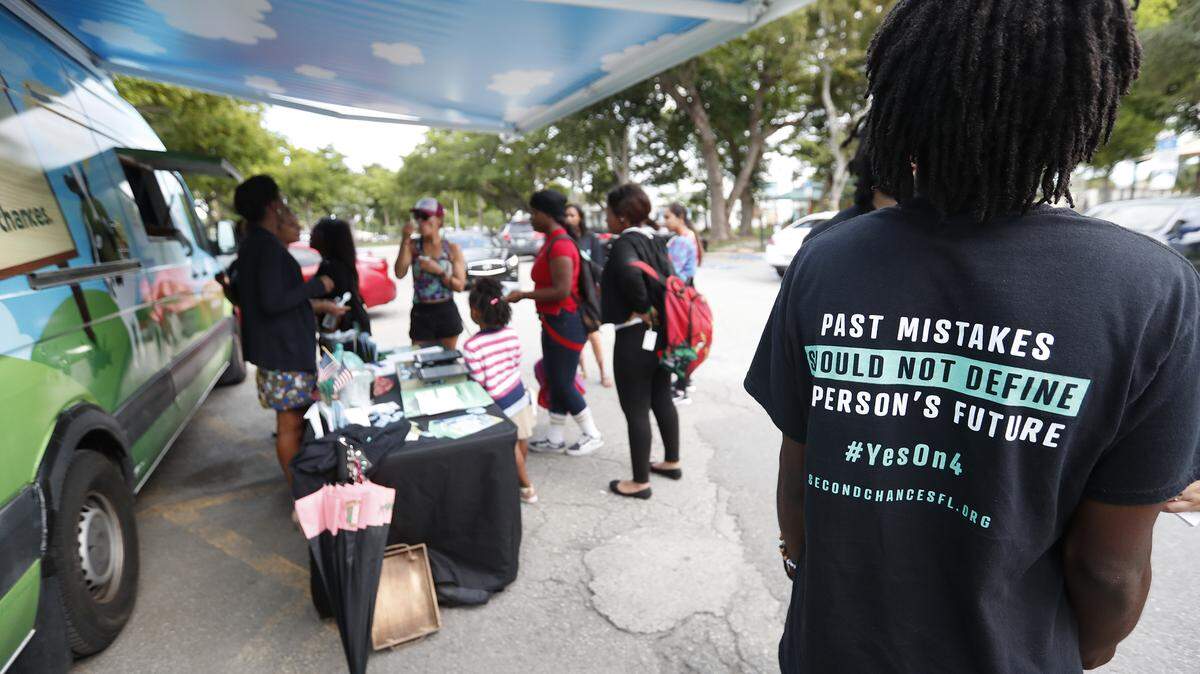
The citizens’ initiative known as Amendment 4 was as reaction to Florida’s highly restrictive civil rights restoration process for ex-offenders under Gov. Rick Scott and the Cabinet convening in their capacity as Florida’s Executive Clemency Board — in many respects the most restrictive in the country.
This ballot initiative was lauded as the greatest expansion of voting eligibility since the 1960s when approved by a super majority of voters in November. But if legislation advancing largely along party lines passes, the effect would be far less sweeping.
The House bill is more restrictive than the Senate version Sen. Jeff Brandes, R-St. Petersburg, vice-chair of the Senate Criminal Justice Committee, is shepherding and varies regarding which specific offenses would be ineligible for restoration given exclusions for “murder” and “felony sexual offenses.”
There also are similarities.
Both essentially require paying all fines and fees, or converting them to a civil judgment or lien. They also require first paying court-ordered restitution to crime victims.
Some legislators have asserted Amendment 6, also approved by voters in November and known as Marsy’s Law or more simply as the victims’ rights amendment, first requires payment of all court-ordered restitution.
It doesn’t, so long as any such obligation to repay a victim isn’t diminished.
Notably Scott didn’t require payment of fines and fees or converting them to a civil judgment or lien to restore eligibility to vote, or other complementary civil rights to serve on a jury and hold public office given how pervasive and uneven they are.
No reasonable person would conclude voters approved Amendment 4 to make it harder for ex-offenders to vote.
However, some legislators assert a preliminary Florida Supreme Court proceeding in May 2017 is controlling. That’s when Jon Mills, former House Speaker and esteemed dean emeritus of UF ‘s Levin College of Law, appeared on behalf of proponents of the ballot initiative and essentially said all monetary obligations imposed at sentencing must first be paid. While accurate as far as traditional jurisprudence this doesn’t address context regarding the implications of requiring payment of fines and fees, or converting any such obligations to civil judgments or liens to restore voting eligibility acknowledged by Scott.
In deference to Mills, highly accomplished lawyers are often unaware of matters involving executive clemency. Aspects of traditional practice and jurisprudence don’t necessarily apply. That’s essentially why federal District Judge Mark Walker authorized me to file a “friend of the court brief” after he ruled that Florida’s civil rights restoration process for ex-offenders ran afoul of the U.S. Constitution -- to better inform the court about the clemency process as he deliberated over an appropriate remedy.
While Mills’ pronouncements are relevant, the scope of review for that routine proceeding was limited to the actual language of the petition, and whether it addressed a single subject — nothing more.
Nevertheless, Mills’ analysis seemingly matters more to some legislators than the plain language of Amendment 4, or independent research highlighted by the Sentencing Project in 2016 estimating 1.5 million people were still barred from voting in Florida after completing legislatively mandated sentences. That equated to almost half of all post-sentence felony disenfranchisement throughout the U.S. — a staggering number even for a state with the nation’s third-largest population.
And that’s not all. Florida Department of Corrections statistics indicate each year, nearly 50,000 people complete felony sentences that result in losing their civil rights. Many are subject to fines and fees.Research by the Clemency Board’s investigative arm indicates post-sentence civil rights restoration reduces recidivism and promotes more successful re-entry. Simply put, there’s cause to ensure restoring voting eligibility under Amendment 4, and restoration of complementary civil rights, is as easy and inclusive as possible.
It follows that crime victims would be more likely to collect restitution upon ex-offenders’ successful re-entry, and community policing objectives to reduce crime would be furthered. Senator Jose Javier Rodriguez, D-Miami, offered related amendments recently that were voted down.
Finally, both bills deviate from the actual language of Amendment 4 in at least one instance. The actual phrasing of the amendment is, “restored upon completion of all terms of sentence including parole or probation.”
However, legislative drafting changed the sentence structure by inserting additional punctuation before “parole or probation.” As a result, the weight of the actual language modifying — and arguably limiting completion of all terms of sentence beyond incarceration to parole or probation was diminished. Amendment 4 doesn’t say including but not limited to, but the legislation does.
There’s still opportunity to get this right!
Mark R. Schlakman is senior program director for the Florida State University Center for the Advancement of Human Rights.