Portable power is more useful than ever for homes, RVs, and outdoor adventures. I have used both traditional and inverter generators, and inverter technology has completely changed the way you can get reliable power.
A portable generator is a small engine that makes electricity. People use them during outages or off-grid trips, but OSHA reminds us they are still risky if misused.
If you have ever asked yourself, “What is an inverter generator?” you are in the right place. This guide covers how they work, why they matter, and how they compare to regular generators with clear facts and examples.
Key Takeaways
- Three-Stage Power Production: Converts electricity more cleanly (AC → DC → AC), typically producing less than 3% harmonic distortion, safer for electronics.
- Fuel Efficiency and Portability: Runs quieter and longer while being easier to carry than many conventional models.
- Higher Output From Conventional Generators: Often deliver more raw wattage per dollar, though some inverter models can match this in mid-range sizes.
- Parallel Capability: Lets you double the power by linking two units.
- Carbon Monoxide Safety: All generators emit CO — use outdoors only.
How Does an Inverter Generator Work?
An inverter generator uses a three-step process to create stable power:
- The engine drives an alternator to generate AC electricity.
- This AC power is converted into DC power.
- The inversion process converts DC back into clean AC electricity with consistent voltage.
This results in electricity with less than 3% total harmonic distortion (THD), safe for sensitive devices such as laptops and smartphones. Traditional generators skip the DC stage, which makes their power less consistent.
Real-World Uses for Inverter Generators
Thanks to their quiet operation and clean power output, inverter generators are ideal for a wide range of everyday and emergency scenarios:
- Camping: Their compact size and low noise levels make them campground-friendly.
- RVs: Quietly run air conditioners and sensitive electronics without voltage spikes.
- Medical Devices: Safely power CPAP machines and monitors during outages.
- Household Appliances: Keep essentials like refrigerators and lights running during blackouts.
- Events: Great for tailgates, festivals, or outdoor parties where quiet, portable power is needed.
While they’re not a full replacement for a standby generator, inverter units shine in portable situations where efficiency, low noise, and clean electricity are priorities.
Inverter Generators vs. Conventional Generators
Conventional generators produce alternating current directly from the alternator. They are simple, powerful, and can handle appliances or heavy tools, but they use more fuel, create more noise, and deliver less stable voltage.
Inverter technology creates cleaner power with quieter operation. While they often have lower wattage output, they still work well for household appliances, RVs, and backup power during outages.
Inverter vs Conventional Generators Comparison
| Feature | Inverter Generator | Conventional Generator |
| Power Quality | Stable, typically | Less stable |
| Noise | 48–60 dB (quieter, load-dependent) | 70–80 dB |
| Fuel | Uses less fuel with eco mode | Runs at constant speed |
| Portability | 40–60 lbs, compact | 90–150+ lbs, heavier |
| Sensitive Electronics | Safe | Higher risk of damage |
Advantages vs. Disadvantages
Inverter generators offer several key benefits over conventional models:
- Clean power for electronics
- Quiet operation
- Fuel efficient
- Portable and compact
- Parallel capability
Disadvantages:
- Higher upfront cost
- Lower power output
- Regular maintenance needed
- Not for whole-house backup
Fuel, Maintenance, and Cost
Inverter generators tend to run on gasoline, though some models support diesel or dual-fuel. Routine upkeep includes oil changes, spark plug swaps, and air filter checks. While they cost more upfront than conventional units, they use less fuel over time and protect sensitive electronics, a worthwhile trade-off for many users.
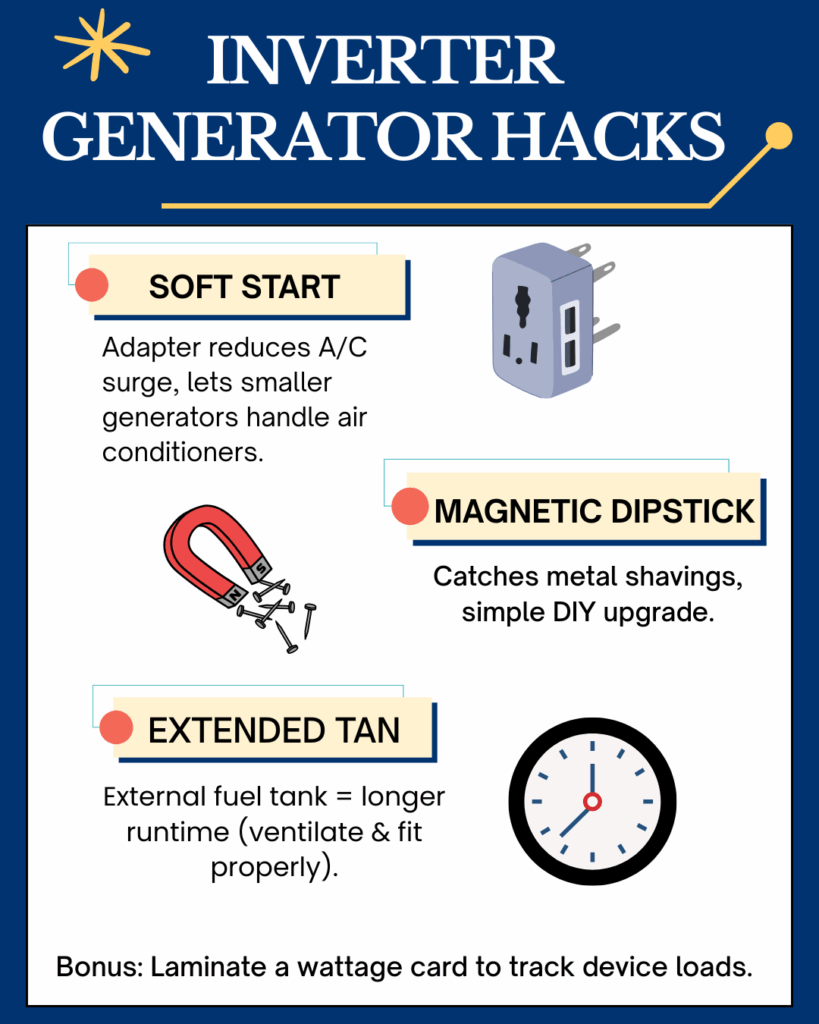
Lesser-Known Inverter Generator Hacks
- Soft Start for A/C Units: A soft start adapter lowers startup surge, helping smaller generators run air conditioners (check model compatibility).
- Magnetic Dipstick: A magnetic dipstick can catch metal shavings, a simple upgrade used by many DIYers.”
- Extended Fuel Tank: Some models support external tanks for longer runtime. Make sure the setup is well-ventilated and properly fitted.
💡 Bonus: Laminate a wattage load card with your devices to avoid overloads during outages.
Safety Concerns with Generators
Whether using an inverter or a standard generator, safety remains a priority. All portable generator models emit carbon monoxide, which may lead to carbon monoxide poisoning if run in an unventilated space. Always place units outside, at a safe distance from windows and doors.
A transfer switch is recommended when connecting any generator to home circuits. Without it, users risk back-feeding electrical energy into power lines, which can endanger utility workers.
My Final Verdict
From my experience, inverter generators are the smarter choice for quiet, fuel-efficient, and electronics-safe power. They’re ideal for camping, RVs, or emergency backup, especially if you’re powering sensitive gear.
Regular generators are cheaper and more powerful, but they’re also louder and not as good for running things like laptops or medical devices. For camping, RV trips, or powering sensitive equipment during an outage, inverter generators usually make more sense.
FAQs
Yes, most inverter generators can run refrigerators, lights, and smaller household appliances, depending on output wattage.
Yes, most inverter models operate between 48 and 60 decibels, while conventional generators often reach 70 to 80 decibels.
No. All portable generators create carbon monoxide. They must be placed outdoors in a well-ventilated area at a safe distance from the home.
Yes, they adjust engine speed based on demand, which reduces fuel consumption compared to constant-speed standard generators.
Yes, inverter generators provide stable voltage and clean power, ideal for CPAPs and other sensitive medical equipment.