
Art Review: Natalia Garcia-Lee: Homo Sapien Sapien at MDC, Kendall Art Gallery
Natalia Garcia-Lee works in many media, including jewelry, but in her solo exhibition in the generously proportioned gallery at Miami-Dade College, the artist, born in Madrid and who lives part of the year in Miami and the rest of the time in France, focuses on painting, collage and sculpture.
Curated by Amaranta Mattie, the Cultural Arts Curator at the Deering Estate, each of the three genres contains overlapping information from printed diagrams and sewing patterns from another time. The sizes within each medium are consistent. Her eight paintings are large, the twenty-four collages are smaller than a single page of a broadsheet newspaper, and the fourteen sculptures are small enough to be worn, an option she intends.
The collage and mixed-media paintings illustrate the creation of the human body within a factory system. The artist depicts these ideas as if they are manuals from an outdated government or science lab from another time. This gives the impression that the information is old, especially since the works are recent, all created within the last three years. It raises whether these processes are still relevant today. Since humans have not fundamentally changed, she might be revealing a forgotten truth.
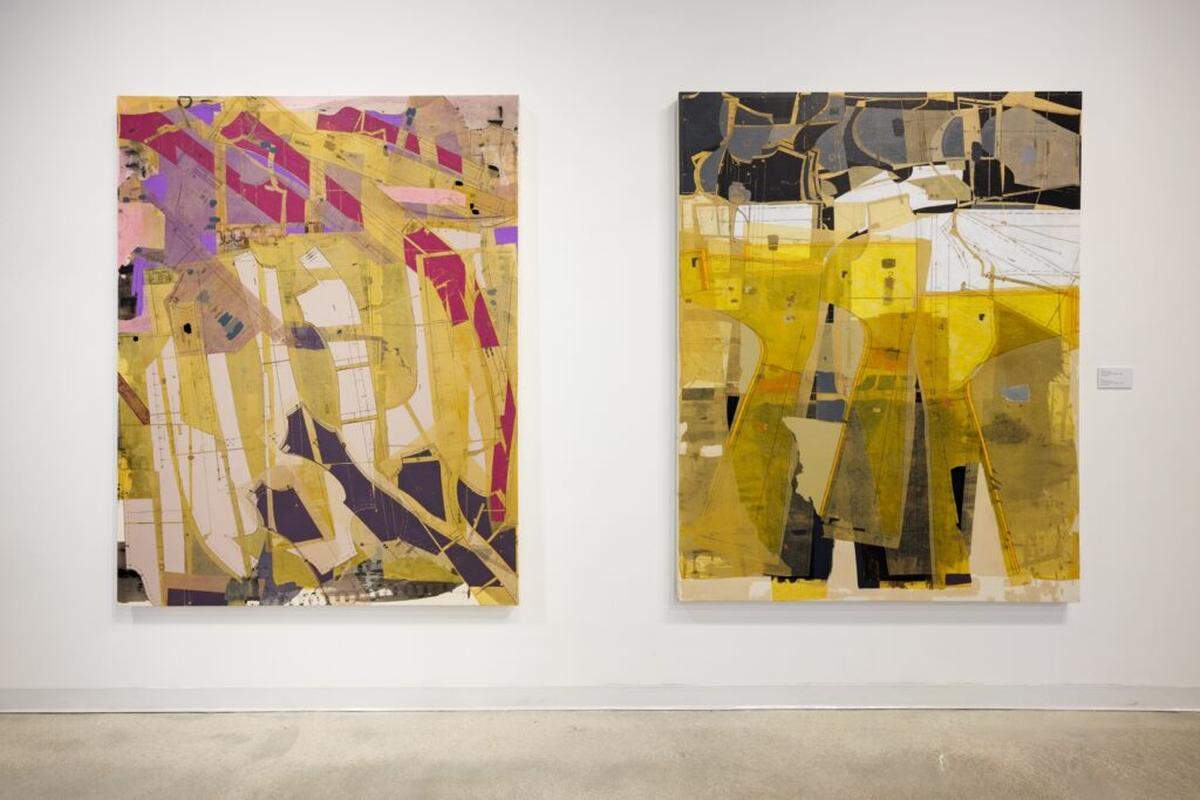
The paintings are serious works of deliberate construction which read satisfactorily as abstractions not unrelated to the work of Caio Fonseca. Her work is not purely decorative. It is constructed by careful choices in materials, coloration, and subject matter to enter the realm of conceptual art. The line and shape quality recall the many collages of Kurt Schwitters.
Each painting depicts either male or female subjects, subtly presented in pairs, using diagrams and clothing patterns that relate to them. They are created with tissue-paper sewing patterns and paint, carefully layered. The male pieces feature patterns for pants or gloves, while the female pieces include those for ballgowns, for example. These color differences across the surface add subtlety and nuance. Modernist rhythms establish the tempo for each work, often involving rows of repetition, such as the pattern for a baby’s bonnet. These evoke the detailed, all-encompassing assembly-line mural by Diego Rivera at the Detroit Institute of Arts. Rivera included heritage and geology, using Social Realism; Garcia-Lee offers an abstracted version through carefully composed gestural collages.
The artist’s titles and materials are all very specific to her idea of humans being made en masse, with no differentiation. Structurally, physiologically, we are identical, almost as if factory-made. These works retain interest and the pleasure of looking because the artist doesn’t take it overly seriously; she is not pontificating or educating via a manifesto from an authority figure’s position. In the early twentieth century, artists were driven to write manifestos proclaiming the groundbreaking nature of their work.
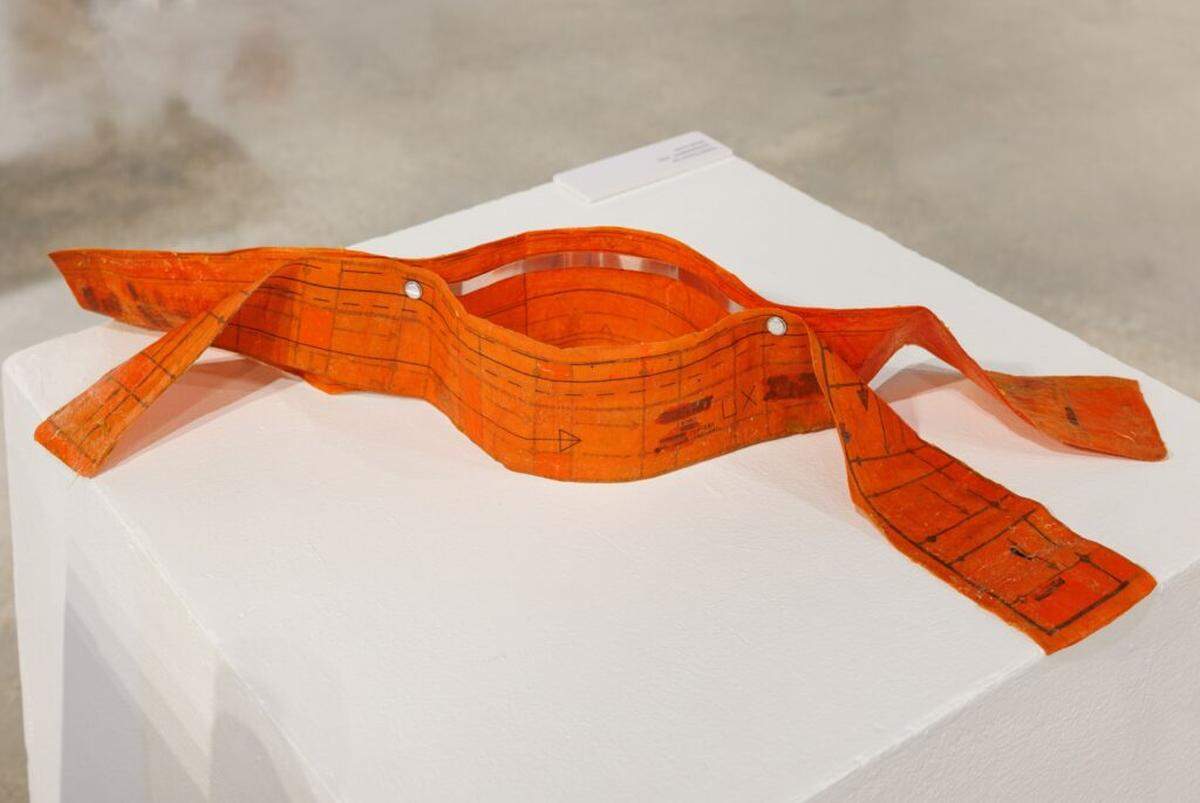
The gallery holds an L-shaped line of pedestals in the center, echoing both the angled walls and the repetition of loose geometry in her work. Each is topped with a single soft color sculpture made from fragile paper coated with rubber. They are simple forms with a mailable, fabric-like construction, making them wearable as collars. This represents the distinction between blue-collar and white-collar workers. These collars, too, are color-coded; they represent the major professional groups that make up a working society and are tinted to reflect their industries. These sculptures are intended to be uncomfortable to wear and are made even creepier by the skin-like texture of the transparent, dull ochre rubber coating. They are like outdated hazmat material, like the kind used against acid spills.
The sculpture titled “Service” resembles a memorial ribbon, such as the pink ribbon for breast cancer. It almost looks like something an eccentric dandy would wear. “Prison,” is orange. “Industrial,” is black. Overall, they appear aged, as if found in a forgotten vault of a defunct Eastern European government, the contents of which date from the 1940s.
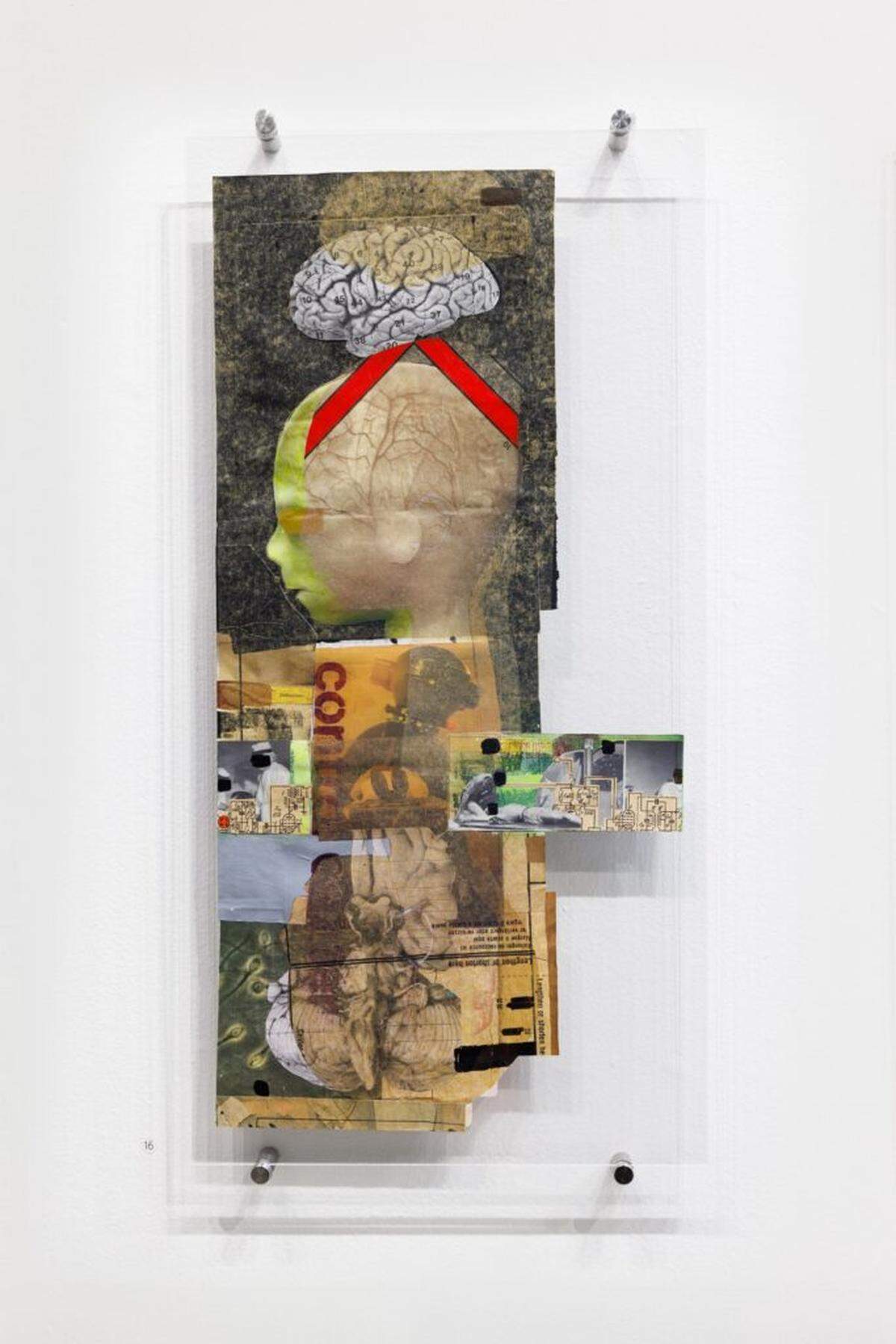
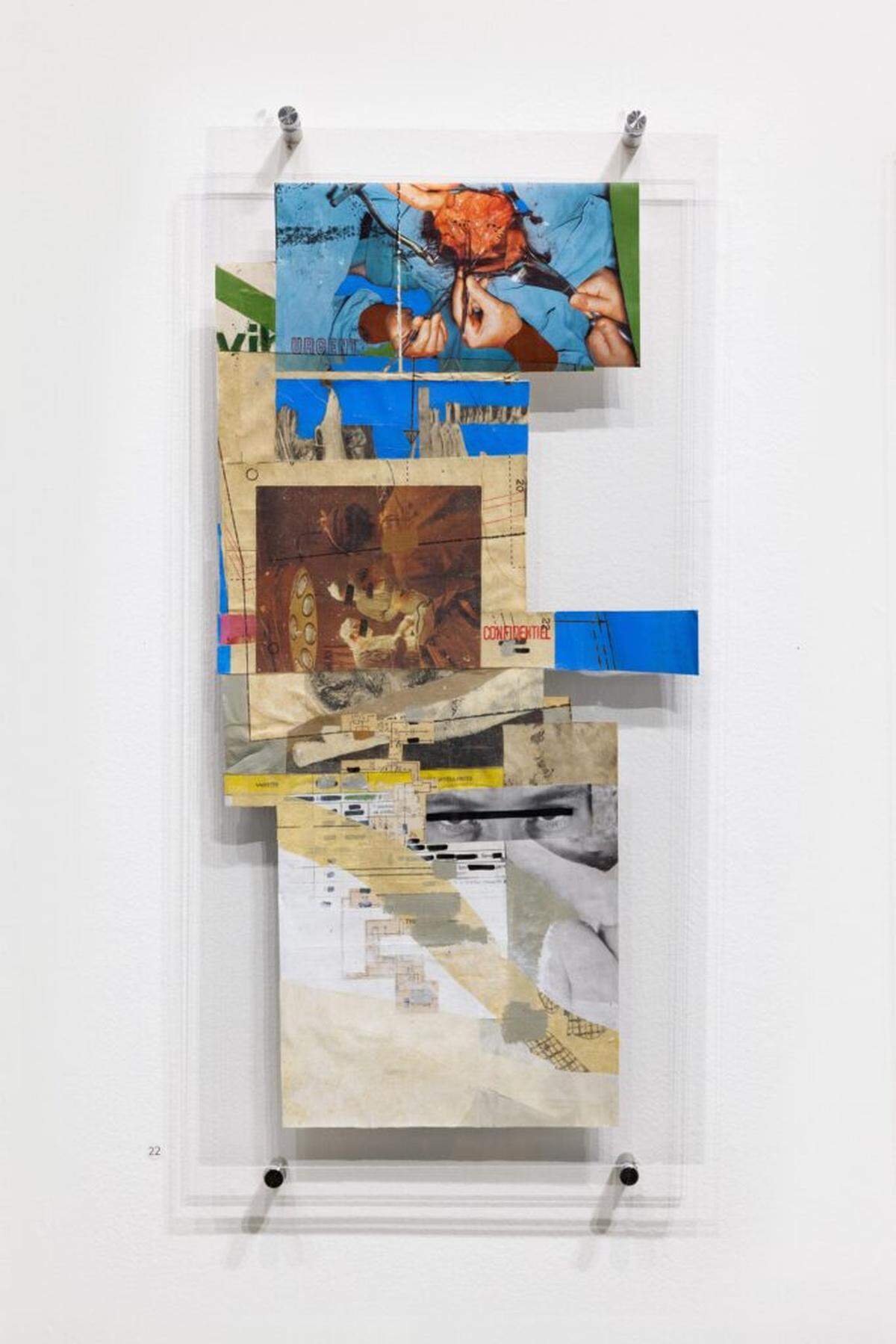
The similarly sized, but irregularly shaped, collages are visually complex. In looking at all of them, while each is its own piece, they all contain the same topical elements: science, medicine, and systems of construction. Directions such as “buckle here,” “urgent,” “lengthen or shorten here,” “cut here,” “confidential,” and “fold line” instruct. They contain diagrams and tables that illustrate how to construct each part of our anatomy. Taken all together, they would constitute a manual of how to put a human together and keep it alive. It is rife with details within details, yet it remains visually intriguing and retains a lightness of intention.
The translation of HOMO SAPIEN SAPIEN, the exhibition’s title, is Modern Human. Overall, the works are visually captivating and conceptually compelling. The exhibition shows a complex and impressive body of work beautifully installed.
If you go:
WHAT: Natalia Garcia-Lee, HOMO SAPIEN SAPIEN
WHERE: Miami Dade College’s Kendall Campus Art Gallery, Building M – 123, 11011 SW 104th St., Miami
WHEN: 10 a.m. to 5 p.m., Monday and Friday; 10 a.m. to 6 p.m., Tuesday and Thursday; Wednesday, 10 a.m. to 1 p.m. and 2 to 5 p.m.; 11 a.m. to 4 p.m. Saturday. Closed Sunday. Through Wednesday, Dec. 10
COST: Free
INFORMATION: 305-878-2894, www.mdc.edu/kendall/art/ and https://nataliagarcialee.com/
ArtburstMiami.com is a nonprofit media source for the arts featuring fresh and original stories by writers dedicated to theater, dance, visual arts, film, music and more. Don’t miss a story at www.artburstmiami.com.