
Miami Beach’s Bass Museum celebrates 60 years during Miami Art Week
In Miami Beach, it took a day to build a mountain.
Silvia Karman Cubiñá, the Bass Museum of Art executive director for the past 16 years, recalled the rainy day in 2016 when “Miami Mountain,” a towering rainbow totem of six stones by artist Ugo Rondinone, was installed.
Each painted boulder sat on its own flatbed truck on a trip from Nevada to Miami. By the time they arrived, it was an unusually misty day on the beach, Cubiñá said, and the installation was far more complicated than just stacking rocks. The first one took nine hours to place. The total job took 14 hours.
Now, the “Miami Mountain” shines brightly in sunlight as it sits permanently in Collins Park, greeting visitors and residents as they walk toward the museum’s Art Deco building. On a recent afternoon, a team of workers gave the rocks a fresh coat of paint for the artwork to be picture-perfect when it greets art lovers from around the world during Miami Art Week, which kicks off with the return of Art Miami on Tuesday and Art Basel on Wednesday, plus more than a dozen other fairs throughout the county and countless VIP events, art-adjacent brand activations and interactive installations galore.
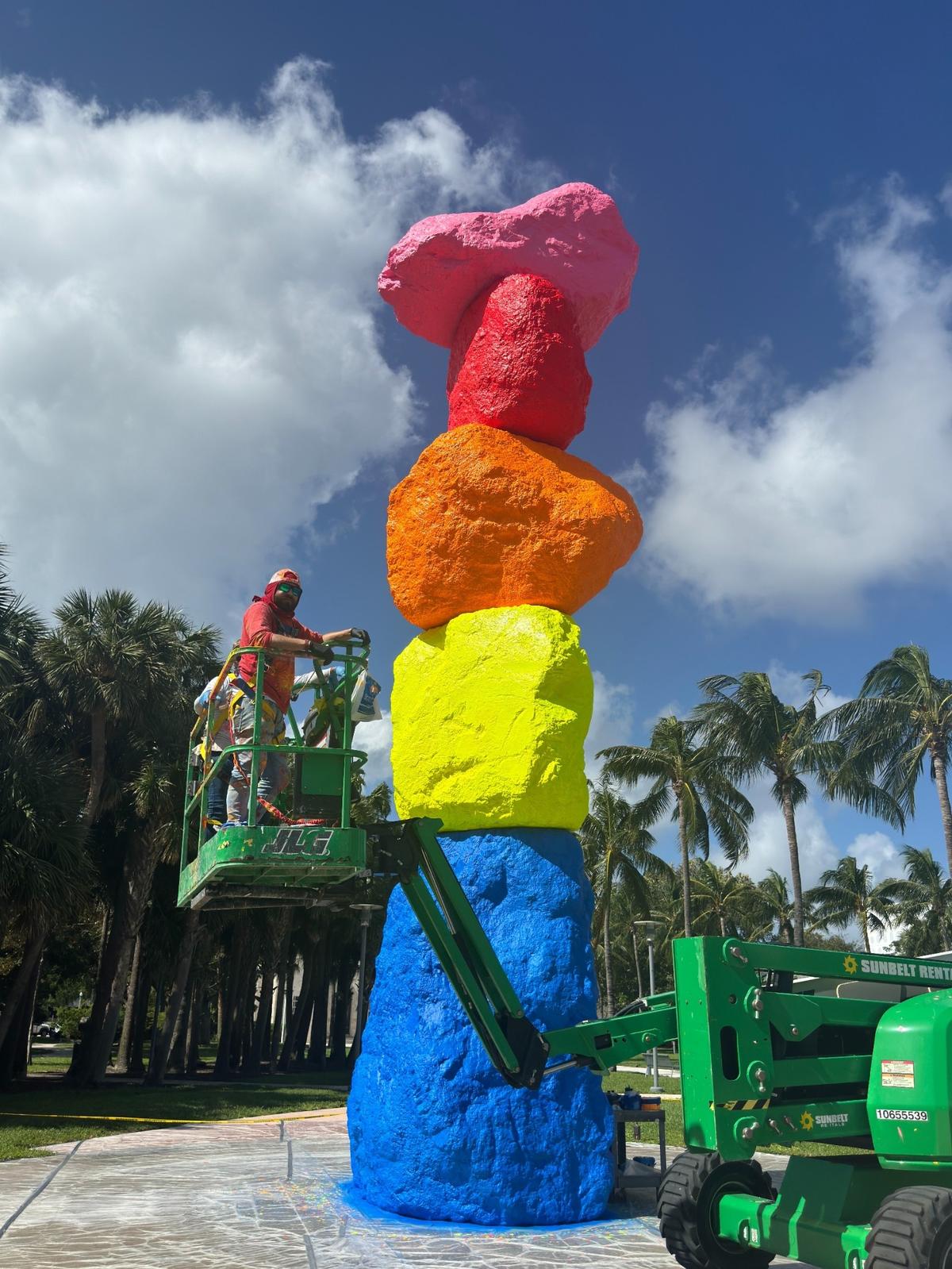
“The whole process was really fun, and still, seven years later, we’re illuminating it. I just came one night to visit it,” Cubiñá said. “It has turned into quite an iconic symbol.”
Miami Beach has much to hang its hat on today. Sure, there are the beaches, night clubs and luxury hotels. There are also the world-renowned cultural institutions, like the ballet and symphony. And this week, the city hosts the main event of Miami Art Week, Art Basel Miami Beach.
That wasn’t the case 60 years ago, when the only reliable attractions were the beaches and a new, plucky art museum: The Bass.
The museum was named after John and Johanna Bass, the married couple who donated their 500-piece art collection, mainly Renaissance and Baroque works, to the city of Miami Beach.
“Miami Beach has everything but culture,” said John Bass in a 1964 New York Times interview. “It really needed it.”
Miami City Ballet was founded in 1985. New World Symphony was founded in 1987. Art Basel Miami Beach debuted in 2002. Before any of that, before the Miami area became an arts hub, before local governments even considered prioritizing arts funding, there was The Bass.
“It is a jewel of a building,” said Paul George, the resident historian at HistoryMiami Museum. “It sits in a great place that is often overlooked in the Art Deco district.”
With the ballet and Miami Beach Regional Library right next door, The Bass is the center of a “cultural oasis,” in tourist-driven South Beach, George said.
“It was probably serendipitous the way the location turned out. It was just the perfect antidote to nothing but hotels around it,” he said. “And I think it functioned beautifully as a result of that.”
The museum has been celebrating its 60 years of contemporary art exhibitions, commissions, education and growth this year. It’s a time of reflection that Cubiñá has taken to heart. She had been researching the significance of the number 60 in other cultures and learned that in Hinduism, completing 60 years marks the end of a life cycle and the beginning of a new one.
For Cubiñá, who turns 60 next year herself, The Bass’ 60th anniversary is the start of a new era as the museum embarks on another expansion, not just as an arts space but as a community space.
“We’re celebrating our 60th, and the museum, it feels mature,” she said. “In all of [former director] Diane Camber’s time and 16 years of my time, we’re here. You look back, but you also look forward at the same goal. It’s a rebirth.”
Ups and downs at The Bass
In a relatively young city like Miami Beach, the landmark building The Bass occupies is as venerable as it gets.
Made from limestone in the 1930s, the original building used to be the Miami Beach Public Library and Art Center. It was designed by Russell Pancoast, the grandson of Miami Beach pioneer John Collins.
John and Johanna Bass were a Jewish immigrant couple from Vienna, Austria, who lived in Miami Beach. Before he retired to devote his time to art and music, John was the head of several large sugar companies. The couple invested heavily in Baroque and Renaissance-era art, fabulous tapestries and works by the Old Masters, including Botticelli, El Greco and Van Dyck.
The Basses were about to give their collection to a New York institution when they happened to see the old Miami Beach library building, Johanna Bass told the New York Times. They gifted the art to the city on the condition that the museum would be open to the public. When The Bass debuted, admission was free in the morning and 50 cents in the afternoon.
But from then on, it wasn’t always smooth sailing at The Bass. Controversy struck in 1968, when the Art Dealers Association of America questioned the authenticity of some of the collection’s paintings. The city closed the museum down for a period after John Bass’ death in 1978. Art historian and Miami Beach native Camber had her work cut out for her when she was recruited to run The Bass in 1980.
“The facility was woefully inadequate,” Camber said. “And the surrounding neighborhood was a disaster.”
The Bass was a fixer-upper, Camber recalled. The museum itself was not accredited, there was poor climate control in the building and there was no gallery space big enough to show large artworks. Collins Park was “rife with drug use and drug transactions,” Camber said. On top of all that, Miami Beach was not an affluent city at the time, so few city officials were keen on allocating funds to the local art museum.
“The museum was an orphan in the city,” Camber said. “I remember the budget director saying to me, ‘We’re spending so much money on bullets for the police to go to the firing range. And that Bass museum. Who needs a museum in a city of 25,000 people?’”
For the next 27 years, Camber made lemonade out of lemons, turning a small art space into a modernized, legitimate institution. She wasn’t savvy in politics when she started out, she said, but she got invaluable advice from a city attorney: “Diane, you need to go see who contributed to the different commissioners so you know who in the community has an influence there.”
“Diane is very important, because she appreciated it,” George, the historian, said. “She was one of the early disciples of that district and the fact that it needed to be designated, that we needed to bring investors down.”
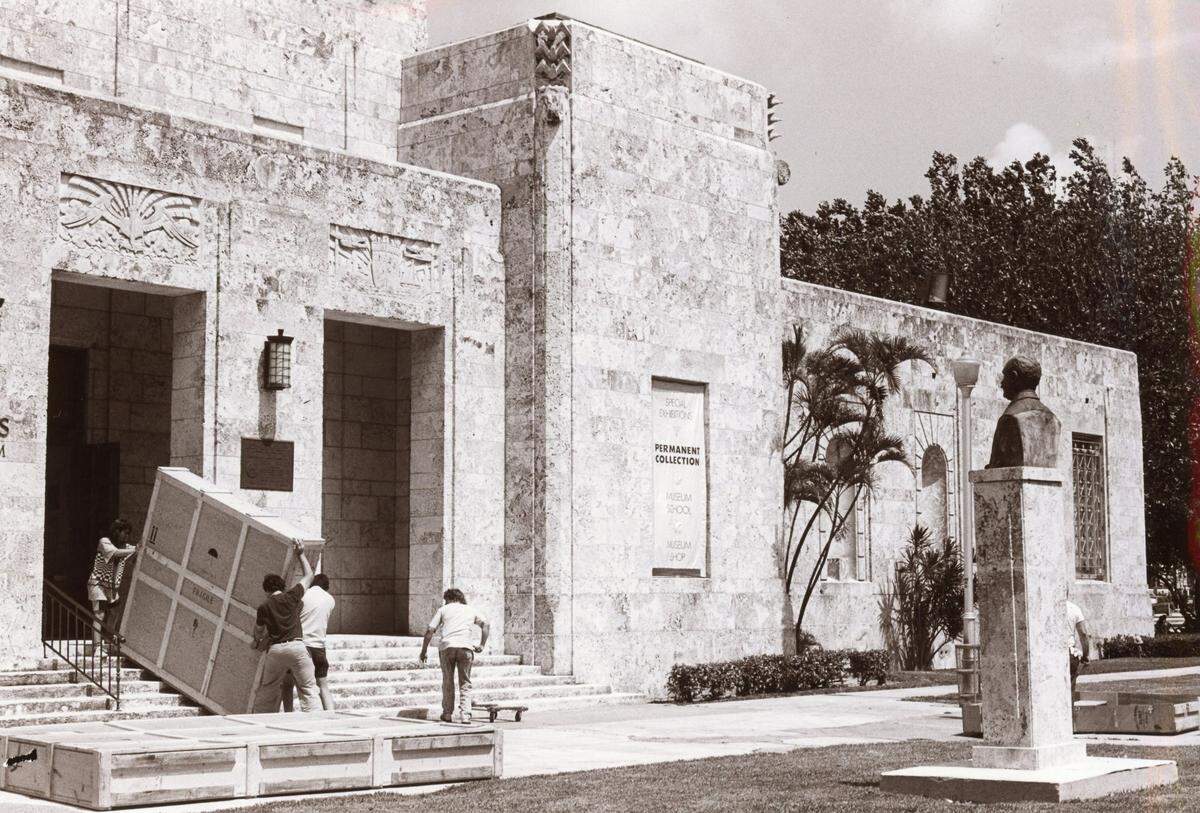
She made waves in 1981, when the museum showed “Precious Legacy,” a traveling exhibition of European Judaica that was looted by Nazis. Over a seven-week period, 100,000 visitors flocked to the small museum to see the show. She learned to invite large groups of people to speak during commission meetings to advocate for the museum. She applied for state grants when she couldn’t rely on the city. When the museum had no loading dock and a staff of five people, herself included, Camber had nearby firemen help bring crates of artwork in through the front door.
Camber was also behind the museum’s first expansion, which finally materialized in 2001. When she was raising money, she learned that local businessman Stephen Muss’ name was removed from the Miami Beach Convention Center building, “which was a real slap in the face,” she said. Camber came up with an idea.
“Steve, your name has to be permanently on some building in the city. You have done so much for the city,” she told him one day. “Would you consider making a contribution? We could name the big gallery in the new wing on the second floor after you.”
“Well, what would it take?” he said.
“Well, it would take a million dollars,” she said.
“Well, I’m not going to give you a million dollars,” he told her. “And I don’t want my name. I want my parents’ names on it.” He wrote a check on the spot for $500,000, a whopping amount of money Camber is still thankful for.
Camber, now 90, is recognized as the museum’s Director Emeritus. And her old struggles to get support from the city are all “water under the bridge” now, she said. Miami Beach has certainly changed its ways when it comes to prioritizing the arts. After Gov. Ron DeSantis vetoed all state arts grants, Miami Beach commissioners approved a nearly $500,000 fund for local arts nonprofits, which they later doubled.
“The Bass is becoming such a beacon in our community as a one-stop-shop of not only viewing art, but being take a moment, enjoy their cafe, grab some gifts for your family at the gift shop,” said Lissette Garcia Arrogante, the Miami Beach Tourism & Culture Department director. “The Bass is a cultural anchor and cornerstone that brings new perspectives to Miami Beach.”
The years of hard work were worth it, Camber said.
“It was fun, it was challenging,” she said. “It was a real sense of accomplishment because I knew that it could be a real asset for this city.”
‘Fresh’ Art Week exhibits
Amid the frenzy of Miami Art Week, with Art Basel bringing its largest edition yet with 286 premier galleries from 38 countries and territories to the Convention Center, Art Miami boasting 160 galleries from around the world, plus countless other satellite events taking place throughout the week, a visit to The Bass serves as a crash course on the museum’s history, its role in Miami’s arts community and its unique art collection.
During Camber’s tenure, the museum expanded its collection to 3,000 pieces by focusing more on contemporary artists than Old Masters.
“Performing Perspectives: A Collection in Dialogue,” the exhibition put together by chief curator James Voorhies and associate curator Claudia Mattos, pairs Baroque-era paintings with provocative contemporary artworks, all from the museum’s permanent collection. Where else could you see a Nam June Paik cello made of TVs displayed alongside a 1700s portrait of a woman playing a viola?
“This is our big hurrah,” Cubiñá said as she walked into the gallery space. “With the permanent collection, we thought performance was very much a part of it.”
The exhibition uses works from the museum’s permanent collection to explore performance in all its iterations, from traditional entertainment to performing rites of passage to taking a selfie and posting it online, Cubiñá said. She pointed at one wall emblazoned with an image Camber must be familiar with: a black-and-white photo of workers moving crates of art up the museum stairs through the front door. In front of the wall, there’s a row of theater seats.
“You have these pieces of the permanent collection that are, in fact, having conversations with contemporary works of art,” said Cynthia O’Keefe, a Bass museum guide. “I love that they’ve taken a fresh new way. It’s always a new look for the permanent collection, which I think is a huge talent.”
The entire second floor of the museum is bursting with color and personality. There are the bright geometric shapes of “Ulla von Brandenburg: In Dialogue,” an exhibition that pairs the German-born artist’s work with The Bass’ recently acquired ceramic mural by Lebanese-American artist Etel Adnan.
The next gallery boasts another colorful, and slightly overwhelming, acquisition: a floor-to-ceiling installation of drag queen-inspired wallpaper, a modular stage, sculptures, a large-scale projection and more. The exhibition, called “XI” by assume vivid astro focus, a São Paulo–based multidisciplinary art collective, was previously installed in the home of prominent Miami art collectors Rosa and Carlos de la Cruz. The couple donated the work to the museum before Rosa’s death in February.
“This work is going to have a new life here,” Cubiñá said.
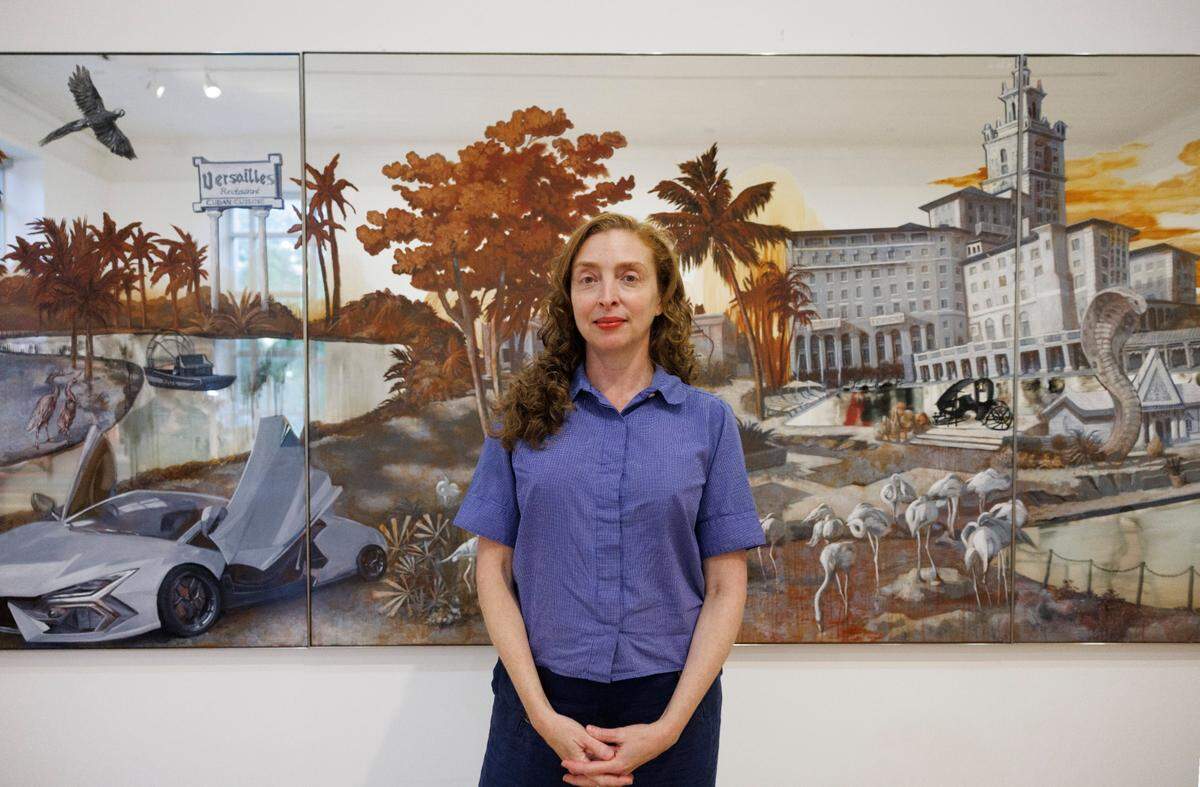
Downstairs is the latest edition of the museum’s “Miami Years” series, which focuses on the influence Miami had on an individual artists’ career. The current exhibition is a touching and nostalgic solo show of artist Rachel Feinstein, whose childhood in ‘70s and ‘80s Miami shaped her work.
The next 60 years
As the museum enters its next life cycle, The Bass has been positioning itself as both an arts institution and a community center.
“This concept of openness is something we’re after,” Cubiñá said. “This idea that maybe you can come to the museum after hours, socialize and meet new people is the changing role of the museum.”
O’Keefe, a cultural arts and hospitality consultant, knows this first hand. In 2016, she was a new Miami Beach resident looking to make friends and find something to do. At the recommendation of some fellow former New Yorkers, O’Keefe meandered into The Bass. She quickly fell in love.
Just a couple years later, O’Keefe dove straight into The Bass’ programming and educational department. She joined the museum’s docent program, which trains volunteers to study the collection and guide guests through the museum. O’Keefe recently became the chair of the museum’s Women’s Circle benefactor group, which promotes women’s voices in the arts community, she said.
The Bass’ programming, especially in recent years, reflects its role in the community as its premier contemporary art museum, O’Keefe said.
“It feels more like a city hall than the actual City Hall,” she said. “Where it sits, physically facing the Atlantic, [...] it’s so auspiciously placed. It does command a responsibility to the community, because it’s so open to the community.”
That openness is central to one of the museum’s newest additions, Social Assembly, an informal, artistically curated, living room-esque space for people to come, relax, socialize and experience art. The space is right next to another new feature, a cafe by local brewery Offsite.
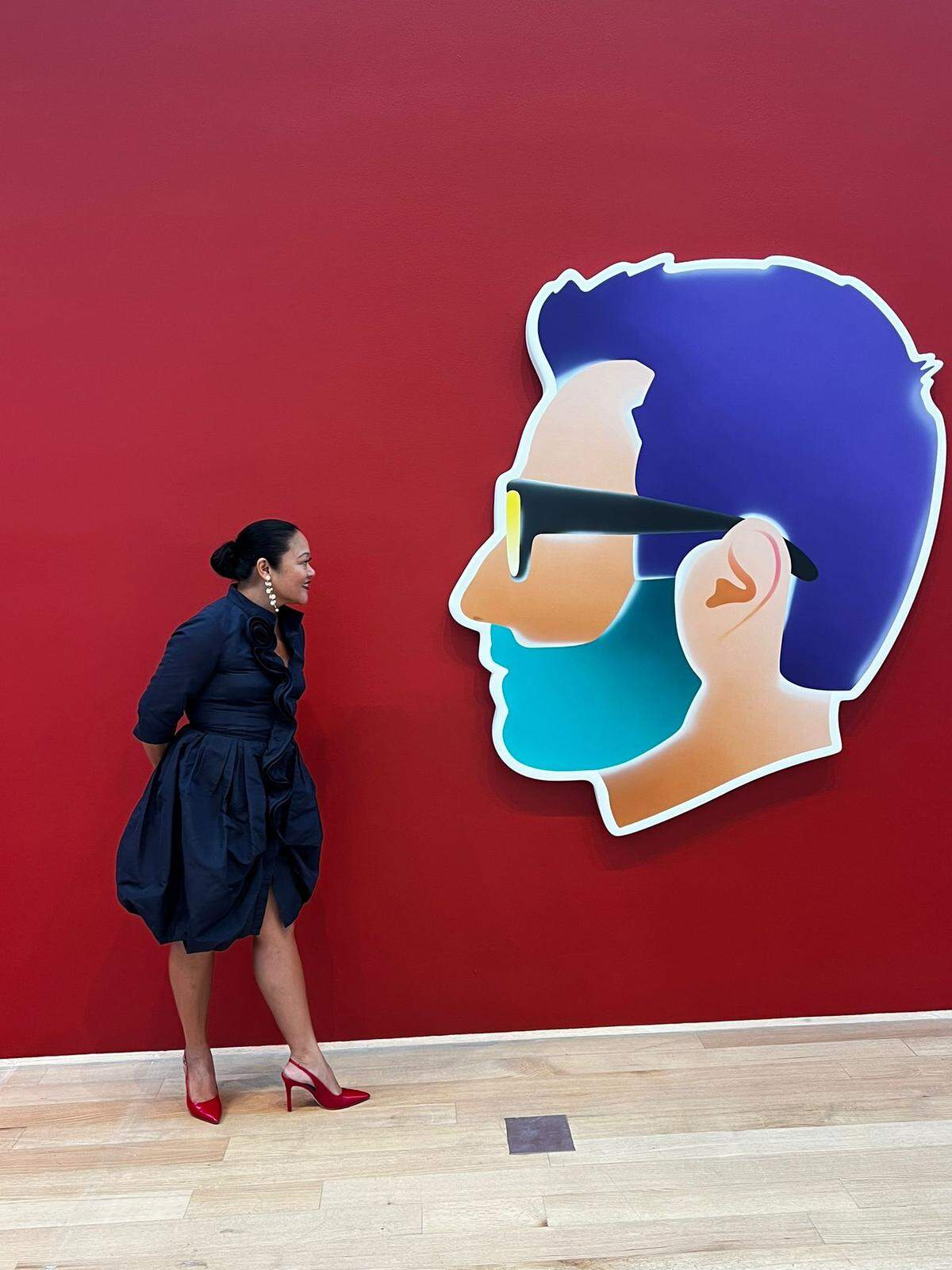
“We show art, we’re going to continue doing that, but it’s also a meeting place for the community,” Cubiñá said.
The Bass is also in the midst of another physical transformation, this time thanks to the $159 million in bonds Miami Beach voters approved for local arts organizations in 2022. A new, state-of-the-art wing of the museum is in the works. The Collins Park rotunda is undergoing some renovations, and in a few years time, Collins Park will be home to two new major outdoor works, Cubiñá said.
“We’re building for the next generation,” Cubiñá said. “What is it that the next generation needs and wants? What can we do to be that place that the community wants and needs? Looking into the future, people want that third space.”
Perhaps The Bass’ ethos is best summed up by one artwork installed last year.
A blue neon sign illuminating the seats in the lobby reads: We belong here.
The Bass Museum
Address: 2100 Collins Ave, Miami Beach
Art Week hours: 10 a.m.-5 p.m. Sunday-Dec. 8
Cost: Free admission Sunday (Dec. 1), $8-$15 Monday-Sunday
Info: 305-673-7530 or https://thebass.org/
This story was originally published December 1, 2024 at 4:30 AM.