Quincy Jones, maestro behind Sinatra and MJ, said music filled a void. Take a look back
Quincy Jones, the famed record producer and arranger who taught Sinatra to swing hard in the ‘60s and who made pop music a cross-generational “Thriller” in the ‘80s for Michael Jackson and millions of listeners, died Sunday night at 91.
His publicist, Arnold Robinson, said Jones died at his home in Bel Air, Los Angeles, surrounded by family, according to reports. Jones’ family honored the patriarch of pop, R&B and jazz in a statement. “While this is an incredible loss for our family, we celebrate the great life he lived, knowing there will never be another like him.”
READ MORE: Music legend Quincy Jones dies at 91
Just days before Jones died, he posted a birthday message to his daughter Martina Jones to celebrate her 58th on Friday for his million Instagram followers.
Family and music shaped Jones’ 91 years.
In this re-publication of an interview Jones gave to the Miami Herald for music reviewer Howard Cohen’s monthly Just Jazz column in 2001 on the eve of the release of a memoir and boxed set of his music, Jones rhapsodized about the loves of his life.
Jones’ Miami Herald archive
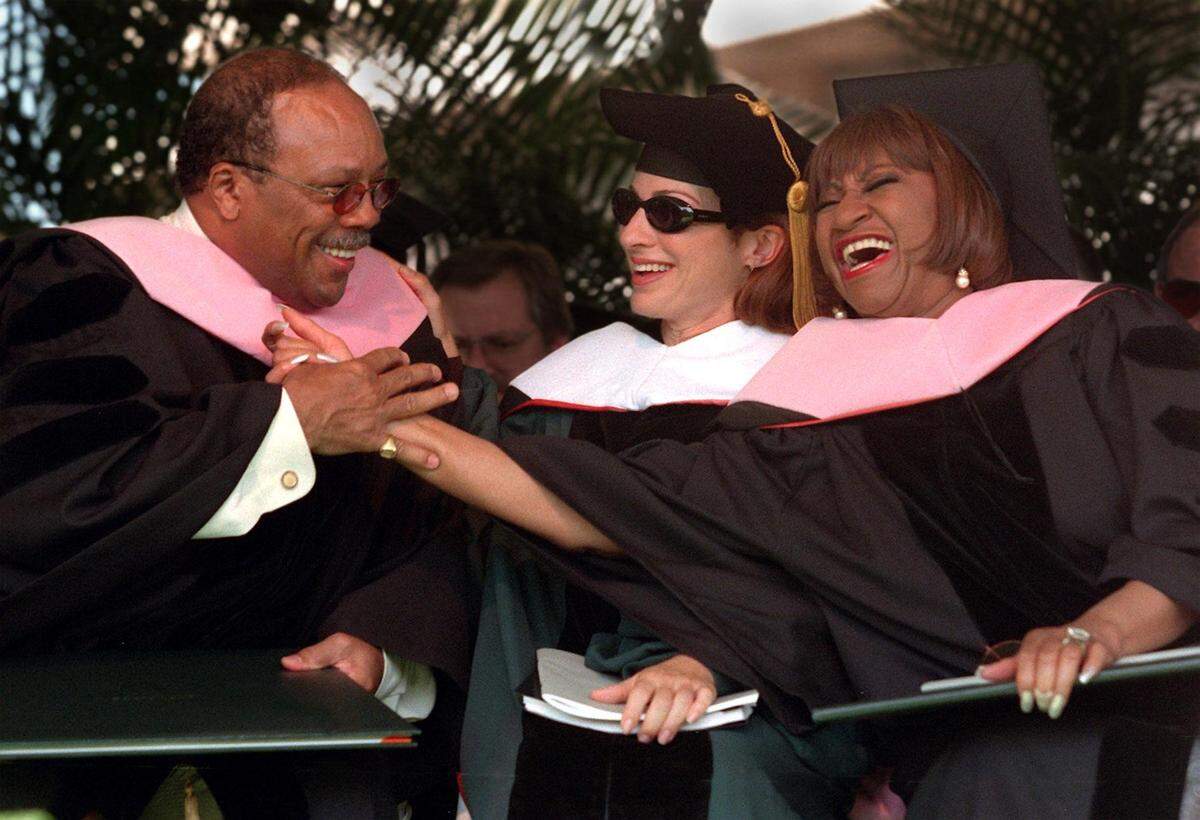
Originally published in the Miami Herald on Nov. 9, 2001
Jazz saved Quincy Jones’ life.
No doubt about it. No jazz, no Quincy.
And with a résumé unmatched by anyone in entertainment, no Q and some of the world’s best pop music wouldn’t exist.
Quincy Delight Jones Jr. was born poor 68 years ago in Chicago. Life back then afforded little hope for a Black man in his situation. Jones says, to this day, he has no concept of what “mother” means. His had mental problems and was institutionalized.
“There are two kinds of people, those that ‘have’ and those that ‘don’t.’’ I have no idea what ‘mother’ means and it’s amazing. That’s become a real focal point,” Jones says in a phone interview from his California home. “You must have a male or female caretaker before you are 9 or you have a hole you have to fill the rest of your life. We compensate. It’s very deep.”
Jazz became the earth to fill that bottomless hole. Jones found his calling when his father moved to Seattle with the family, which by that time included a stepmother who made no secret of her distaste for the young Quincy Jones. Jones broke into a rec room at an armory and came upon a room with a piano. He started to play around with it.
“That’s where I began to find peace. I was 11. I knew this was it for me. Forever,” he writes in his newly published “Q: The Autobiography of Quincy Jones” (Doubleday, $26).
The rest is, as they say, history.
Jones would go on to arrange music for Frank Sinatra, childhood friend Ray Charles and jazz greats Ella Fitzgerald, Sarah Vaughan, Louis Armstrong, Duke Ellington, Miles Davis and Clifford Brown.
Jones’ myriad pop productions include three albums with Michael Jackson, one of which, “Thriller,” remains the best-selling studio album in history. He composed scores for films and television. Jones’ latest CD, last year’s overlooked “Basie & Beyond” (Qwest/Warner Bros.), marked his return to big band music. It’s one of his most joyous projects yet.
“There’s nothing like sitting in front of a big band,” he says.
Memoir and music collection
Jones’ best music — or, at least, some of it — is contained on the new four-CD boxed set “Q: The Musical Biography of Quincy Jones” (Rhino). It’s an amazing set, touching on every style he has been involved in. But picking the tracks was a Herculean task.
“There were a lot of choices. About 250 songs. But it was hard,” Jones says. “I mean, these are all your babies. Some might be born with harelips but they are still your babies,” he says with a laugh.
The most interesting sequence finds Sinatra’s “Fly Me to the Moon” leading into Jackson’s “Thriller” on the third CD. That was by design, Jones says.
“When I hear Michael come in after Frank singing Count Basie, that’s like hyper space going through 40 years of icons. In the ‘50s it was Sinatra. The ‘60s were the Beatles. The ‘70s was Stevie Wonder. And the ‘80s were Michael,” he says. “Forty years, what a rush from Frank to Michael. And they’d sing like a jazz instrument plays.”
Broken down by styles, the set’s first CD, “Jumpin’ in the Woodshed,” will be the one jazz devotees appreciate. But jazz is in everything Q does. It’s the invisible child tugging at his arm at the recording console.
Selling out?
Q has been accused of selling out when he moved to more commercially lucrative pop music, but he says that doesn’t bother him at all. They just weren’t listening. Jackson’s “Thriller” is, at heart, a jazz song. Listen to the rhythms. The Hammond B3 organ solo on Jackson’s 1987 hit “Bad” is brother to Ray Charles’ similar solo on 1960’s “One Mint Julep.”
Jones picks up on that beat on the phone by singing wordlessly the melody of Jackson’s “Baby Be Mine.”
“You listen to “Baby Be Mine,” that sounds like Coltrane, man. Everything [I do is jazz]. That’s what made me want to be in music in the first place. It had an identity and style and such a rich personality,” he says. “It was the greatest way for a Black male to have his dignity and pride and sense of family. In the Northwest in those days we had nothing to connect to, no sense of identity [but] then Duke and Basie and Dizzy [Gillespie] came through . . . and I’d hear what they play and almost cry and I’d watch Billy Eckstine and I was in heaven. I was bitten by the arranging bug and was like a junkie. I couldn’t stop.”
Jones sees some of that today in an unlikely source: hip-hop.
“It reminds me of the same spirit be-bop had,” he says. “The disenfranchised set up their own lifestyle. I long for the day when we get more content going but it’s going to evolve.”
As Q writes in his autobiography: “The kids coming up needed to be introduced to jazz; most important, they needed to understand that all of our music springs from the same roots. There doesn’t need to be a disconnect between the various forms of expression.”
.jpg "sipa_57550600 (1).jpg")