
Review: Peter Carey’s ‘Amnesia’
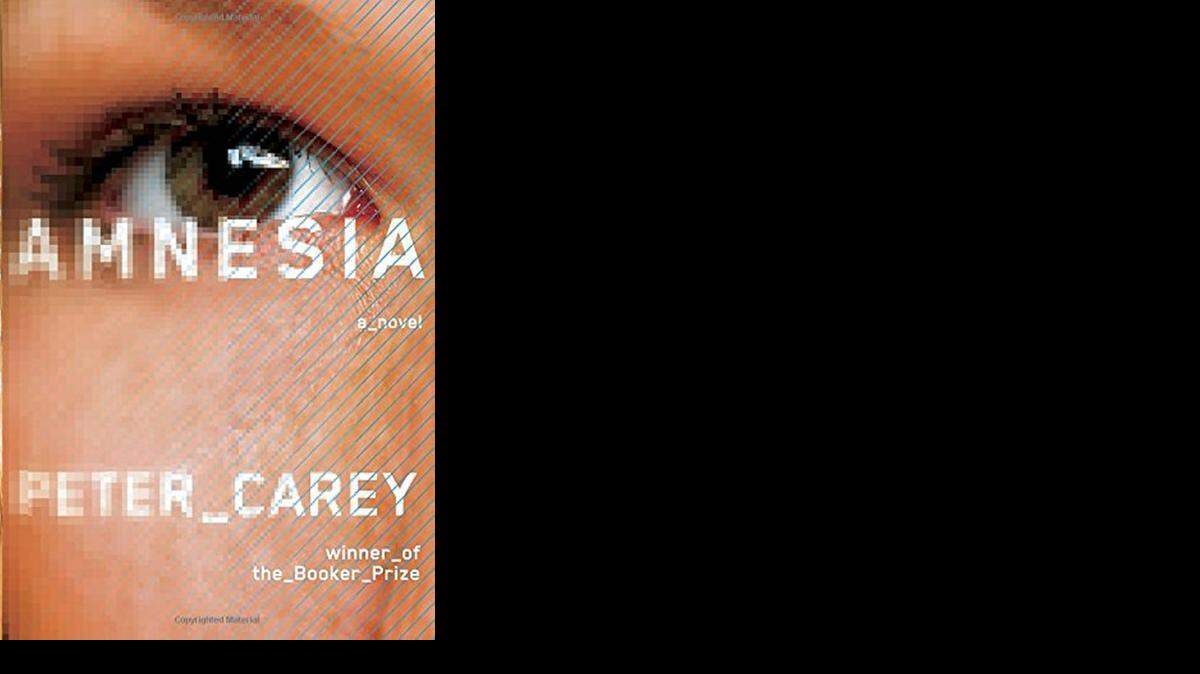
Fugitives, cyber-hacking, corporate coverups, media leaks — Amnesia could be fresh from today’s headlines. But we are stepping off the standard thriller route to enter the wilds of Peter Carey territory. As in novels including Oscar and Lucinda, the first of Carey’s two Man Booker wins, and the dazzling Parrot and Olivier in America, Amnesia links two hapless characters thrown together by circumstance, in this case an imprisoned computer hacker who needs the truth to be told and the journalist who needs to tell it. But what is the truth and who owns it?
The novel’s narrator, Felix Moore is a faded leftist newsman who’s been sued — again — and slapped with defamation damages for a work he refers to as PANTS ON FIRE. Felix is “overweight and out of breath,” in debt and tossed out by his wife. He’s saved — maybe — by his bullying wheeler-dealer friend Woody “Wodonga” Townes, a Rupert Murdochesque media mogul who hands him the story of a lifetime just when he needs it most.
Woody commissions Felix to write the story of the hacker whose Angel Worm virus has infected prison system software in Australia and America (Carey’s birthplace and adopted home, respectively) and set thousands of prisoners free. The problem is, admits Felix, “If this was a story about hackers, I was laughably ill-equipped.”
However, he is also desperate. If this muddles his journalistic credibility, that, beneath the comedy, is Carey’s point. We are all too flawed, too compromised, too human, to see or tell the truth.
Stepping into the role of Julian Assange or Edward Snowden is the novel’s hacker, facing extradition to the United States and an all but certain death sentence. “Angel was her handle. Gaby was her name in what I have learned is ‘meat world,’” Felix says. “She was charged as Gabrielle Baillieux and I had known her parents long ago — her mother was the actress Celine Baillieux, her father Sando Quinn, a Labor member of Parliament.” Celine, Woody and Felix are old schoolmates, and both men have been in love with her. Coincidences abound with Carey, who tucks them into the story just as nimbly as Dickens. Usually.
Woody deposits Felix in a remote shack without electricity, supplies him with manual typewriter, paper, a tape player, batteries and boxes of cassettes — Gaby’s exclusive testimony. All he has to do is write the story.
But things do not go well for Felix nor for his creator Carey. Both insist Gaby’s story is linked to two ignoble moments in Australian-American history: the Battle of Brisbane in 1942 (around when Felix, Woody and Celine are born); and 1975, the time of The Dismissal, a covert CIA ouster of Australian Prime Minister Gough Whitlam. The author has made history vital in such works as True History of the Kelly Gang, which earned him his second Man Booker Prize. He even made a case for democracy in Parrot and Olivier in America. Here, America is not the good guy, and though history is intrinsic to Amnesia, it feels forced, inserted.
An abrupt shift in style and point of view marks the move to Part 2 and Gaby, born in 1975, the time of Australia’s American-led coup, but early days for cyberspace. Computers don’t interest her growing up, but with Sando in love with his constituency and Celine in love with herself, Gaby becomes a jumble of crazed adolescent hormones for Frederic, a schoolmate who paints his nails “burnt sienna,” whose “skin smelled of coriander” and who thinks in computer code (“PICK UP SOCCER BALL”). Suddenly, computers are fascinating. Frederic, Gaby and their geeky thug friends play endless computer games, “an unlikely gang glued together, Gaby said, by not much more than dope and games.”
As Gaby’s narrative unspools, Woody and Celine each grow more demanding and erratic, Felix, faced with conflicting stories, starts to unravel ... and so does the novel. The truth “is ugly and often frightening. We have placed truth in our stained-glass windows but when it arrives in person, unwashed and smelly, loud and violent, our first act is to pull a gun on it.”
Carey writes with brilliance and brio and not a little anger, yet loses the gist of Amnesia in a surfeit of story. Ultimately, he cannot integrate the personal and the political here any better than the rest of us.
Ellen Kanner is a writer in Miami.
This story was originally published February 6, 2015 at 11:50 AM with the headline "Review: Peter Carey’s ‘Amnesia’."