
Bringing valuable lessons from space to earth
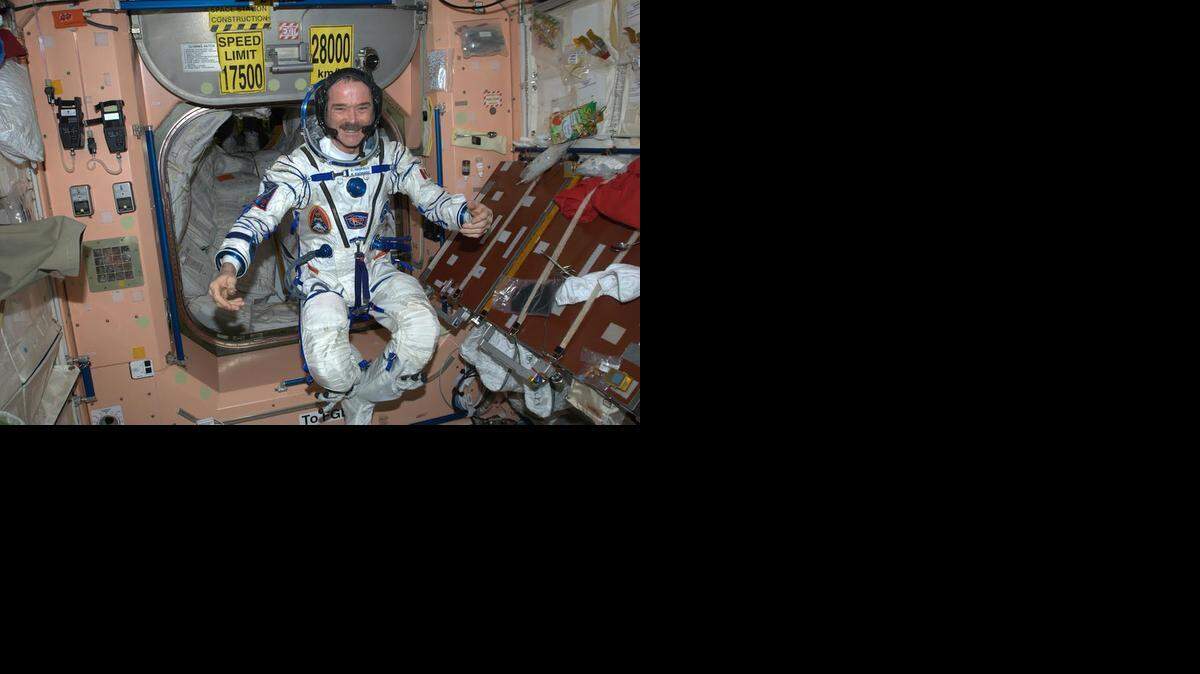
Col. Chris Hadfield has been in the space business for his entire career. A former top graduate of the U.S. Air Force Test Pilot School, the astronaut has been on three missions, logging almost 4,000 hours in space. The first Canadian to walk in space, he has flown on the Shuttle and the Russian Soyuz craft and acted as commander of the International Space Station, where he shot some of the most jaw-dropping photographs of planet Earth you’ll ever see, collected in the book You Are Here: Around the World in 92 Minutes.
And still, some people know him best as the guy who sang David Bowie’s Space Oddity — in space.
“Well, I am on the five-dollar bill in Canada,” Hadfield says, joking about his YouTube fame. “But it’s really interesting. I’ve been a musician my whole life, and it’s so intriguing to see how artistic communication works, how many people took a gut-level, innate interest in the space station when you express it through music.”
Hadfield, who appears Tuesday at Books & Books in Coral Gables, writes about making the music video — which has logged more than 25 million hits — in An Astronaut’s Guide to Life on Earth (Back Bay, $17 in paper). But the book is more than just a compilation of intriguing stories and details about life in space (though there are plenty of both — did you know you can open the door to the space station with a Swiss Army knife?). In addition to providing irresistible descriptions of his work, the book — which has been translated into 20 languages — also acts as a self-help guide, with Hadfield offering practical applications to what he has learned over the years.
“I didn’t want it to just be: ‘Here are some funny space stories.’ I wanted it to be more ‘Here are some things people are up to that might have relevance to the things you’re choosing to do,’” says Hadfield, who grew up on a farm in Ontario. “That’s how I chose the stories for the book. It’s the result of having spoken for 20 years at schools and businesses and the United Nations, all around the world. I talked about what happened but tried to give people something useful out of the talk.”
Hadfield, 55, knows a lot about the mindset required to achieve one’s goals. After all, the road from that Ontario farm to the inner NASA sanctum was not an easy one. His most useful advice — “Visualize failure in advance” — isn’t about being a pessimist; if anything, Hadfield writes, he’s one of the most optimistic people in the world. The concept is about being prepared for any eventuality, the cornerstone of an astronaut’s training.
“If something’s going to happen in the next five seconds then sure, cross your fingers and hope,” he says. “But if you’ve got a minute or five minutes, use that minute or minutes to get ready for what’s liable to happen. For me it’s all about the deliberate process of how you decide what you’re going to do next. It’s like saying, ‘This weekend I’m going to learn CPR even though nobody is actually choking or having a heart attack.’ So you learn the skills of CPR. ... The only thing that has changed is your ability to deal with something that might happen. ... It’s how we fly spaceships. You can’t be a test pilot or astronaut without it.”
Hadfield takes this belief so far that once, when organizers of an Elton John concert were cross-promoting an air show in Windsor, he thought he might end up on stage with the pop singer and learned to play Rocket Man — just in case.
He did attend the show, he writes, but “I never got anywhere near the stage, nor, to this moment, is Elton John aware that I can pull off a respectable rendition of his song. But I don’t regret being ready.”
This attitude has helped Hadfield, who’s married with three grown children, throughout his career — an astronaut’s job is mostly on Earth, and he is not only content but excited about his role on the ground. He doesn’t lament the end of the shuttle program or the fact he won’t be going back to space. There’s so much to do now that he has retired: He’s teaching, speaking, working on adapting his book for kids. There’s a Warner Bros. pilot in the works, and in August he’ll release a collection of music recorded on the space station.
And, like he did with the Space Oddity video, he’ll take advantage of the Internet and social media (you can follow him on Twitter @Cmdr_Hadfield and on Facebook at AstronautChrisHadfield).
“Social media is as important an invention as the printing press,” he says. “We’re just starting to understand how powerful it is. ... Imagine if Michelangelo could have set up a live video in his studio, and you could watch him decide where to put the chisel when he was carving David. You would understand the process of creation differently. The immediacy of human experience is what it’s all about. ... It’s really interesting now that we have primitive Internet on the space station. It’s slow. But on my first flight I had a ham radio and a film camera, and it was so hard bringing people on board with no video. Whereas now I could take pictures and send them within minutes. It opens the experience up to the natural curiosity of millions of people.”
And as for the idea that interest in space is waning, Hadfield isn’t buying it.
“Go talk to 9-year-olds, and you are instantly refreshed,” he says. “The level of interest and curiosity and hope, it’s just as strong as it was when I was 9.”
Meet the author
Who: Col. Chris Hadfield
When: 6 p.m. Tuesday
Where: Books & Books, 265 Aragon Ave., Coral Gables
Info: 305-442-4408 or www.booksandbooks.com
This story was originally published April 10, 2015 at 7:40 AM with the headline "Bringing valuable lessons from space to earth."