
Inside Pump.co’s Push to Make Infrastructure Move Faster
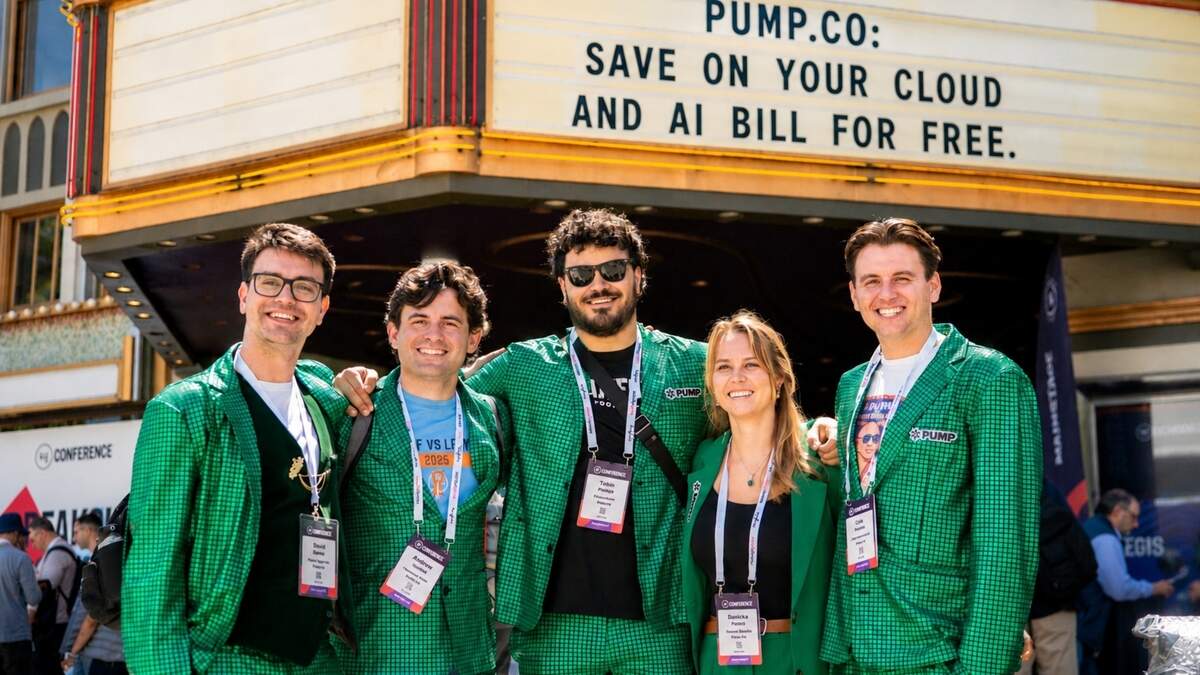
Most infrastructure companies do not try to make themselves memorable. Pump.co does. The Silicon Valley startup has the kind of energy that feels more like a team racing toward a scoreboard than a traditional enterprise software company waiting for a procurement cycle to move. That personality is part of the story, but CEO Spandana Nakka says it is not the whole story.
“People notice the energy first,” Nakka says. “That is fine. We are a young team, and we move quickly. But the reason we move quickly is that the problem is real. Companies are spending too much time and money trying to understand their own infrastructure.”
Pump has positioned itself around cloud savings, with services designed to help companies manage spending across AWS, GCP, and Azure. The company says it now works with about 1,500 customers and saves them roughly 20 percent on average. Company materials state that Pump supports businesses representing more than $600 million in annual cloud spend and has helped thousands of customers save millions across cloud and AI costs.
Those figures can help establish credibility, while the company’s culture offers a more personal side of the story.
Pump’s team brings a mix of technical, business, and operational experience to its work in cloud infrastructure. Its employees come from a range of academic and professional backgrounds, including experience at major technology and financial companies. The company also points to an 8-minute average support response time and a 48-minute resolution time, details that reflect how seriously it takes speed.
“Competitive people like clear results,” Nakka says. “For us, the result is not a trophy. It is customer savings, fast support, better visibility, and a product that makes a painful job easier.”
That competitive streak matters because cloud operations is not a simple category. It is full of slow reviews, scattered dashboards, consultant handoffs, and technical decisions that can become expensive if they are made too late. A company may know its cloud bill is rising, but not know whether the increase comes from product growth, inefficient commitments, AI inference, storage, databases, or a tool that no one is watching closely.
Pump wants to bring more speed and clarity to that work.
“We do not think cloud operations should feel like a mystery,” Nakka says. “A company should not have to wait weeks to understand why costs changed or where the waste is. The answers should be available much faster than that.”
The company began with cost savings because the outcome tends to be seen immediately. A customer either saved money or did not. That made cloud savings a useful first proving ground for Pump’s broader ambition. Now, Nakka wants Pump to apply that same pace to a wider set of infrastructure decisions.
That work is difficult because every cloud environment has its own shape. A consumer app, an enterprise platform, a data-heavy business, and an AI company will all use infrastructure differently. Their costs shift for different reasons. Their security needs differ. Their usage patterns can change quickly.
“Every customer has a different environment because every business is different,” Nakka says. “That is why the old approach often required people to study the setup manually. We think AI can help make that process continuous instead of occasional.”
The platform now reaches beyond savings into visibility and security, pulling cloud, AI, and infrastructure data into a clearer view while monitoring against more than 30 compliance frameworks.
For the customer, those details do not arrive as tidy categories. They arrive as one problem: the company needs to know what changed, what it costs, and what should happen next.
Pump wants AI to connect those signals faster.
“The future is not just another dashboard,” Nakka says. “The future is a system that can understand what is happening across infrastructure and helps teams act before small issues become expensive ones.”
That ambition is why the company does not want to be seen only as a cloud savings vendor. Savings matter, but Nakka sees them as the first proof that Pump can understand cloud environments well enough to improve them. The larger goal is to become an AI layer for cloud operations and DevOps work.
The company’s personality may help it stand out in a market that often sounds cold and technical. Pump does not present itself as a distant enterprise vendor. It wants customers to feel that real people are moving quickly behind the product. That tone is unusual in infrastructure, but Nakka sees it as practical.
“Cloud costs are stressful,” she says. “If a customer comes to us with a painful bill, they do not need a slow, complicated experience. They need people who move with urgency and a product that gives them a clear path forward.”
That is where Pump’s culture and product vision meet. The playful side of the company helps people notice it. The competitive side helps explain how it operates. The bigger technical ambition gives the energy a job to do.
Pump is not trying to make cloud operations feel flashy. It is trying to make the work less painful, less manual, and easier to understand. The company’s bet is that the same speed that defines its team can be brought to the systems companies rely on every day.
“We want to be the team that makes the hard infrastructure work feel lighter,” Nakka says. “Not because the problem is small. Because companies need a better way to handle it.”
For more information, visit Pump.co.
Members of the editorial and news staff of miamiherald.com were not involved with the creation of this content. All contributor content is reviewed by miamiherald.com staff.