If you’re wondering, “When should I take the SAT?”, you’re not alone. Figuring out when to take the SAT is one of the first fundamental steps in the college admissions process.
According to recent statistics, nearly 2 million students took the SAT, with the majority testing during junior year through School Day programs when timing matters most.
This is where school-day testing and early planning play a crucial role. Taking the SAT during school hours, if your school offers it, lets you avoid weekend scheduling conflicts, test in a familiar environment, and stay focused. Early planning also gives you time to prepare correctly, choose the right test window, and avoid last-minute surprises that can impact your performance.
Keep reading to learn more about this and other ways to make sure you take the SAT at the right time.
Key Takeaways
- The Best SAT Test Date: Most high school students take the test once they’ve built a solid academic foundation in their third or fourth year of high school.
- Registration Timing: Sign up approximately one month before test day; late registration options are available for a fee.
- Score Turnaround: Results are typically available within two weeks for digital tests.
- Why Timing Matters: Testing before application stress kicks in gives you room to plan, improve, and choose your best score.
- College Admissions Alignment: Taking the SAT by the fall of senior year ensures your scores are ready for college applications.
Timing Is Everything: Choosing the Right Test Date
The right SAT date depends on more than just your schedule. After reviewing the SAT, it is evident that timing has a significant impact on performance. Students who align testing with their academic readiness and prep progress often report stronger SAT scores and less stress.
Factors to Consider:
- Your current coursework and math/reading proficiency
- Your SAT prep plan or course schedule
- Application deadlines, especially for early decision or early action
Most programs recommend starting preparation in the spring of junior year to allow time for testing and retesting, as well as meeting college application deadlines.
Sophomore, Junior, or Senior Year? Know Your Window
Prep courses often encourage early awareness, but testing too soon may not reflect your academic potential. The consensus is that junior year is the ideal time for this transition.
Grade-level breakdown:
- Sophomore Year: Good for practice exams and diagnostics
- Junior Year: Strongest academic foundation and best time for first attempt
- Senior Year: Final opportunity to improve scores for applications
Balancing School, Activities, and the SAT Exam
From sports and AP exams to part-time jobs, students juggle a multitude of responsibilities. According to leading prep tools, overbooking hurts prep consistency.
Best Scheduling Strategies:
- Do not choose test dates that overlap with major school events
- Use school breaks for full-length practice tests
- Reserve time on weekends or early mornings for focused study
On test day, arrive early with your photo ID and admission ticket. Know your test center in advance and be ready for both the reading and math modules of the digital SAT.
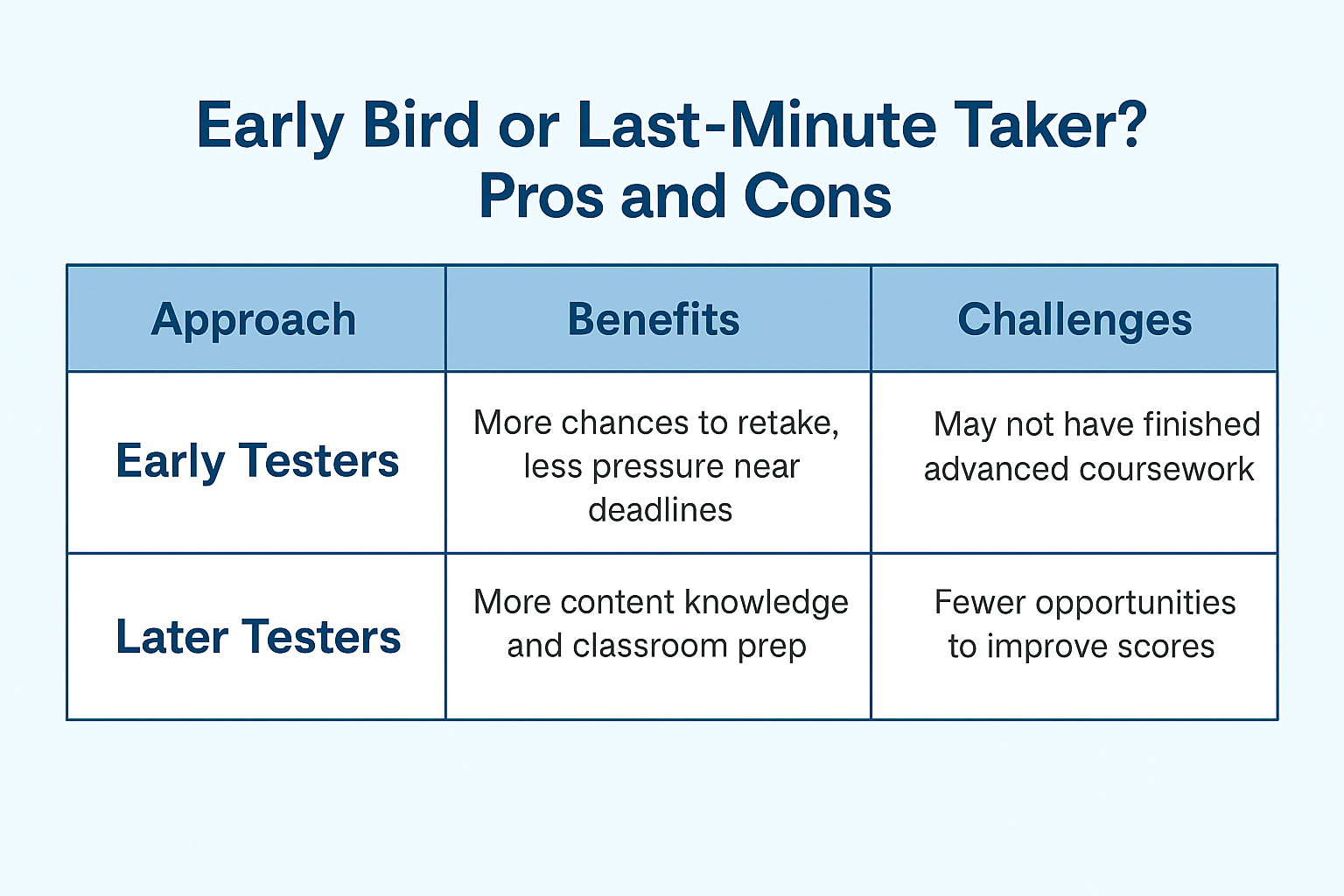
Early Bird or Last-Minute Taker? Pros and Cons
From what I’ve seen in SAT prep programs, early testers receive more opportunities to retake the test and less deadline pressure. However, many have not yet completed key coursework, which can hinder their progress.
Later testers usually know more content and feel academically stronger. The trade-off? Less time to adjust if scores fall short before college deadlines.
Diagnostic testing helps determine readiness. If your baseline score is near your target, it makes sense to register for an earlier test. Otherwise, allow at least 10 to 12 weeks of structured preparation.
School Day Testing and Early Planning
Testing and early planning go hand in hand for students who want a smoother experience. Some high schools offer the SAT during regular class hours, making it easier to test in a familiar setting without needing to travel to a weekend test center. Students who take advantage of this option often feel less anxious and more prepared, as it integrates seamlessly into their regular school routine. Planning early with your counselor can also help you secure a spot, access fee waivers, and align your test date with your college goals.
Pro Tips:
- Track score report delivery times for each SAT session
- Confirm deadlines for colleges you plan to apply to
- Register early and build your prep around school obligations
- Use fee waivers if eligible, through your high school counselor
Across the board, students who plan and register early reduce last-minute stress and perform more confidently.
When Should You Take the SAT? The Sweet Spot
There’s a lot of pressure to take the SAT early and “get it out of the way,” but test takers and tutors alike overwhelmingly agree: timing matters more than urgency. Taking the SAT too early—before you’re academically or emotionally ready—can backfire and lead to lower scores, unnecessary burnout, and missed opportunities for growth in other areas like extracurriculars.
Instead, many experienced students and tutors suggest the ideal SAT timeline starts during the summer before junior year, giving you the benefit of more high school coursework and maturity without piling on stress from college applications.
Why Junior Year is the Sweet Spot
- You’ve learned more: The SAT tests material that builds throughout high school. Taking it after you’ve had Algebra 2 and strong reading instruction can make a big difference.
- Your reading skills are stronger: Reading comprehension improves with time. One commenter put it best: “The more you’ve read, the better you’ll do.”
- You’re more mature: Older students tend to have better focus, test stamina, and time management.
- Prep fits better into your schedule: One popular plan is to prep over the summer before junior year, take your first SAT in the fall, and use spring and summer for retakes if needed.
“Start prepping the summer before junior year. Then test when you’re ready during junior year—it gives you time to improve and retake if needed.”
Reddit u/MJBCuber
Why Early Testing Can Backfire
- You’re not ready academically: Prepping before you’ve even learned core concepts wastes time.
- You lose momentum: Studying too far in advance may lead to burnout or forgetting material.
- It crowds out EC development: A user noted: “If you focus on the SAT early, you delay building meaningful extracurriculars—those take time to grow.”
- Practice tests exist for a reason: You don’t need to “test for experience”—just take official practice exams until you’re hitting your goal score.
Real Advice from Real Students
- “I got a 1550 and my ECs are doing great—but I waited until I had taken Precalc.”
- “SAT is less about cramming and more about experience. Focus on school first, then test.”
- “I started the summer before junior year and it gave me plenty of time without rushing.”
Exceptions to the Rule
Of course, there are exceptions:
- If you’re scoring 1500+ as a sophomore, an early test might make sense—especially if a school-funded test is available later.
- International students with demanding schedules (like A-levels) may need to plan around coursework.
- Students in special programs or honors math tracks may be encouraged to test early.
Final Thoughts
There’s no one-size-fits-all answer to when you should take the SAT—but there is a smart strategy. Most students find their sweet spot during junior year, when academic readiness, maturity, and prep time align. Testing too early can lead to lower scores, added stress, and missed chances to strengthen extracurriculars. On the other hand, waiting too long can leave you scrambling before deadlines.
That’s why school-day testing and early planning are so powerful—they help you stay on track without the pressure of weekend scheduling. And if you’re aiming to boost your score, don’t leave it to chance, investing in a trusted SAT prep course (UWorld SAT is my personal favorite) can help you perform with confidence and hit your target.
FAQs
Most students take the SAT in the spring of junior year to leave time for a possible retake.
Only if your school is a registered SAT School Day test center; otherwise, select a nearby school or test site.
Yes, the College Board releases the full SAT schedule in advance.
Yes. Participating schools may offer it in March, April, or October.
Register at least 4 to 5 weeks before your test date. Late registration is possible for a fee.