What subjects are on the SAT? This is a common question for students gearing up for college.
As I researched and gathered information for this guide, I saw that the national average SAT scores fell from about 1028 for the Class of 2023 to 1024 for the Class of 2024. This is a modest four-point drop that still signals a steady decline and underscores why being prepared for what you’ll be tested on is so important.
In this breakdown, I will explain every subject that is on the SAT and provide expert tips on how to prepare for each part of the exam.
Key Takeaways
- Subjects You’ll See on the SAT: Now the test has only Reading-Writing and Math sections.
- Adaptive Two Module Format: Your score on the first module sets the level of the second.
- Reading and Writing Skills Covered: Tests Information and Ideas, Craft and Structure, Expression of Ideas, and Standard English Conventions.
- Math Section Topics: Include Algebra, Advanced Math, Problem Solving and Data Analysis, Geometry, and Trigonometry.
- No SAT Subject Tests: The College Board stopped Subject Tests in 2021, but your subject knowledge still drives math and reading performance.
SAT Sections Overview: What the Digital SAT Covers
You answer 98 questions total: 54 in Reading-Writing and 44 in Math. Each section is split into two timed modules: 32 minutes for RW, 35 minutes for each Math module. A 10-minute break is between them. The second module’s difficulty adapts to first-module performance.

✏️ Note: The digital SAT takes about 2 hours and 14 minutes.
Reading and Writing: What Skills Are Tested
You read 25 to 150-word passages from science, history, literature, or humanities. Each passage has one multiple-choice question.
The questions test four key skill areas:
- Information and Ideas – reading graphs, charts, and main points
- Craft and Structure – word meanings, rhetoric, passage pairs
- Expression of Ideas – revising writing for clarity
- Standard English Conventions – grammar, punctuation, usage
Math Section Breakdown: Topics You’ll See on the SAT
Math has a built-in calculator and includes multiple-choice and grid-in (student-produced response) questions. There are four content domains:
- Algebra (linear equations, inequalities, systems)
- Advanced Math (quadratics, exponentials, radicals)
- Problem Solving and Data Analysis (rates, ratios, categorical and graph data)
- Geometry and Trigonometry (triangles, slopes, area, volume, circles)
Each module mixes easy to hard SAT questions in each domain. Total roughly 13 to 15 Algebra, 13 to 15 Advanced Math, and 5 to 7 Problem Solving, and 5 to 7 Geometry per section.
SAT Subject Tests were discontinued in January 2021. No student could take them overseas after mid-2021 either. But the SAT still tests math and evidence-based reading subjects. So your knowledge in algebra, geometry, data analysis, grammar, and reading remains critical for college admission.
Common SAT Question Topics You Might See
The SAT doesn’t just test abstract knowledge—it frames questions in real-world scenarios to assess how you think and apply concepts. Here are some common topics and contexts that frequently appear:
Reading and Writing Examples
- Historical speeches or documents (e.g., excerpts from U.S. founding texts or global historical writings).
- Scientific research summaries (biology, chemistry, and environmental studies).
- Humanities-based passages (literature, philosophy, and arts).
- Everyday scenarios requiring grammar or structure corrections (emails, editorials, or reports).
Math Examples
- Linear and quadratic equations used in business or finance scenarios (e.g., calculating profits or interest).
- Data tables or graphs tied to trends like population growth or environmental changes.
- Geometry questions involving practical design or construction problems.
- Probability or statistics linked to sports or experiments.
💡 Why this matters: Recognizing these common contexts can make prep less intimidating. Students can practice reading science articles, reviewing editorials for grammar patterns, or solving math problems framed in everyday contexts to build confidence.
SAT Digital Scoring at a Glance
Each Digital SAT section, Reading and Writing, as well as Math, is based on the number of correct answers you get. Wrong answers don’t count against you.
Your raw correct-answer total is scaled to a section score from 200 to 800.
The two section scores are added for a total score ranging from 400 to 1600.
How to Prepare for the SAT: Skills, Resources, and Practice
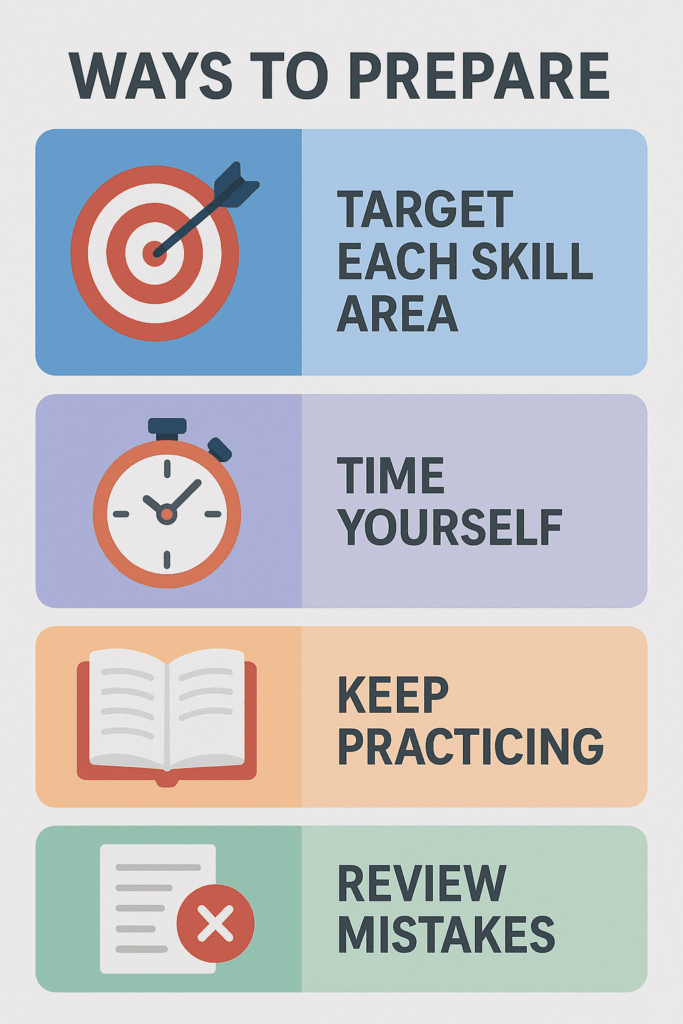
Based on my review of the formats and content, here’s what works best:
- Target Each Skill Area: Practice reading passages and identify the structure of questions.
- Time Yourself: Simulate 32 or 35-minute modules. Count questions until you reach 98 total.
- Use Trusted Online Resources: Find practice problems that map to the four math domains and four reading-writing domains.
- Review Mistakes: Focus on what skill area caused errors and target your weak spots.
💡Confidence Booster: Select a prep course that strengthens your test-taking confidence. UWorld is one of the best; learn more here.
Conclusion
The SAT covers just two main subjects: Reading-Writing and Math. You’ll face four Reading-Writing skill domains and four math topics. Students walk into the SAT without knowing which skills it covers and get the result they did not expect. Knowing exactly what’s on the test helps avoid that and gives students the confidence to focus their study time. Practicing with timed modules that match the key subjects and adaptive format sharpens focus and precision.
FAQs
400 to 1600 total score range.
Unlimited attempts are allowed if you want to retake the SAT.
Handheld or built-in is allowed.
No. It is fully digital.
Around 2 hours and 14 minutes.