
People talk about “the Praxis” like it is one test you pass and move on from.
Not exactly.
This is actually a misconception I had when preparing for my teaching exams. But the Praxis includes more than 120 exams, and the one you need depends on your state, grade level, and teaching subject. Before you start studying, you first need to figure out which version is standing between you and the classroom.
In this guide, I’ll break down what the Praxis exam is, which tests exist, how scoring works, and what you need to do after passing.
Key Takeaways
- ETS administers the Praxis: ETS develops and administers the Praxis exams.
- Different tests: The Praxis includes several types of exams designed for different purposes and subject areas.
- State-specific requirements: Each state determines which Praxis exams are required for teacher licensure.
- Primarily computer-based: Most Praxis exams are administered on a computer.
- Passing scores vary: Required scores depend on both the specific exam and the state.
- One step toward licensure: Passing the Praxis may be required, but it is only one part of the teacher licensing process.
What Is the Praxis Exam?
The Praxis is a group of exams commonly used for teacher preparation and licensing.
Some colleges use Praxis Core scores when admitting students into an education program. States may also require Subject Tests before giving you a teaching license or adding another subject to one you already have.
Praxis exams can measure basic reading, writing, and math skills. Others go deeper into the subject or grade level you plan to teach.
Passing does not automatically make you a licensed teacher. It simply checks off one requirement in your state’s larger licensing process.
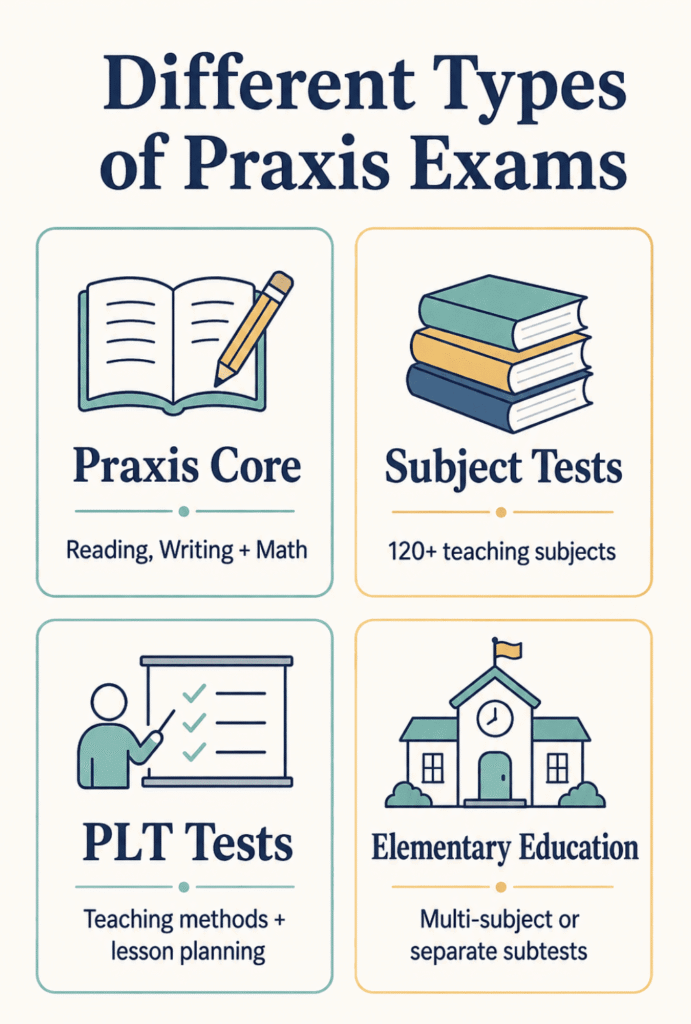
There Are Different Types of Praxis Exams
The test you take depends on where you are in your teaching journey.
- Praxis Core Academic Skills for Educators: the exam covers reading, writing, and mathematics. You can take the three tests separately or combine them into one longer appointment.
- Praxis Subject Tests: focus on specific teaching areas. ETS offers more than 120 tests covering subjects like biology, special education, music, English, and world languages.
- Principles of Learning and Teaching tests: these cover topics like student development, lesson planning, learning environments, and assessment. Different versions are available for certain grade ranges.
- Elementary Education tests: these may combine several subjects or split reading, math, science, and social studies into separate subtests.
Some states are also starting to use the newer Praxis Elementary Education Fundamentals tests. The names can look similar, so always check the test code before registering.
Which Praxis Test Do You Need?
There is no single Praxis path that every future teacher follows.
Your required exam depends on:
- The state where you want to teach
- Your grade level
- Your subject area
- Your teacher preparation program
- Whether you are earning or adding a license
Two people preparing for the same career in different states may have completely different requirements.
Start with your state’s official teacher licensing page. Then match the required exam name and test code on the Praxis website. Checking both can save you from paying for the wrong test.
What Is Actually on the Praxis?
Praxis Core focuses on general academic skills.
The Reading test checks how well you understand and compare written information. Mathematics covers areas like algebra, geometry, statistics, and number skills. Writing includes selected-response questions along with essays.
Subject Tests are much more specific. An elementary education exam may cover several school subjects, while a high school chemistry exam digs deeper into one field.
Depending on your exam, you may see:
- Selected-response questions
- Numeric-entry questions
- Essays
- Short written responses
- Classroom scenarios
ETS releases a free Study Companion for each test. It shows the content areas, question types, and the approximate percentage of the exam each section covers
How Long Is the Praxis and How Much Does It Cost?
| Detail | What to Expect |
|---|---|
| Test Length | Usually 1–4 hours |
| Question Count | Varies by exam |
| Test Format | Mostly computer-based |
| Testing Location | Test center or at home when available |
| Registration Fee | Depends on the exact test |
| Extra Costs | Rescheduling, added score reports, or score reviews |
Combined and multi-subject exams usually take longer. Check your exact test code before registering for its current time limit, question count, and price.
How Do Praxis Pass Rates and Scoring Work?
Most Praxis exams use a score scale from 100 to 200.
There is no universal passing score. Each state or licensing agency chooses the score it will accept for each exam. A score that passes in one state may not meet the requirement somewhere else.
Selected-response questions are scored automatically. Essays and other written responses are graded using scoring rules created for that test.
Your score report may include:
- Your overall score
- Whether you passed for your selected state
- Raw points earned in each content category
- The possible score range
- A comparison with other test takers
There is also no single Praxis pass rate. Rates vary by test, state, year, and candidate group. A broad number for every Praxis exam combined would not tell you much about your own test.
Is the Praxis Exam Hard?
The Praxis can be difficult, but some exams are much harder than others.
Praxis Core tests general reading, writing, and math skills. Subject Tests may expect college-level knowledge of the field you plan to teach. The exam can feel especially tough when it covers material you have not reviewed in a few years.
Open the official Study Companion and try a practice set before deciding how long you need to study. That gives you a much better answer than someone online simply calling the whole Praxis “easy” or “hard.”
When you are choosing resources, Browse our best Praxis study guides to compare courses, practice tests, and study plans for your exact test code.
What Happens After You Pass the Praxis?
Your Praxis score is sent to the recipients you selected during registration. Depending on your setup, that may include your state licensing agency, college, or teacher preparation program.
You still have to complete the other requirements for your teaching license. These may include:
- Finishing an approved education program
- Earning the required degree
- Completing student teaching
- Passing a background check
- Submitting a state application
- Paying licensing fees
Requirements vary, so passing the Praxis may be the final step for one person and just the beginning for someone else.
Once you know which test you need, see our guide on how to study for the Praxis exam and how long the Praxis exam takes.
My Final Thoughts on the Praxis Exam
The Praxis sounds more complicated than it is because there are so many versions. Once you know your state requirements and exact test code, the rest becomes much easier to plan.
Start there, check the official exam outline, and build your prep around what is actually on your test.
FAQs
Can anyone take the Praxis exam?
Usually, yes. However, your state or teacher preparation program may tell you when to take it.
Can you take the Praxis online?
Many Praxis exams offer at-home testing. Availability depends on the test and your location.
How many times can you take the Praxis?
You can retake an exam, but you have to wait at least 28 days after your previous test date.
How long are Praxis scores valid?
ETS keeps Praxis scores reportable for 10 years. Your state may have separate rules about accepted test versions.
Do you need to pass Praxis Core before taking a Subject Test?
Not always. Your state or education program decides which tests you need and when you should take them.

![Education.com Coupon Code [Verified Discounts]](https://www.miamiherald.com/careers-education/wp-content/uploads/sites/2/2026/10/education-com-promo-code-mh-1024x768.jpg)
![AATBS Discount Codes [Verified Coupons]](https://www.miamiherald.com/careers-education/wp-content/uploads/sites/2/2026/10/aatbs-promo-code-mh-1024x768.jpg)
![Pocket Prep Discount Code [Verified October 2026 Coupons]](https://www.miamiherald.com/careers-education/wp-content/uploads/sites/2/2026/10/pocket-prep-promo-code-mh-1024x768.jpg)
![Hosting.com Coupon Discounts [Verified October 2026 ]](https://www.miamiherald.com/careers-education/wp-content/uploads/sites/2/2026/10/hosting-com-promo-code-mh-1024x768.jpg)
![At Your Pace Online Coupon Code [Verified Discounts]](https://www.miamiherald.com/careers-education/wp-content/uploads/sites/2/2026/10/aypo-promo-code-mh-1024x768.jpg)
![Coursera Coupon Discounts [Verified October 2026 ]](https://www.miamiherald.com/careers-education/wp-content/uploads/sites/2/2026/10/coursera-promo-code-mh-1024x768.jpg)