The Certified Management Accountant (CMA) designation is a professional recognition for those with expertise in strategic financial management and business decision-making. To earn this title, one must meet educational standards set by the Institute of Management Accountants (IMA), gain relevant experience, and pass the CMA exam.
CMAs go beyond traditional accounting, delving into the strategic realm, where financial data informs key business decisions. With this in mind, let’s look at what the certified management accountant designation entails.
Key Takeaways:
- Professional Recognition: The CMA is a prestigious title for expertise in strategic financial management and decision-making.
- Educational and Experience Requirements: Earning the CMA title involves meeting educational standards, gaining relevant experience, and passing the CMA exam.
- Specialized Expertise: CMAs excel in areas like strategic financial management, performance analytics, financial planning, and cost management.
- Diverse Career Paths: CMAs can pursue various roles, including financial analysts, corporate controllers, CFOs, risk managers, and more.
- Salary Prospects: CMAs enjoy lucrative salaries, with entry-level positions in the U.S. starting at around $92,000 and increasing with experience and specialization.
- Continuous Learning: CMAs are committed to ongoing professional development, including continuing education requirements to stay current in the field.
Certified Management Accountant
CMAs are known for their broad skill set and deep knowledge of financial and strategic management. They handle a variety of financial tasks and work with different businesses and clients across many industries.
In simple terms, a CMA is like a financial wizard who helps companies make important money decisions by deeply understanding the numbers and their impact on the future.
Specialized Areas of Expertise for CMAs
Certified Management Accountants have a wide range of skills that make them stand out in the finance world, much like experts in other professions. They are skilled in many important areas like:
- Strategic Financial Management and Corporate Finance: CMAs are pivotal in shaping financial strategies and managing corporate finances. This includes long-term planning, investment decisions, capital structure analysis, and risk management.
- Performance Management, Analytics, and Financial Planning: They excel in analyzing performance data to enhance business efficiency and effectiveness, alongside budgeting and forecasting to support financial decision-making.
- Cost Management and Internal Controls: CMAs specialize in reducing costs and improving profit margins while also ensuring the accuracy and compliance of financial processes through robust internal control systems.
- Professional Ethics and Decision Support: Upholding ethical standards in financial practices, CMAs provide critical insights and support for key business decisions, often collaborating closely with top management.
In each of these domains, CMAs use their specialized knowledge to contribute significantly to business operations and strategy.
Certified Management Accountant Career Paths
Not all CMAs do the same job. Just like some doctors specialize in surgery while others focus on pediatrics, CMAs also choose different career paths based on their interests and skills. Some might excel as financial analysts, diving deep into market trends and data, while others may thrive as strategic planners, shaping the financial future of entire companies.
Here are some common career paths for CMAs:
- Financial Analyst and Management Accountant: In these roles, CMAs analyze financial data to guide business decisions, manage budgets, and evaluate performance.
- Cost Accountant: Specializing in cost analysis and control, CMAs in this role help businesses manage expenses and improve profit margins.
- Corporate Controller and CFO: CMAs oversee financial reporting and auditing as corporate controllers or manage a company’s overall financial actions as chief financial officers.
- Risk Manager and Internal Auditor: They identify and mitigate financial risks and assess compliance and efficiency in financial operations.
- Consultant and Educator: CMAs provide expert financial advice as consultants or share their knowledge in academic settings as educators.
Each of these roles leverages the unique skills and expertise of a CMA, offering diverse and fulfilling career opportunities in finance and accounting.
CMA Certification Requirements
Becoming a Certified Management Accountant is both challenging and rewarding. It requires meeting strict educational and professional experience standards along with passing the CMA exam.
CMA Educational Requirements
The educational foundation for a CMA typically begins with a bachelor’s degree in accounting, finance, or a related field. This degree provides the essential groundwork for key concepts such as financial accounting, corporate finance, and management principles.
To qualify for the CMA program, candidates must complete specific coursework in accounting and finance. Unlike the CPA, which requires 150 semester hours, the CMA certification requirements can typically be met with a standard four-year bachelor’s degree.
However, the depth of knowledge required for the CMA exam encourages many candidates to pursue further studies:
- Advanced Degrees: Some aspirants choose to acquire a Master’s degree, such as a Master of Business Administration (MBA) or a Master of Accountancy (MAcc). These programs offer deeper insights into strategic financial management, advanced cost management, and analytical skills.
- Continuing Education and CMA Prep Courses: In addition to further formal education, candidates often enroll in CMA review courses. These courses are specifically designed to prepare candidates for the CMA exam, covering all the necessary topics and providing practice exams and study materials. They are an invaluable resource for understanding the exam format and mastering the content.
- Additional Professional Training: Others may opt for CMA exam review course programs or professional training to ensure they are well-prepared for the CMA exam topics, especially in areas like advanced corporate finance, strategic planning, and decision analysis.
CMA Experience Requirements
Practical experience is a critical component of the CMA certification process. Candidates must fulfill two continuous years of professional experience in management accounting or financial management.
This experience can be acquired before or after passing the CMA exam but must be completed within seven years of passing the exam. This hands-on experience is essential for applying theoretical knowledge in real-world scenarios and developing practical skills like budget preparation, financial statement analysis, and risk assessment.

CMA Exam Process
Becoming a CMA culminates in a challenging and comprehensive professional examination. With a pass rate of around 50%, only half of the candidates who qualify to sit for the exam will actually succeed.
Structure of the CMA Exam
The CMA exam is split into two parts, each focusing on key areas of knowledge and skills:
- Part 1: Financial Planning, Performance, and Analytics: This section tests candidates on external financial reporting decisions, planning, budgeting, forecasting, performance management, cost management, internal controls, and the use of technology and analytics in finance.
- Part 2: Strategic Financial Management: This segment covers financial statement analysis, corporate finance, decision-making, risk management, investment strategies, and professional ethics.
CMA Exam Process
The CMA exam is known for its rigorous nature, testing candidates’ depth of understanding and practical application of management accounting principles.
- Exam Format: Each part of the CMA exam consists of 100 multiple-choice questions and two case studies (with roughly 7 questions per study in a variety of formats, from drag-and-drop to fill-in-the-blank). The format is designed to evaluate a candidate’s analytical skills, technical knowledge, and ability to apply management accounting concepts in real-world business scenarios.
- Scoring and Passing Criteria: The CMA exam is scored on a scale of 0 to 500, with a passing score of 360 or higher. This scoring system assesses a candidate’s proficiency in each subject area, ensuring they meet the high standards set by the Institute of Management Accountants (IMA).
- Preparation and Study: Due to the comprehensive nature of the exam, candidates typically invest significant time in preparation. This includes studying the specified content, enrolling in CMA prep courses, and practicing with exam simulations and practice tests.
Continuing Professional Education (CPE) for CMAs
After earning the CMA certification, professionals are required to maintain their skills and knowledge through continuing professional education. CMAs must complete 30 hours of CPE annually, including two hours in ethics. This requirement ensures that CMAs stay current with the evolving practices and standards in management accounting and financial management.
Possible examples include:
- Workshops on Emerging Technologies in Finance: Staying updated with the latest technologies like AI, blockchain, and data analytics in financial management.
- Seminars on Global Financial Regulations: Understanding the impact of international financial regulations on business strategy.
- Leadership and Management Training: Developing skills in leadership, team management, and effective communication.
- Courses on Ethical Financial Practices: Specific training focused on ethics in finance, covering topics like fraud prevention and ethical decision-making.
- Conferences on Strategic Risk Management: Learning about new strategies and tools for managing financial risks in an organization.
CMA Salaries: An Overview
CMA salaries are a crucial indicator of the profession’s value and demand in the business world. CMA salaries show considerable variation, influenced by several factors, including geographic location, area of expertise, experience level, and the industry sector.
Factors Influencing CMA Salaries
- Geographic Location: Similar to CPAs, CMA salaries vary significantly across different regions. Urban areas with higher living costs typically offer higher salaries compared to smaller cities or rural areas. For instance, CMAs in major financial hubs like New York City or London often earn more than those in less metropolitan areas.
- Area of Specialization: CMAs with specializations in high-demand areas such as strategic financial management, risk management, or financial planning may command higher salaries. Specialized skills in these areas are highly valued and can significantly impact salary levels.
- Experience Level: Experience is a major determinant of salary for CMAs. Those at the entry level can expect modest salaries, which increase as they gain more experience and take on roles with greater responsibility.
Average CMA Salary Ranges
According to the IMA and global salary surveys, CMA salaries range widely:
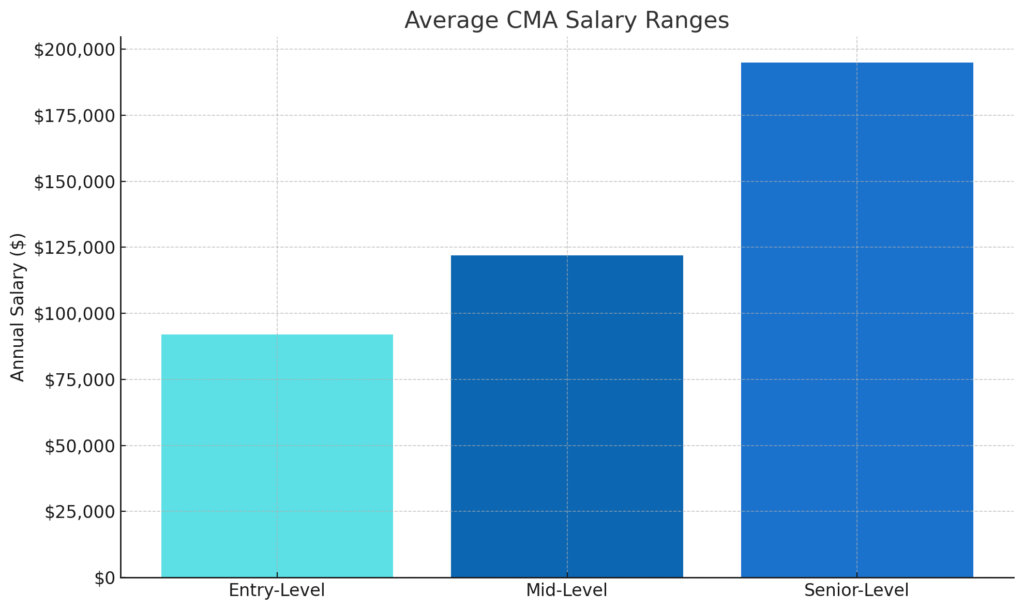
- Entry-Level CMAs: At the beginning of their careers, CMAs who live in the U.S. can expect salaries of approximately $92,000 annually, varying based on their role and the industry they work in.
- Mid-Level CMAs: With a few years of experience, CMAs often see their salaries grow significantly. For example, a management accountant with several years of experience might earn around $122,000
- Senior-Level CMAs and Specialized Roles: Experienced CMAs in senior management roles or those with specialized expertise can earn substantially more. Salaries in these positions usually make around $195,000, with top roles in large corporations potentially exceeding this range.
Additional Considerations
- Bonuses and Benefits: Many CMAs receive additional compensation through bonuses, profit sharing, and other benefits, which can considerably boost their overall earnings.
- Self-Employment and Consultancy: CMAs who work as consultants or run their own businesses might have higher earning potential, though this can vary widely based on the success and scale of their business.
Higher CMA Salaries in Specific Sectors
The expertise of Certified Management Accountants is particularly valued in certain industries, leading to higher compensation. For instance, CMAs working in the technology and financial services sectors often receive higher salaries, reflecting the high demand for their specialized skills in these areas.
These sectors require a deep understanding of complex financial strategies and analytics, areas where CMAs excel. This sector-specific demand underscores the value of CMA expertise in driving business success and financial management in rapidly evolving and competitive industries.
Conclusion
The pursuit of CMA charter status is not just a matter of pursuing a reputable credential—it’s about opening doors to a future when you are prepared and equipped to take the reins in driving fortunes and shaping financial futures across industries. The CMA equips you with the advanced skills required for traversing complex business landscapes, making enlightened decisions based on empirical facts and figures, and playing a strong role in the success of any organization.
Whether it is increasing your earning potential, bringing diversity in career opportunities, or assuming strategic leadership roles, CMA provides the perfect key needed to unlock literally endless possibilities in the ever-evolving world of finance.
FAQs
CMA stands for Certified Management Accountant, a certification for accountants who wish to specialize in management accounting.
CMAs enjoy career advancement, higher salary prospects, and recognition as experts in management accounting and financial decision-making.
To become a CMA, you must pass the CMA exam, which consists of two parts, and meet the professional experience and continuing education requirements.
While both CMAs and CPAs are highly respected, CMAs specialize in management accounting, strategic planning, and financial management, whereas CPAs typically focus on public accounting, auditing, and tax-related services.
CMAs need a diverse set of skills, including financial planning, advanced analytics, performance management, and ethical decision-making. They should also be adept in areas like cost management, corporate finance, and internal controls, along with strong communication and leadership abilities.
The CMA certification is ideal for accounting and finance professionals aiming to enhance their expertise in management accounting, advance to senior roles, or play a strategic role in business decision-making. It’s also beneficial for those seeking a globally recognized credential in financial management.
CMAs are required to complete 30 hours of continuing professional education (CPE) annually, including at least two hours in the area of ethics. This ensures they stay updated with the latest practices and standards in management accounting and financial management.
Yes, CMAs can work across various industries due to their versatile skill set. They are equipped to handle financial roles in sectors like manufacturing, healthcare, technology, finance, and many others. Their expertise in management accounting makes them valuable assets in any business setting.
CMA salaries vary by experience and job role. Entry-level CMAs in the U.S. typically earn around $92,000 annually. With experience, salaries increase, with mid-level CMAs earning about $122,000 and senior-level CMAs or those in specialized roles making around $195,000 or more.
The CMA certification significantly enhances career opportunities across a wide range of industries. With their expertise in management accounting, strategic planning, and financial management, CMAs are highly sought after in sectors like manufacturing, healthcare, technology, and finance. Their ability to understand and analyze complex financial data makes them valuable assets in any business setting, opening doors to diverse roles such as financial analysts, corporate controllers, CFOs, and more.
The process to become a CMA typically takes around 6 years. This timeline includes meeting the educational and work experience requirements and preparing for and passing the two-part CMA exam. How long it takes can vary depending on your study schedule, work commitments, and how much time you dedicate to exam prep.
Check out my extensive CMA prep course reviews for my top picks of Becker, Gleim, and Surgent CMA courses.


![Gleim Promo Codes – Save $1,200 on CPA, CMA, CIA, EA [$50 Amazon Card]](https://www.miamiherald.com/careers-education/wp-content/uploads/sites/2/2025/11/Gleim-Promo-Codes-feature-img.png)