If you’re studying to be an agent, one of the best ways to prepare is to familiarize yourself with real estate practice questions. On the most challenging exams, only 60% of test takers pass on the first try.
This is proof that the exam is quite challenging. Focusing on practice tests and study guides can significantly improve your chances of becoming an agent on the first try.
In this guide, I’ll dive deep into the structure and types of questions on the real estate exam, share practical tips for preparation, and give you a clear roadmap to follow. By the end, you’ll have the tools and confidence you need to pass the exam and earn your real estate license, starting your exciting journey in the real estate industry.
Key Takeaways
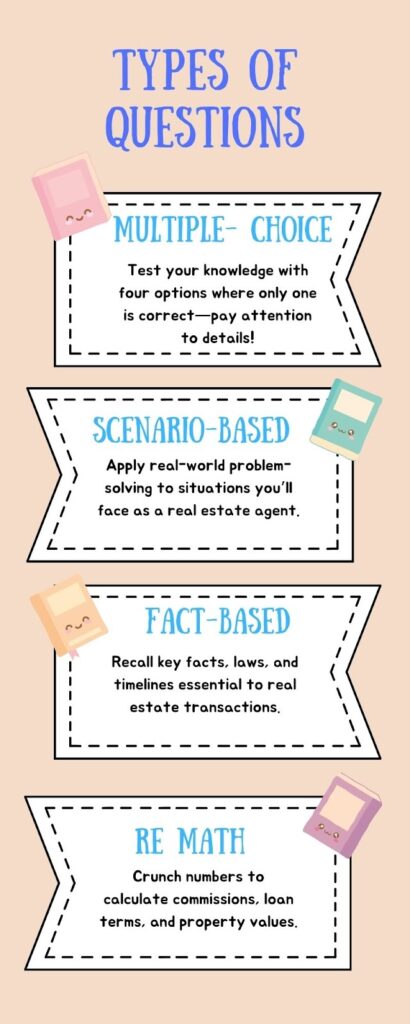
- Most real estate exams include multiple-choice, scenario-based, fact-based, and math questions.
- The test is divided into a national portion and a state-specific portion, covering property ownership, financing, and legal compliance.
- Practice exams are essential for building confidence, improving time management, and identifying weak areas.
- Most questions have four answer choices, with only one correct answer, testing both knowledge and application.
- A solid study plan, including practice tools and a clear timeline, increases your chances of passing the exam on your first try.
Level 1: The Basics of Real Estate Exam Questions
The real estate exam is a big step toward becoming a real estate agent and tests everything you need to know to succeed. It’s split into two parts: the national section, which covers general real estate knowledge, and the state-specific section, which focuses on the rules and laws unique to your state.
What to Expect on the Exam
- National Portion:
- This section covers core real estate principles, practices, and laws that apply across the country.
- Common topics include property ownership, contracts, financing, real property laws, and ethics.
- State-Specific Portion:
- This section varies depending on your state and tests your knowledge of local laws and procedures.
- Topics may include property line disputes, state disclosure laws, and landlord-tenant regulations.
Most exams use multiple-choice questions. While this might sound straightforward, the questions are often worded to test your critical thinking skills and understanding of real-world scenarios.
Key Topics Covered
By now, you know that what is on the test will depend on where you live. However, the bullets below are indicative of what many tests include:
- Property Ownership and Titles: Questions often explore what constitutes real property, how ownership is transferred, and the legal implications of property titles.
- Financing: This includes questions on mortgage loans, collateral, and lender obligations.
- Legal Compliance: From the Americans with Disabilities Act to good faith agreements, you’ll need a solid grasp of key legal concepts.
- Contracts and Agreements: Understanding the ins and outs of listing agreements, purchase contracts, and agency relationships is essential.
Level 2: Understanding the Question Styles
To succeed on the real estate exam, it’s essential to know the types of questions you’ll face. This will help you tailor your study plan and confidently approach the exam.
Level 3: Preparing with Real Estate Practice Tests
Once you understand the types of questions you’ll face, the next step is to practice. Real estate practice exams are an essential tool for preparation, helping you familiarize yourself with the real estate test format and identify areas where you need more study time.
Real Estate Practice Exam
Why Practice Exams Are Crucial
- Simulate the Test Environment: Practice exams replicate the real test, including the time limits and format, so you’ll know exactly what to expect.
- Build Confidence: By practicing regularly, you’ll feel more comfortable and confident when test day arrives.
- Identify Weak Areas: Reviewing your practice test results will help you focus your study efforts on areas where you need improvement.
What Practice Exams Cover
- National Portion: These questions cover broad topics like property ownership, contracts, real estate math, and financing.
- State-Specific Portion: These focus on local laws, regulations, and procedures. For example, if you’re taking the exam in Florida or New Mexico, you’ll see questions tailored to those states’ unique rules.
- Time Management: Practice exams include a time limit to help you build the pacing skills needed for the real test.
Tips for Studying
- Create a Study Schedule: Dedicate specific blocks of time to study each day. Break your time into sections, focusing on the national portion one week and the state-specific portion the next.
- Focus on Your Weaknesses: Spend extra time reviewing topics you find challenging, whether it’s real estate math or property titles.
- Review Mistakes: Go over every incorrect answer to understand why you got it wrong and how to approach similar questions in the future.
Building Your Timeline for Success
To keep your preparation on track, follow this suggested timeline:
- Weeks 1-2: Familiarize yourself with the exam structure and gather study materials, including practice exams and flashcards.
- Weeks 3-6: Focus on the national portion, completing practice tests and reviewing key topics like property ownership, financing, and contracts.
- Weeks 7-8: Dive into the state-specific portion, focusing on local laws and regulations.
- Week 9: Take full-length practice exams to simulate the real test and refine your time management skills.
- Week 10: Take the real estate exam and begin the process of applying for your license if you pass.
Final Thoughts
The real estate exam is a challenging but rewarding step toward becoming a licensed real estate agent. By understanding the types of questions you’ll face—whether they’re multiple-choice, scenario-based, or math-focused—you’ll be better prepared to tackle the test with confidence.
Practice exams provided by real estate courses are an invaluable resource, giving you the chance to identify weak areas, build familiarity with the real estate test format, and practice under timed conditions. With a solid study plan and a clear timeline, you’ll be ready to pass the exam and start your real estate career.
Your journey to success starts with preparation—and you’ve got everything you need to make it happen. Good luck, and here’s to your future as a real estate professional!
FAQ
The exam includes multiple-choice, scenario-based, fact-based, and math questions, all designed to test your understanding and application of real estate concepts.
Each question typically has four answer choices, but only one is the correct answer.
Topics include property ownership, financing, contracts, legal compliance, real estate math, and state-specific laws.
Use real estate practice exams, study guides, and flashcards to review key topics and improve time management.
They simulate the test environment, highlight areas to improve, and build your confidence for exam day.